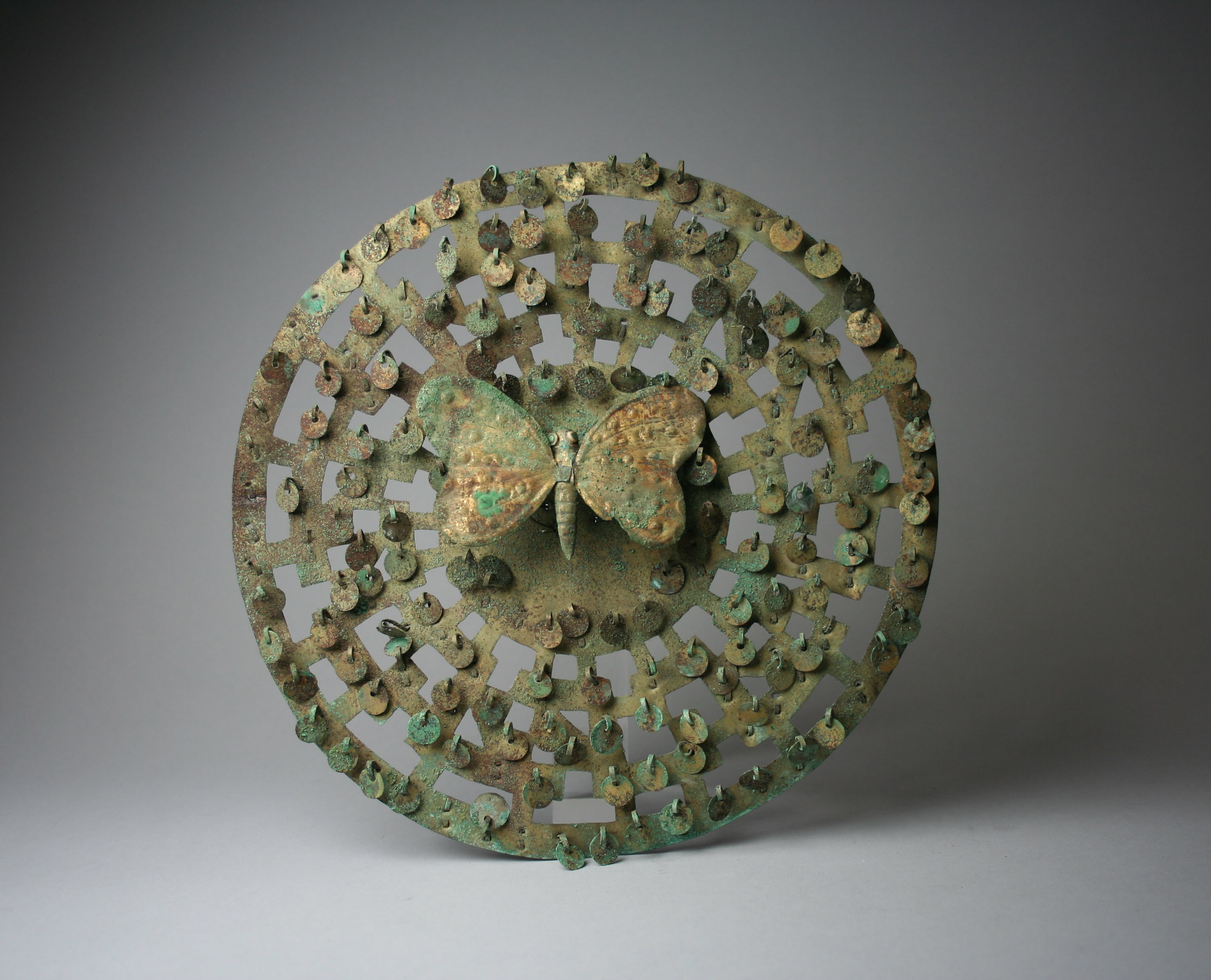
Deconstructing the Disk: A Moche Ornament as a Framework for Modern Couture
Within the rigorous, research-driven environment of Katherine Fashion Lab, we engage with historical artifacts not as static museum pieces, but as dynamic blueprints of human expression. The Moche Disk Ornament, a standalone artifact of gilded copper from the north coast of Peru (circa 100-800 AD), presents a profound case study. Its apparent simplicity—a circular form—belies a complex narrative of power, cosmology, and technical mastery. This analysis deconstructs its constituent elements to extract core principles applicable to contemporary haute couture, moving beyond literal interpretation to a philosophical and methodological assimilation.
Semiotics of the Circle: Power, Permanence, and the Celestial
The fundamental geometry of the disk is its first and most powerful statement. In Moche iconography, the circle was rarely merely decorative. It represented celestial bodies—the sun and moon—which were central to their agrarian and ritual life. This imbues the form with an inherent symbolism of cyclical time, permanence, and cosmic order. For the modern couturier, this translates into the power of the silhouette as a primary signifier. Just as the disk’s shape communicated its context immediately, so too does a definitive silhouette—be it a cocoon, a sphere, or a column—establish a garment’s narrative before a single detail is perceived. The lesson is to treat the overall form with the same intentionality as surface decoration, understanding that a strong, geometric foundation carries its own mythos.
Furthermore, the disk’s function as a pectoral ornament, worn centrally on the body, speaks to strategic placement. It commanded attention to the thorax, the center of breath and life force, often associated with status and divinity. In couture, this underscores the strategic power of focal points. A Lab-designed piece might centralize extraordinary craftsmanship—an intricate textile manipulation, a startling jewel—not as random embellishment, but as a deliberate topographic anchor that guides the viewer’s eye and centers the wearer’s presence, much like the disk centered the wearer within the cosmic order.
Material Alchemy: The Stratigraphy of Gilded Copper
The materiality of the artifact is a masterclass in layered meaning and technical innovation. The Moche were unparalleled metallurgists, and their choice of gilded copper is deeply strategic. Copper, mined from the Andes, held earthly, tangible value. Gold, associated with the sun and the divine, represented the immutable and sacred. The process of depletion gilding—whereby the surface copper is chemically removed to reveal a layer of pure gold—is a transformative act. It creates a hierarchical materiality: a base of functional strength crowned by a surface of luminous symbolism.
This stratified approach directly informs couture’s relationship with material. It advocates for a philosophy where the interior and exterior of a garment engage in dialogue. Consider a structured jacket where the inner lining is a hand-painted silk depicting a personal cartography (the "copper core"—personal, foundational), while the exterior is sheathed in a minimalist, laser-cut wool that only hints at the complexity beneath (the "gilded surface"—public, refined). The value lies in the conscious construction of layers, both physical and metaphorical. Furthermore, the gilding process itself—a chemical revelation of a hidden layer—parallels couture techniques like devoré, burn-out, or strategic fraying, where treatment reveals a substrate, telling a story of transformation and depth.
Surface as Narrative Canvas: Abstraction and Iconography
While our specific study piece is a standalone disk, Moche metalwork often featured repoussé or engraved narratives depicting deities, rituals, and symbolic creatures. This practice treats the surface as a curated field for storytelling. In couture, this translates to the treatment of fabric as a canvas. However, the Lab’s take is not literal illustration but abstracted embodiment. The narrative is not printed; it is encoded through technique.
The rhythmic repetition of a specific pleat can mirror the repetitive patterns in Moche pottery. The textured application of beadwork can emulate the tactile quality of hammered metal. A garment’s surface can tell a story through its topography—raised embroideries, recessed seams, smooth plains of fabric—creating a legible, haptic narrative without figurative imagery. This approach elevates craftsmanship to the level of iconography, where the very method of making carries the conceptual weight.
From Artifact to Algorithm: A Couture Methodology
The ultimate value of this standalone study is the derivation of a transferable creative algorithm. The Moche Disk Ornament provides a framework:
1. Foundational Geometry: Begin with a silhouette that possesses intrinsic symbolic power (the Circle as Cosmic Order).
2. Stratified Materiality: Engineer layers with distinct functional and symbolic roles, allowing for revelation and dialogue (Gilded Copper over Core).
3. Anchored Focus: Design with intentional focal points that command the visual field and center the wearer (The Pectoral Placement).
4. Encoded Surface: Translate narrative into abstracted textile manipulation and technique, not decoration (The Engraved Canvas).
Applying this algorithm, a Katherine Fashion Lab collection might feature a series of looks built on the circular silhouette—from rounded shoulders to full, orbiting skirts. Fabrics would be composite: a technical mesh fused with gold-leafed lace, or leather etched to reveal a contrasting color beneath. Each piece would possess a central, transformative element—a closure that reforms the neckline, a detachable panel that alters the silhouette—acting as the modern pectoral. The surfaces would be meticulously worked with textures that reference tool marks, corrosion, and the patina of time, making the story of process visible.
In conclusion, the Moche Disk Ornament, in its elegant self-containment, is a potent manifesto. It teaches that true luxury lies in the synthesis of profound concept, innovative material science, and impeccable execution. For Katherine Fashion Lab, it stands as a testament to the principle that the most forward-looking couture is often forged in a deep, analytical dialogue with the past, extracting not motifs, but matrices for innovation.