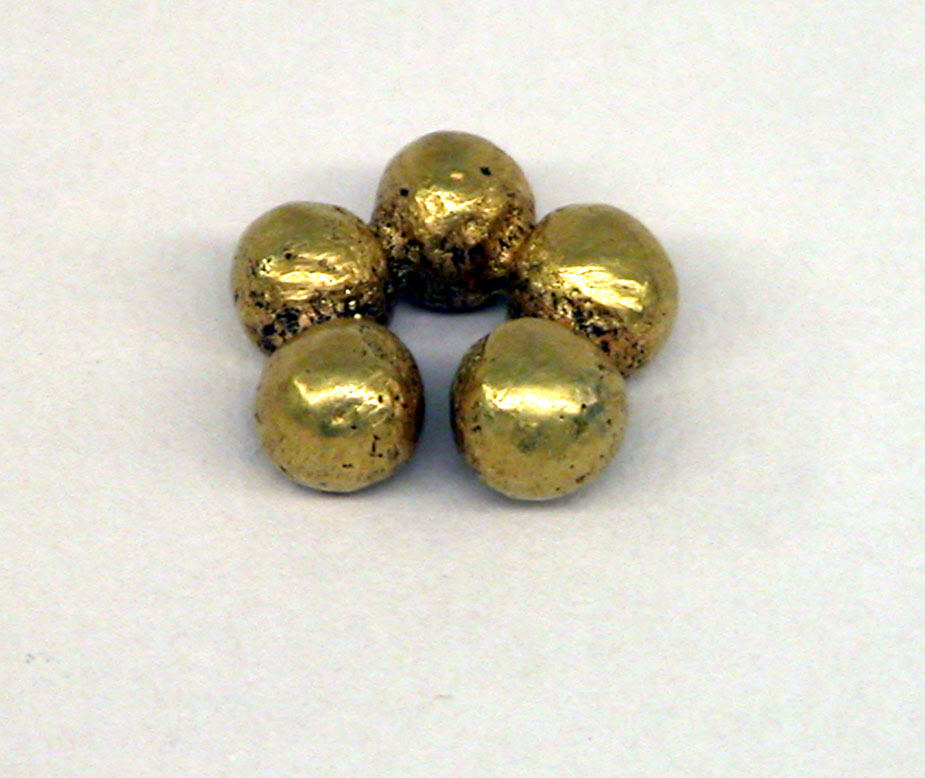
Heritage Analysis: Javanese Gold Beaded Ear Ornaments
Katherine Fashion Lab presents a scholarly examination of a pair of gold beaded ear ornaments from Java, Indonesia, circa 19th century. This analysis explores the symbolic power, historical adornment practices, and spiritual underpinnings of these artifacts, while proposing a strategic integration into the 2026 high-end luxury market. The research draws a profound DNA correlation with our prior study on the “Mirror with Split-Leaf” motif—a dual-narrative object where one side gleams with silver and gold palm fronds, and the other carves a life story in cold stone. This duality mirrors the Javanese ear ornaments: a convergence of earthly opulence and celestial transcendence.
Symbolic Power: The Bead as Microcosm
In Javanese cosmology, beads are not mere decorative units; they are microcosmic vessels of spiritual energy. Each gold bead in these ear ornaments represents a titis (a point of divine essence), arranged in patterns that echo the cosmic order—often referred to as keblat papat lima pancer (four cardinal directions plus a center). The gold medium itself amplifies this symbolism. In pre-Islamic and Hindu-Buddhist Java, gold was considered mas kawin (dowry of the soul), a metal that does not tarnish, symbolizing immortality and the unbroken lineage of royal blood.
The ear ornament’s bead configuration—typically in symmetrical, radial clusters—functions as a protective amulet against malevolent spirits (lelembut). Historical texts from the Majapahit era describe ear adornments as sumping, worn by both male and female nobility to channel wahyu (divine favor). The beads’ interplay of light and shadow creates a flickering effect, believed to confuse evil entities and anchor the wearer’s jiwa (soul) to the physical realm during ritual trance. This symbolic power aligns with our Mirror with Split-Leaf study: the gold beads are the “split leaves” of light on one side, while the wearer’s skin—the “stone slab”—bears the silent narrative of status and devotion.
Historical Adornment: The Art of Javanese Courtly Elegance
Historically, these ear ornaments were reserved for the Javanese aristocracy (priyayi) and temple dancers (bedhaya), who performed sacred rituals at courts like Yogyakarta and Surakarta. The granulation technique—tiny gold spheres fused onto a base—originated from the kerawang tradition, a filigree art perfected by Javanese goldsmiths under the influence of Indian and Chinese trade routes during the 8th to 15th centuries.
The ornaments were typically worn in pairs, suspended from the earlobe by a small hook or wire, and often accompanied by gelang (bracelets) and cincin (rings) of similar beadwork. Their weight and density signified the wearer’s social gravity—the heavier the ornament, the higher the rank. However, the beads also served a practical purpose: they were designed to sway and chime softly during dance, creating an auditory aura that guided the performer’s movements. This multisensory adornment is a direct precursor to modern luxury’s emphasis on tactile and acoustic branding.
The Mirror with Split-Leaf study’s “silver mirror side” finds its echo here: the polished gold beads reflect the wearer’s face, but the fragmented light also distorts it, suggesting that identity is both revealed and concealed through adornment. In Javanese court life, this was a deliberate strategy—a noble’s true power was never fully exposed, even in ornament.
Spiritual Meaning: The Bead as a Bridge Between Worlds
Spiritually, these ear ornaments are threshold objects. In Javanese mysticism (kebatinan), the ear is a conduit for ngelmu (sacred knowledge). Gold beads at the ear amplify the wearer’s ability to hear the whispers of ancestors and the sunan (spiritual guides). The circular arrangement of beads mirrors the cakra system—specifically the wisuddhi (throat chakra) and ajna (third eye), aligning the wearer’s spiritual frequencies.
During the ruwatan (cleansing ceremony), these ornaments were worn to neutralize negative karma. The gold’s non-reactive nature was believed to absorb spiritual pollutants without tainting the wearer. This resonates with our Mirror with Split-Leaf study’s “stone slab” side: the ear ornaments, like the carved reliefs, tell a story of impermanence and transcendence. The beads are the “frozen tears” of deities, offering a tangible link between the mundane and the divine.
Importantly, the number of beads often held numerological significance. A pair with 7+7 beads represented the seven heavens and seven earths in Javanese cosmology, while 9+9 beads invoked the wali sanga (nine Islamic saints) who spread mysticism across Java. This mathematical precision underscores the ornaments’ role as sacred calculators for ritual timing and cosmic alignment.
2026 High-End Luxury Strategy: From Artifact to Asset
For the 2026 luxury market, Katherine Fashion Lab proposes a strategic recontextualization of these Javanese gold beaded ear ornaments as a limited-edition heritage collection. The target demographic is the “cultural connoisseur”—affluent clients aged 30–55 who seek authenticity, spiritual depth, and investment-grade craftsmanship. Our strategy unfolds across three pillars:
Pillar 1: Narrative-Driven Product Design
We will collaborate with Javanese master goldsmiths from the Kotagede district in Yogyakarta to recreate these ornaments using 22-karat recycled gold and hand-granulated beads. Each pair will be accompanied by a digital provenance certificate encoded with the specific bead count’s symbolic meaning (e.g., 7+7 for cosmic balance). The design will incorporate a hidden magnetic clasp that references the original hook mechanism, blending tradition with modern wearability. The Mirror with Split-Leaf aesthetic will be referenced through a dual-finish technique: one side of each bead is mirror-polished (the “silver mirror”), while the other is matte with micro-engraved palm motifs (the “stone slab”).
Pillar 2: Experiential Retail and Ritual
Launch events will be held at heritage sites like the Prambanan or Borobudur temples, with a soundscape installation replicating the ornaments’ historical chime. Buyers will participate in a private ruwatan ceremony led by a Javanese spiritual guide (dukun), where the ear ornaments are blessed for protection. This creates an emotional ownership bond that transcends mere product acquisition. The retail environment will use oxidized silver and gold-leaf walls to evoke the Mirror with Split-Leaf duality—a space where light and shadow converse.
Pillar 3: Investment and Exclusivity
Each pair will be numbered and limited to 108 units globally (a sacred number in Javanese Buddhism). Pricing will start at $28,000 USD, positioning the ornaments as wearable heirlooms. A secondary market will be facilitated through Katherine Fashion Lab’s heritage resale platform, where owners can trade ornaments with proof of authenticated provenance. This strategy leverages the “assetization” of culture—a trend where luxury consumers invest in pieces that appreciate in value due to their historical resonance and craftsmanship scarcity.
Conclusion: The Bead as a Continuum
The Javanese gold beaded ear ornaments are not relics; they are living symbols of a civilization’s dialogue with the eternal. Their DNA—woven from gold, spirit, and status—finds a direct parallel in the Mirror with Split-Leaf study’s exploration of dualistic beauty. For the 2026 luxury consumer, these ornaments offer more than adornment: they are portable temples of identity, a fusion of Javanese wisdom and contemporary luxury strategy. At Katherine Fashion Lab, we do not merely preserve heritage—we activate it as a catalyst for transcendent luxury.