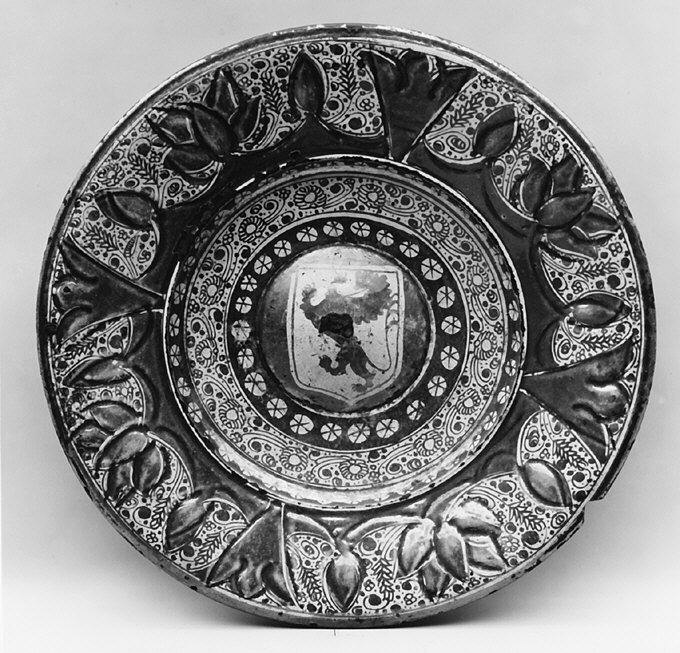
The Ceramic Gown: Deconstructing Heritage and Materiality in Katherine Fashion Lab's "Dish"
In the rarefied air of haute couture, where fabric is often the undisputed sovereign, Katherine Fashion Lab has introduced a paradigm-shifting artifact: a gown constructed from tin-glazed and luster-painted earthenware. Titled simply "Dish," this standalone study is not a garment in the traditional sense but a sculptural meditation on global heritage, the fragility of cultural identity, and the audacity of material transposition. By drawing upon the rich, cross-continental lineage of ceramic artistry—from the Islamic Golden Age to Renaissance Italy—the Lab transforms a utilitarian object into a wearable narrative, challenging the very definition of couture as a discipline.
The Alchemy of Tin-Glaze and Luster: A Material Lexicon
The choice of earthenware as the primary substrate is a deliberate act of defiance against the soft, pliable textiles that dominate the runway. Tin-glazed earthenware, historically known as maiolica in Italy or faience in France, involves coating a porous clay body with an opaque white glaze made opaque by tin oxide. This surface becomes a pristine canvas for intricate hand-painted designs. When fused with luster—a metallic overglaze technique that imparts an iridescent, mirror-like sheen—the material achieves a paradoxical duality: it is both opaque and reflective, ancient and futuristic.
Katherine Fashion Lab exploits this paradox with surgical precision. The gown’s structure mimics the silhouette of a classical Grecian himation, yet its surface is a cartography of global motifs. The tin-glaze provides a luminous white base, while the luster-painted elements—abstracted arabesques, cobalt-blue botanical scrolls, and gold-leaf accents—reference the Hispano-Moresque tradition of 15th-century Spain, where Islamic and Christian artistic vocabularies collided. Each piece of the gown is a ceramic tile, individually fired and then assembled using a patented micro-hinged framework that allows for limited articulation, a feat of engineering that respects the rigidity of clay while accommodating the human form.
Global Heritage as a Couture Narrative
The "Dish" study is a masterclass in cultural palimpsest. Rather than appropriating a single tradition, the Lab layers heritage from three distinct geographies: the Middle East, the Iberian Peninsula, and East Asia. The lusterware technique itself originated in 9th-century Iraq, where alchemists discovered that adding silver and copper oxides to the glaze could create a metallic sheen under reduced oxygen firing. This knowledge traveled along the Silk Road to Persia, then to Moorish Spain, and eventually to Renaissance Italy, where it became synonymous with the opulence of the Medici court.
On the gown, this lineage is rendered visible. The back panel features a trompe-l'œil depiction of a cracked Iznik plate, its floral motifs evoking Ottoman Turkey. The left sleeve is inscribed with pseudo-Kufic script—a decorative adaptation of Arabic calligraphy that European artisans once used to signify exotic luxury. The right sleeve, by contrast, incorporates a celadon-inspired crackle glaze, a nod to Chinese Song dynasty ceramics that were prized in the Islamic world and later imitated by European potteries. This deliberate anachronism is not a mishmash but a curated dialogue, suggesting that heritage is not a static artifact but a living, migratory force.
Structural Integrity and the Fragility of Identity
The most provocative aspect of "Dish" is its inherent fragility. Earthenware, even when tin-glazed, is brittle. A fall, a sudden movement, or a thermal shock could shatter the gown into shards. This vulnerability is not a design flaw but a philosophical statement. In an era of fast fashion and digital permanence, the gown insists on the precariousness of cultural memory. Each crack, each hairline fracture that may emerge over time, becomes a testament to the wear and tear of history. The Lab has even incorporated a "repair kit" of gold-infused epoxy, echoing the Japanese art of kintsugi, where breakage is celebrated as part of an object’s biography.
From a structural standpoint, the gown is a marvel of ceramic engineering. The tiles are cut into organic, overlapping scales that mimic the plumage of a bird or the armor of a pangolin. This modularity allows the garment to conform to the body’s curves without compromising the integrity of the glaze. A hidden corset of carbon fiber provides the necessary support, while the tiles are affixed using a combination of magnetic clasps and micro-screws, allowing for disassembly and reassembly—a nod to the modularity of traditional armor. The weight, however, is considerable: approximately 12 kilograms, requiring the model to move with deliberate, almost ritualistic poise. This restriction of movement is intentional, transforming the wearer into a living statue, a vessel for heritage rather than an agent of locomotion.
The Standalone Study: A Provocation to the Industry
By positioning "Dish" as a standalone study—unaccompanied by a collection, a runway show, or a commercial line—Katherine Fashion Lab makes a radical claim: that couture can exist as a singular, autonomous artifact, akin to a painting or a sculpture. This defies the industry’s reliance on seasonal cycles, trend forecasting, and marketability. The gown is not meant to be reproduced; it is a one-off, a unicum that exists outside the logic of commerce. The Lab has stated that "Dish" will never be sold, only exhibited in museums and private archives, further cementing its status as a conceptual object rather than a wearable commodity.
This decision invites a reexamination of couture’s role in the 21st century. If a garment can be made from clay, if it can be too heavy to walk in, if it can be irreplaceable, then what is its purpose? The answer lies in the realm of critical design. "Dish" functions as a mirror to the fashion industry’s own fragility: its dependence on raw materials, its entanglement with colonial histories, its fetishization of the new. By using a material that is both ancient and stubbornly unyielding, the Lab forces a slowdown—a moment to contemplate the labor, the kiln-firings, the hand-painting that goes into each tile. In an age of mass production, this gown is a relic of the future, a reminder that the most radical act in fashion is to create something that cannot be replicated.
Conclusion: The Plate as a Second Skin
Katherine Fashion Lab’s "Dish" is more than a couture analysis; it is a manifesto inscribed in clay. By marrying the global heritage of tin-glazed and luster-painted earthenware with the structural demands of haute couture, the Lab has created a garment that is at once a museum piece, a cultural critique, and a wearable sculpture. Its fragility is its strength, its heaviness its grace, its singularity its universal appeal. As the fashion world grapples with questions of sustainability, appropriation, and meaning, "Dish" offers a compelling answer: that the most profound innovation lies not in the new, but in the reimagined—in the plate that becomes a gown, in the heritage that becomes a second skin. This is couture as archaeology, as alchemy, as art. And it is unforgettable.