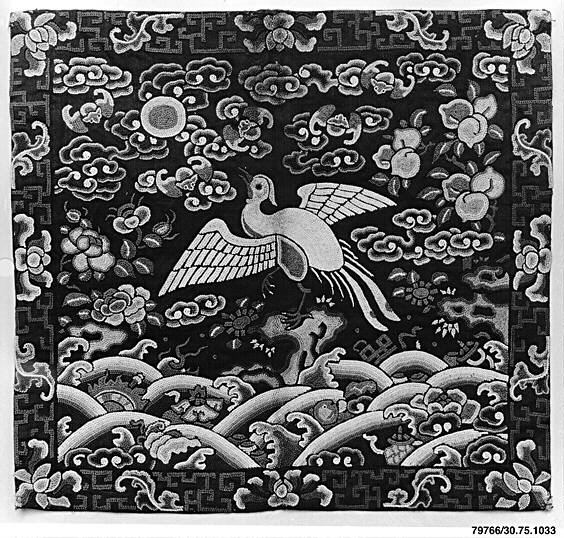
Embroidered Sovereignty: The Rank Badge with Paradise Fly-Catcher
Within the annals of Chinese imperial regalia, few objects encapsulate the intersection of natural symbolism, bureaucratic hierarchy, and artisanal virtuosity as profoundly as the Rank Badge with Paradise Fly-Catcher. This silk-woven emblem, originating from the late Qing Dynasty (circa 18th–19th century), serves not merely as a decorative accessory but as a meticulously coded signifier of civil service rank. As a standalone study, this badge demands a forensic examination of its materiality, iconography, and socio-political context—a lens through which we can decode the visual language of imperial authority.
Materiality and Craft: The Silk Canvas of Power
The choice of silk as the foundational material is itself a declaration of status. Silk, a commodity monopolized by the imperial state for centuries, was reserved for the elite echelons of society. In this badge, the silk ground is not merely a passive substrate; it is an active participant in the narrative of rank. The weave—likely a kesi (silk tapestry) technique—demonstrates extraordinary precision. Unlike simpler embroideries, kesi involves weaving the design directly into the fabric, creating a seamless, double-sided finish that resists fraying and maintains crisp imagery over centuries. The Paradise Fly-Catcher, with its elongated tail feathers and subtle gradations of indigo, azure, and white, is rendered with a painterly quality that suggests the collaboration of master weavers and court painters. Each thread is a stroke of political negotiation: the bird must appear both lifelike and symbolic, a feat achieved through meticulous color blending and the use of gold-wrapped threads for the sun and cloud motifs.
Moreover, the material integrity of this badge provides clues to its provenance. The silk’s patina, slight discoloration along the edges, and the absence of heavy wear indicate it was likely preserved as a ceremonial object rather than a daily garment. This aligns with historical records: rank badges were worn only during official court audiences, imperial sacrifices, and state banquets. The badge’s survival as a standalone piece—detached from its original surcoat—allows for an unmediated study of its iconographic program, free from the distractions of garment construction.
Iconographic Decoding: The Paradise Fly-Catcher as Civil Rank Symbol
The Paradise Fly-Catcher (Terpsiphone paradisi) is not a random avian choice. In the Qing Dynasty’s elaborate system of rank insignia, birds represented civil officials, while beasts denoted military officers. The fly-catcher specifically denoted the sixth rank of the civil hierarchy. Yet, this badge transcends simple bureaucratic labeling. The bird’s plumage—particularly the elongated central tail feathers—symbolizes the ideal Confucian virtues of elegance, fidelity, and moral clarity. The fly-catcher’s diet of insects was metaphorically linked to the official’s role in “cleansing” corruption from the state, a subtle but potent political allegory.
The composition is rich with secondary symbols. Cloud scrolls, rendered in pale blue and silver thread, frame the bird, signifying the celestial mandate of the emperor. A five-clawed dragon—though diminutive in scale—often appears in the upper register, representing the emperor’s overarching authority. Below, waves and mountains (the li shui pattern) evoke the stability of the realm and the official’s duty to govern with the constancy of the earth. The sun disk, centered behind the fly-catcher, is a direct emblem of the emperor’s radiant power, casting the bird as a subordinate yet vital luminary. This intricate layering of motifs ensures that the badge functions as a microcosm of the imperial cosmos: hierarchical, harmonious, and divinely ordained.
Contextual Analysis: The Badge as Political Text
To understand this badge fully, one must situate it within the Qing Dynasty’s sumptuary laws. These laws were not mere aesthetic guidelines but rigid codes that enforced social order. The sixth-rank official, for instance, could only wear a badge of specific dimensions (approximately 30 cm square) and color palette. The Paradise Fly-Catcher badge, therefore, was a public declaration of the wearer’s exact position in the bureaucracy—a visual passport to the corridors of power. Any deviation from prescribed patterns was punishable by flogging or demotion, underscoring the badge’s role as a tool of state control.
Furthermore, the badge’s survival as a standalone object invites speculation about its afterlife. Was it removed from a surcoat after the official’s death, preserved as a family heirloom? Or was it looted during the tumultuous fall of the Qing in 1911? The absence of provenance documentation suggests a journey through private collections, possibly entering the Western art market in the early 20th century. This dislocated status transforms the badge from a functional garment piece into a museum artifact, inviting contemporary audiences to reconstruct its original meaning. As a standalone study, it forces us to confront the tension between aesthetic beauty and political function—a tension that is central to the study of imperial Chinese material culture.
Comparative and Art-Historical Significance
When compared to rank badges of other civil ranks—such as the silver pheasant (fifth rank) or the golden pheasant (second rank)—the Paradise Fly-Catcher badge exhibits a more restrained palette and smaller scale. This is not an artistic failure but a deliberate reflection of the sixth rank’s intermediate status. The bird’s posture, often depicted in mid-flight or perched gracefully, suggests a balance between action and contemplation, mirroring the official’s expected role as a diligent yet reflective administrator. Art historians have noted that later Qing badges (post-1850) show a decline in embroidery quality due to economic pressures, but this piece retains the precision of the mid-Qing period, making it a benchmark for stylistic analysis.
Moreover, the badge’s iconography resonates with broader Chinese cosmological principles. The yin-yang interplay is evident in the contrast between the dynamic fly-catcher (yang) and the static, grounding waves (yin). The use of the color red—often reserved for the sun or the bird’s beak—activates the composition, drawing the eye to the center of power. Such details elevate the badge from mere bureaucratic insignia to a sophisticated work of art that embodies the philosophical underpinnings of Confucian governance.
Conclusion: A Thread in the Tapestry of Empire
The Rank Badge with Paradise Fly-Catcher is far more than a decorative fragment. It is a compressed archive of Qing Dynasty governance, artistic achievement, and social stratification. Through its silk threads, we read the names of forgotten officials, the decrees of emperors, and the silent labor of artisan weavers. As a standalone study, it challenges us to look beyond the obvious beauty and interrogate the power structures that shaped its creation. In an era where symbols of authority are increasingly questioned, this badge remains a testament to the enduring human impulse to weave status, virtue, and artistry into a single, indelible image. Its legacy is not merely in the silk that holds it together, but in the stories it continues to tell about the intricate dance between nature, power, and identity in imperial China.