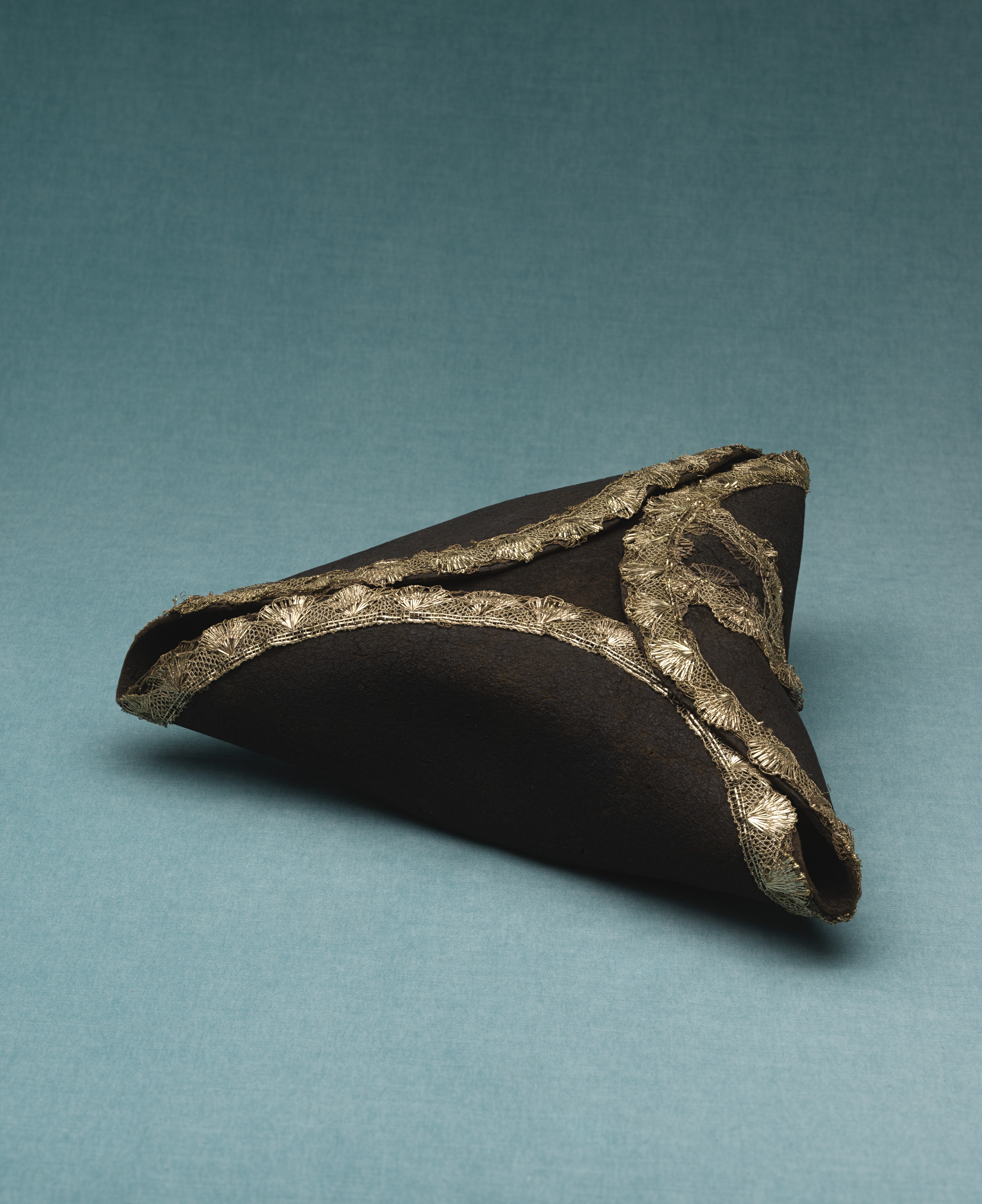
Deconstructing the Tricorne: An Italian Woolen Study in Architectural Form
Within the rigorous analytical framework of Katherine Fashion Lab, the tricorne hat emerges not as a mere historical accessory, but as a profound case study in the intersection of materiality, socio-political semiotics, and pure sculptural form. Originating in the late 17th century and reaching its apogee in the 18th, the tricorne—characteristically defined by its triangular brim, pinched at three sides to create a crown—represents a pinnacle of intentional design. This analysis, focusing on its Italian iteration crafted from wool, isolates the object for a standalone study, dissecting its structural logic, cultural currency, and the inherent dialogue between its humble material and its formidable silhouette.
Materiality & Manufacture: The Woolen Paradox
The specification of wool as the primary material is the first critical variable in our equation. Unlike the luxurious velvets or silks often employed for formal wear in the courts of Europe, wool presents a narrative of pragmatic versatility. Italian wool, sourced from regions like Lombardy or the Tuscan hinterlands, was renowned for its quality—fine yet resilient. This choice of material underscores a fundamental truth of the tricorne: it was designed for the theater of daily life, from the bustling piazzas to the maritime ventures of the Republic of Venice. Wool’s inherent properties dictated the manufacturing process and final form. The material’s malleability under heat and moisture allowed for the precise, sharp blocking required to create the hat’s definitive peaks and valleys. Its felted nature provided structural integrity, enabling the broad brim to maintain its cocked position without collapsing—a feat less achievable with a more fluid textile. Furthermore, wool’s natural water-resistance offered practical utility, while its density allowed for a rich, matte finish that absorbed light, giving the hat a substantive, weighty presence even from a distance. This created a paradox of humble materiality conveying immense authority.
Architectural Silhouette: A Study in Geometric Command
Divorced from its historical context, the tricorne’s form is an exercise in aggressive geometry. The Lab examines it as a wearable architectural edifice. The standard broad-brimmed hat was geometrically altered through a process of pinching and fixing, effectively deconstructing the circle to invent a triangle. This was not a casual act but one of deliberate design strategy. The three upturned points create a dynamic, directional silhouette that appears different from every angle, engaging the viewer in a circumspect dance. From the front, it frames the face with a strong, horizontal line, directing focus to the wearer’s countenance. From the side, it projects a prow-like sharpness, suggesting forward momentum and purpose.
This architectural manipulation served a critical functional purpose: it solved the problem of obstruction. In an era of elaborate wigs, shoulder-held weaponry, and close-quarters social interaction, a full circular brim was impractical. The tricorne’s design cleared space for the shoulders, prevented the hat from being knocked off in a crowd, and, crucially, allowed for the unhindered slinging of a musket or the graceful gesturing of an orator. Thus, its form was a direct response to the ergonomics of power and social ritual. The Italian interpretation often exhibited a particular elegance in the roll of the brim—sometimes more supple and expressive than the stiffer French versions—hinting at the Baroque sensibility for dramatic movement frozen in material.
Semiotics of the Cocked Brim: A Canvas for Social Code
The tricorne was far from a uniform object. Its precise articulation was a nuanced language. The angle of the pinch, the height of the crown, the width of the brim, and even which corner was positioned where became mutable signifiers of identity, allegiance, and profession. A sharply upturned brim might denote military precision, while a softer, more languid roll could suggest aristocratic leisure. The positioning of the hat on the head—whether the single point faced forward or to the side—was governed by complex etiquette. In the context of the Italian states, fragmented yet culturally interconnected, these variations could signal regional pride, affiliation with a particular city-state, or membership in a specific guild or academy.
Moreover, the tricorne functioned as an integral component of the period’s kinetics of deference and salute. The act of "doffing" the hat—removing it in greeting—was a primary social gesture. The tricorne’s design, with its distinct handles formed by the pinned brim, made this act inherently theatrical and standardized. The way one grasped and swept off the hat communicated grace, respect, or haste. As a standalone object, it was inert wool; on the body, it became an active participant in social performance, its form dictating and refining the choreography of civility.
Conclusion: The Tricorne as a Prototype of Intentional Design
Katherine Fashion Lab’s analysis concludes that the Italian wool tricorne stands as a seminal prototype in fashion history, embodying principles that remain relevant to contemporary design thinking. It represents a perfect synthesis of material constraint and formal ambition, where the limitations of wool were not merely accepted but exploited to create a resilient, iconic shape. It demonstrates how geometric transformation can solve multifaceted functional problems, from practical ergonomics to social ritual. Finally, it exemplifies how a single, standardized form can be infinitely personalized through subtle manipulations of its core architecture, becoming a canvas for non-verbal communication.
In isolating the tricorne, we appreciate it not as a relic of a bygone era, but as a rigorous application of design logic. Its lessons on the interplay between material, form, and function continue to inform the Lab’s approach, reminding us that the most enduring and powerful sartorial statements are often those where every stitch, every fold, and every angle is laden with calculated intention. The tricorne, in its woolen simplicity and geometric complexity, was not just worn; it was operated, a tool for navigating the intricate world of its time.