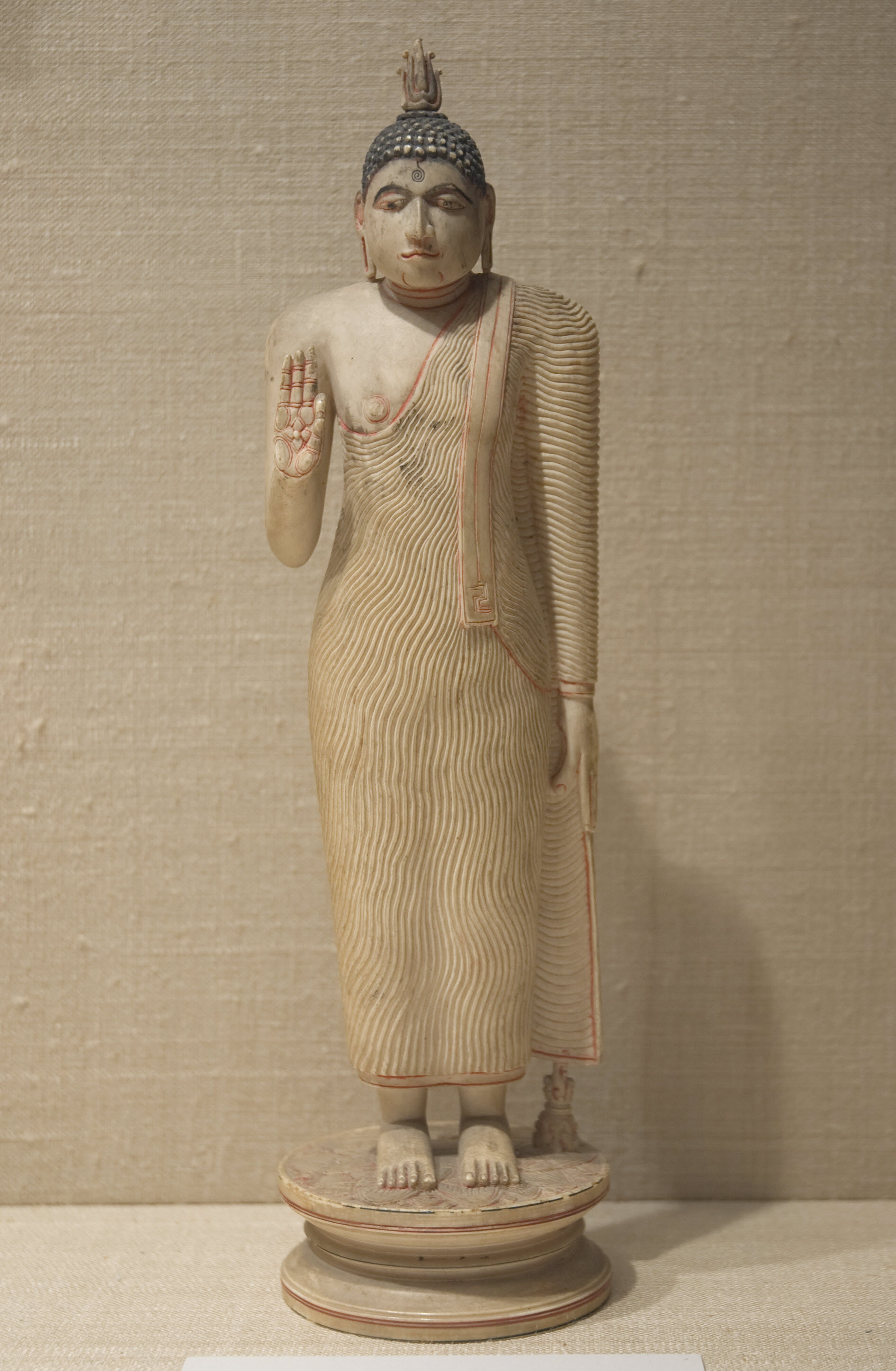
Heritage Analysis: Buddha Offering Protection – Sri Lankan Polychrome Ivory
Symbolic Power and Spiritual Meaning
The artifact known as “Buddha Offering Protection” originates from the Kandy district of Sri Lanka, a region historically revered as the last stronghold of Sinhalese sovereignty and a crucible of Theravada Buddhist devotion. Carved from ivory and adorned with polychrome pigments, this sacred representation embodies the Abhaya Mudra—the gesture of fearlessness and divine reassurance. In Buddhist iconography, the raised right hand with palm facing outward signifies the dispelling of fear, the granting of safety, and the cessation of suffering. For the Kandyan artisans who crafted this piece, the ivory medium was not merely a material choice but a metaphysical one: elephant ivory, sourced from the majestic pachyderm associated with royal power and spiritual purity, was believed to carry protective energies. The polychrome finish, often using natural earth pigments and plant-based dyes, further amplifies the spiritual resonance—each color holds specific meaning: gold for enlightenment, red for life force, white for purity, and blue for compassion. This artifact functioned as a talismanic object, often placed in domestic shrines or royal chambers to ward off malevolent forces and to invoke the Buddha’s unyielding protection over the household or kingdom.
Historical Adornment and Cultural Context
During the Kandyan period (circa 1469–1815 CE), ivory carving reached its zenith as a courtly art form, patronized by the Maharaja and the Buddhist monastic hierarchy. The Kandy district, nestled in the central highlands of Sri Lanka, was a melting pot of indigenous Sinhalese traditions, South Indian influences, and later, Portuguese and Dutch colonial encounters. The Buddha Offering Protection artifact reflects this syncretism: the serene facial features echo the classical Anuradhapura period, while the ornate headdress and drapery motifs betray the baroque sensibilities of the Nayakkar dynasty, which ruled Kandy from the 17th to 19th centuries. Ivory was a material of prestige, often reserved for the elite—royal regalia, temple reliquaries, and ceremonial objects. The polychrome technique, known locally as “Sittara” painting, involved layering pigments over a gesso base, creating a luminous, almost ethereal finish. This artifact would have been displayed during major Buddhist festivals, such as the Esala Perahera, where it served as a focal point for processions and blessings. Its historical adornment is thus inseparable from the ritualistic and hierarchical structures of Kandyan society, where art and faith were intertwined to reinforce both spiritual and temporal authority.
Strategic Standalone Research: Implications for High-End Luxury Strategy (2026)
For Katherine Fashion Lab, the Buddha Offering Protection artifact presents a compelling case study in cultural symbolism as a luxury differentiator. As the global luxury market pivots toward authenticity, spirituality, and heritage storytelling, this artifact offers a blueprint for integrating sacred iconography into contemporary high-end fashion and accessories. The Abhaya Mudra—a gesture of protection and fearlessness—resonates deeply with the 2026 consumer psyche, which is increasingly anxious about geopolitical instability, environmental crises, and digital saturation. By incorporating this symbolic hand gesture into jewelry, scarves, or embroidered motifs, Katherine Fashion Lab can position itself as a purveyor of spiritual armor—luxury that not only adorns but also protects and empowers.
The use of ivory, while historically significant, presents ethical challenges in modern luxury. However, the strategic lesson lies in the material narrative: just as Kandyan artisans chose ivory for its symbolic weight, Katherine Fashion Lab can select contemporary sustainable materials—such as ethically sourced bone, resin, or recycled precious metals—that carry analogous connotations of rarity, durability, and sacredness. The polychrome aspect offers another layer of strategic value. In 2026, color psychology will be a dominant trend in luxury branding, with consumers seeking hues that evoke calm, protection, and vitality. The artifact’s palette—gold, red, white, and blue—can be reinterpreted as a signature color story for a capsule collection, perhaps named “The Kandy Protection Series.” Each piece could be marketed with a narrative linking the color to its Buddhist meaning, thereby elevating the product from mere fashion to a wearable talisman.
Luxury Brand Strategy: Heritage as Status and Meaning
From a strategic standpoint, the Buddha Offering Protection artifact exemplifies how heritage can be leveraged to create exclusivity and emotional resonance. In the 2026 luxury landscape, where Gen Z and Alpha consumers prioritize purpose over provenance, Katherine Fashion Lab can deploy this artifact’s story to build a brand mythology. The Kandy district’s history as a royal enclave of spiritual and political resistance—against colonial powers and internal strife—parallels the modern luxury consumer’s desire for resilience and self-sovereignty. A limited-edition collection inspired by this artifact could be launched with a philanthropic component: partnering with Sri Lankan artisan cooperatives to revive traditional polychrome techniques, thereby ensuring cultural preservation. This not only aligns with ESG (Environmental, Social, and Governance) criteria but also authenticates the brand’s commitment to heritage.
Moreover, the artifact’s role as a protective object can be translated into experiential luxury. Katherine Fashion Lab could host exclusive events—such as private viewings of the artifact in collaboration with museums or spiritual retreats in Kandy—where clients receive personalized blessings or meditation sessions. This transforms the purchase into a rite of passage, deepening brand loyalty. The Abhaya Mudra, when adapted into a logo or monogram, becomes a visual shorthand for the brand’s ethos: offering protection from the chaos of modern life through the quiet power of heritage and craftsmanship.
Conclusion: The Artifact as Strategic Asset
In sum, the Buddha Offering Protection artifact is not merely a historical curiosity but a strategic asset for Katherine Fashion Lab’s 2026 luxury strategy. Its symbolic power—rooted in the Abhaya Mudra and Kandyan spirituality—offers a timeless narrative of safety, resilience, and transcendence. Its historical adornment, from ivory to polychrome, provides a template for material storytelling that balances tradition with ethical innovation. By weaving this heritage into a cohesive brand strategy—through design, storytelling, philanthropy, and experience—Katherine Fashion Lab can position itself at the vanguard of meaningful luxury, where every piece is not just worn but revered. As the market shifts toward conscious consumption, the artifact’s message of protection becomes a compelling value proposition: luxury that shields the soul as much as it adorns the body.