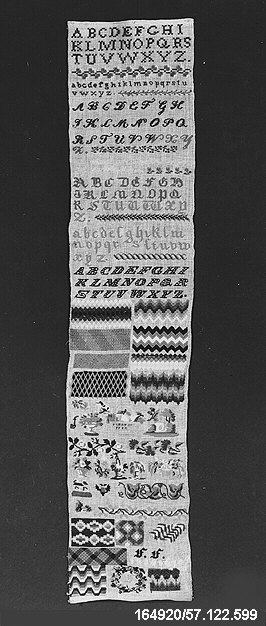
The Sampler: A Global Heritage in Wool on Canvas
In the pantheon of textile arts, the sampler occupies a unique and often misunderstood position. Frequently relegated to the status of a mere practice piece or a child’s educational tool, the sampler is, in fact, a profound cartography of skill, memory, and cultural transmission. At Katherine Fashion Lab, our standalone study of the sampler—executed in wool on canvas and drawing from a global heritage of needlework—repositions this artifact as a critical antecedent to contemporary couture. This analysis deconstructs the sampler’s materiality, its global narrative, and its conceptual resonance within the framework of high fashion, arguing that wool on canvas is not a humble medium but a deliberate, textural declaration of resilience and artistry.
Materiality and Technique: Wool on Canvas as a Couture Statement
The choice of wool on canvas is far from incidental. In the context of couture, where silk, satin, and organza often dominate, wool asserts a grounded, tactile authority. Woolen thread—whether in its natural undyed state or saturated with vegetable-based pigments—offers a distinct volumetric quality. Unlike the flat sheen of silk floss, wool possesses a natural crimp and loft that creates a painterly, almost sculptural surface on the canvas ground. This is not a medium for delicate, ephemeral decoration; it is a medium for durable storytelling.
The canvas itself, typically a sturdy linen or cotton warp, acts as a structural anchor. In our study, the interplay between the rough, open weave of the canvas and the dense, forgiving pile of the wool creates a dialogue between tension and release. Every stitch—whether a cross-stitch, tent stitch, or long-armed cross—becomes a deliberate mark. The sampler’s grid-like structure, often derived from counted-thread techniques, imposes a mathematical precision that mirrors the pattern-making discipline of a couture atelier. Yet, the inherent irregularity of hand-spun or unevenly dyed wool introduces a human imperfection that machine embroidery can never replicate. This tension between geometric order and organic texture is the very essence of the sampler’s couture potential.
Global Heritage: A Tapestry of Cross-Cultural Influence
The sampler’s origins are not monolithic. While the term “sampler” is often associated with European needlework—particularly English, German, and American examples from the 17th to 19th centuries—its lineage is profoundly global. Our study traces threads that connect the costurero of colonial Latin America, where indigenous Andean techniques merged with Spanish embroidery; the sashiko of Japan, where functional white-on-indigo stitching evolved into decorative motifs; and the kente cloth-inspired patterns of West Africa, where symbolic geometry is woven into communal identity.
In the European tradition, samplers served as portable archives of stitches, alphabets, and moral verses. They were often the first and only artistic outlet for young girls, encoding not only technical skill but also social values. However, our analysis expands this narrative. For instance, the use of wool on canvas in the Bayeux Tapestry—a monumental sampler of sorts—demonstrates how this medium was employed for political and historical documentation. Similarly, in the Ottoman Empire, embroidered samplers (often on linen but occasionally on wool) were used to transmit geometric patterns from master artisans to apprentices, creating a visual language that transcended spoken word.
This global heritage informs Katherine Fashion Lab’s approach. By sampling motifs from diverse cultures—such as the tree of life from Persian and Indian traditions, the pomegranate from Armenian needlework, and the endless knot from Tibetan Buddhism—the sampler becomes a syncretic object. It does not appropriate but rather curates these symbols, placing them in a new dialogue. The wool thread, sourced from heritage breeds such as Merino, Shetland, or Karakul, adds a layer of geographical specificity, grounding the global motifs in a tangible, natural origin.
Conceptual Context: The Sampler as a Standalone Study
To treat the sampler as a standalone study is to elevate it from a preparatory tool to a finished work of art. In the atelier of Katherine Fashion Lab, this shift is radical. The sampler is no longer a rehearsal for a garment; it is the garment’s intellectual and aesthetic blueprint. This perspective aligns with the contemporary fashion movement toward deconstruction and reconstruction, where the process of making is as visible as the final product.
The standalone sampler demands a reconsideration of value. In couture, the value of a piece is often measured by the scarcity of materials or the prestige of a label. Here, value is intrinsic to the labor itself. A single square inch of wool-on-canvas embroidery can require hours of handwork, with each stitch representing a decision—color choice, tension, direction. This is a form of slow fashion that predates the term by centuries. It is also a feminist act, reclaiming the domestic needlework that was historically dismissed as “women’s work” and reasserting it as a valid form of high art and design.
Furthermore, the sampler’s grid structure offers a unique lens for understanding pattern drafting. In our study, we deconstruct the sampler into its component parts: the border, the alphabets, the geometric bands, and the pictorial elements. Each section functions as a modular unit, much like the pattern pieces of a couture gown. The border, often the most intricate, can be interpreted as a hemline or seam detail. The alphabets, with their rhythmic repetition, suggest a textural print or a monogram. The pictorial elements—birds, flowers, houses—become embroidered appliqués or broderie anglaise inserts. The sampler thus becomes a lexicon from which entire collections can be generated.
Conclusion: The Sampler’s Place in Future Couture
Katherine Fashion Lab’s standalone study of the sampler in wool on canvas is not an exercise in nostalgia. It is a forward-looking investigation into the foundations of textile craft. In an era of digital printing and mass production, the sampler reminds us that fashion is, at its core, a manual art. The wool thread, with its warmth and weight, connects the wearer to the hand that stitched it. The global heritage embedded in each motif invites a conversation across time and geography. And the standalone treatment affirms that the process of learning, sampling, and practicing is itself worthy of the highest recognition.
As couture continues to evolve, the sampler offers a radical proposition: that the most sophisticated design is often born from the most humble beginnings. In every cross-stitch, there is a universe of possibility. In every woolen thread, there is a story waiting to be told. This is the ethos that defines Katherine Fashion Lab—a reverence for heritage, a commitment to material integrity, and a vision that transforms the archival into the avant-garde.