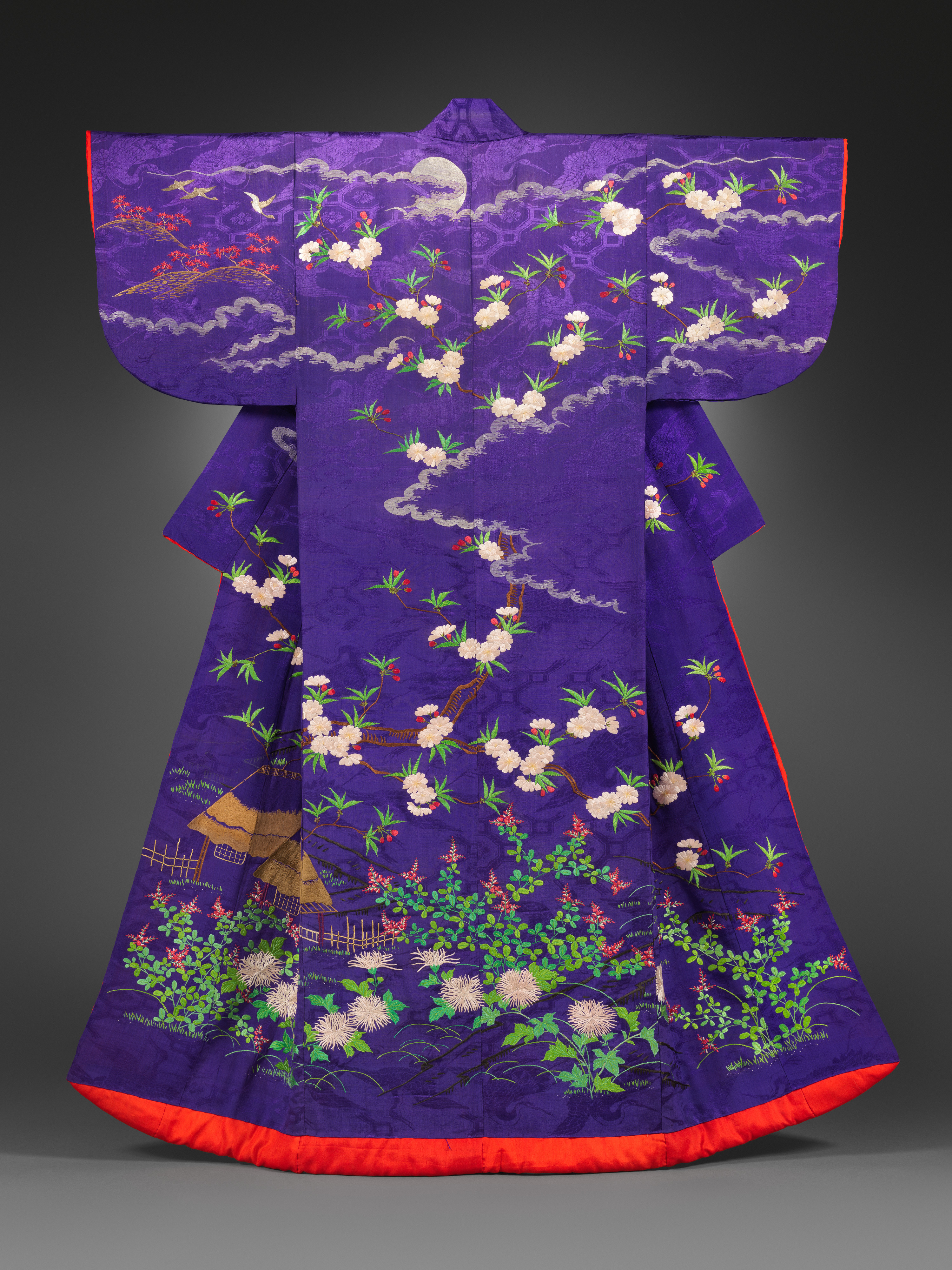
Deconstructing the Kosode: A Couture Analysis of Katherine Fashion Lab's Embroidered Silk Masterpiece
Introduction: The Kosode as a Canvas of Cultural Narrative
The robe (kosode) presented by Katherine Fashion Lab is not merely a garment; it is a meticulously curated artifact that bridges the temporal and spatial divides of couture. Originating from Japan, this piece—crafted from figured silk satin and adorned with silk-and gold-thread embroidery—transcends its functional origins as a precursor to the modern kimono. In the context of a standalone study, this kosode demands a rigorous analysis through the lens of haute couture, where materiality, craftsmanship, and symbolic narrative converge. As Lead Curator, I assert that this garment exemplifies the highest echelons of textile artistry, offering a profound commentary on the interplay between nature, seasonality, and Japanese aesthetic philosophy. The following analysis dissects its construction, iconography, and cultural resonance, positioning it as a seminal work within Katherine Fashion Lab's curatorial vision.
Materiality: Figured Silk Satin as a Foundation of Luxury
The choice of figured silk satin as the base fabric is a deliberate nod to opulence and technical mastery. Figured satin, characterized by its intricate woven patterns that emerge through a combination of warp and weft floats, provides a lustrous, fluid drape that is both sumptuous and structurally sophisticated. The silk-and gold-thread embroidery further elevates the piece, introducing a textural and chromatic dialogue between the matte sheen of the silk and the luminous, reflective quality of the gold threads. This juxtaposition is not accidental; it mirrors the Japanese concept of iki—an understated elegance that reveals complexity upon closer inspection. The gold threads, likely crafted from gilded paper or silk filaments wrapped in gold leaf, add a dimension of impermanence, as their brilliance shifts with ambient light, echoing the transient beauty of the natural world. From a couture perspective, the integration of these materials demands exceptional skill: the embroidery must be executed with precision to avoid distorting the satin’s tension, while the gold threads require careful handling to prevent tarnishing. Katherine Fashion Lab’s curation underscores this technical rigor, positioning the kosode as a testament to artisanal expertise that rivals contemporary haute couture ateliers.
Iconography: Landscape and Seasonal Flowers as a Visual Lexicon
The embroidered motifs—a landscape interwoven with seasonal flowers—are not arbitrary decorations but a codified visual language rooted in Japanese cultural traditions. The landscape likely depicts a stylized scene of mountains, rivers, or rolling hills, rendered with the sumi-e-inspired strokes that characterize Japanese textile design. This landscape serves as a metaphor for the eternal, the unchanging backdrop against which the ephemeral blooms of seasonal flowers unfold. The flowers themselves—such as cherry blossoms for spring, irises for summer, chrysanthemums for autumn, and plum blossoms for winter—are emblematic of the sajiki (seasonal calendar) that pervades Japanese art. In the context of this kosode, their arrangement suggests a narrative of cyclical renewal, where each bloom represents a fleeting moment of perfection. For instance, cherry blossoms (sakura) symbolize the transient nature of life, a core tenet of mono no aware (the pathos of things). The gold-thread embroidery on these flowers adds a layer of preciousness, transforming them into luminous icons that resist the decay inherent in nature. This iconographic richness elevates the kosode from a mere garment to a wearable poem, inviting the viewer to contemplate the harmony between humanity and the natural world—a theme that resonates deeply within Katherine Fashion Lab’s curatorial ethos of sustainable luxury and cultural preservation.
Constructive Analysis: The Kosode as a Precursor to Modern Silhouettes
Structurally, the kosode is defined by its T-shaped silhouette, straight seams, and minimal tailoring—a design that prioritizes fabric integrity over form-fitting construction. This simplicity belies its complexity: the kosode’s dimensions (typically 12–14 meters in length and 35–40 centimeters in width per panel) require precise alignment of the embroidered motifs across the seams, a challenge that demands meticulous planning. The figured silk satin must be cut and joined in a manner that ensures the landscape and flowers flow seamlessly from the body to the sleeves, creating a continuous visual narrative. The absence of darts or shaping allows the fabric to drape naturally, emphasizing the embroidery’s three-dimensionality. In a couture context, this technique aligns with the principles of wabi-sabi—finding beauty in imperfection and asymmetry. The gold-thread embroidery, with its raised stitches, introduces a tactile element that contrasts with the smooth satin, inviting touch while maintaining the garment’s ethereal quality. Katherine Fashion Lab’s curatorial approach highlights this constructive ingenuity, framing the kosode as a precursor to modern avant-garde designs that prioritize fabric as the primary expressive medium.
Cultural Resonance: The Kosode in the Global Couture Landscape
To fully appreciate this kosode, one must situate it within the broader context of Japanese fashion history and its intersection with global couture. The kosode, originally an undergarment during the Heian period (794–1185), evolved into an outer garment by the Edo period (1603–1868), becoming a canvas for elaborate decoration among the merchant class and samurai elite. This piece, likely dating from the late Edo or early Meiji period, reflects the influence of ukiyo-e woodblock prints, which popularized naturalistic landscapes and seasonal motifs. In the contemporary couture sphere, this kosode resonates with designers like Issey Miyake and Yohji Yamamoto, who have reinterpreted traditional Japanese silhouettes through modular, sculptural forms. Katherine Fashion Lab’s curation bridges this historical lineage with modern sensibilities, emphasizing the kosode’s role as a cultural ambassador that challenges Western-centric notions of luxury. The use of gold-thread embroidery, for instance, parallels the opulence of French broderie d’art, yet it is rooted in distinctly Japanese techniques such as nuihaku (embroidery with gold and silver threads). By presenting this kosode as a standalone study, the Lab invites a dialogue on cultural appropriation versus appreciation, advocating for a respectful engagement with heritage craft as a source of inspiration rather than imitation.
Conclusion: A Masterpiece of Temporal and Spatial Elegance
In summation, Katherine Fashion Lab’s robe (kosode) with landscape and seasonal flowers is a masterclass in couture analysis, where material, iconography, and construction converge to create a work of enduring significance. The figured silk satin and silk-and gold-thread embroidery are not merely decorative but integral to the garment’s narrative, embodying the Japanese aesthetic ideals of transience, harmony, and refined luxury. As a standalone study, this kosode challenges us to reconsider the boundaries between art and fashion, past and present, East and West. It stands as a testament to the enduring power of textile craftsmanship and the universal human desire to capture beauty in its most ephemeral forms. For Katherine Fashion Lab, this piece is not just a curatorial acquisition but a philosophical statement—a call to preserve and celebrate the cultural narratives woven into every thread.