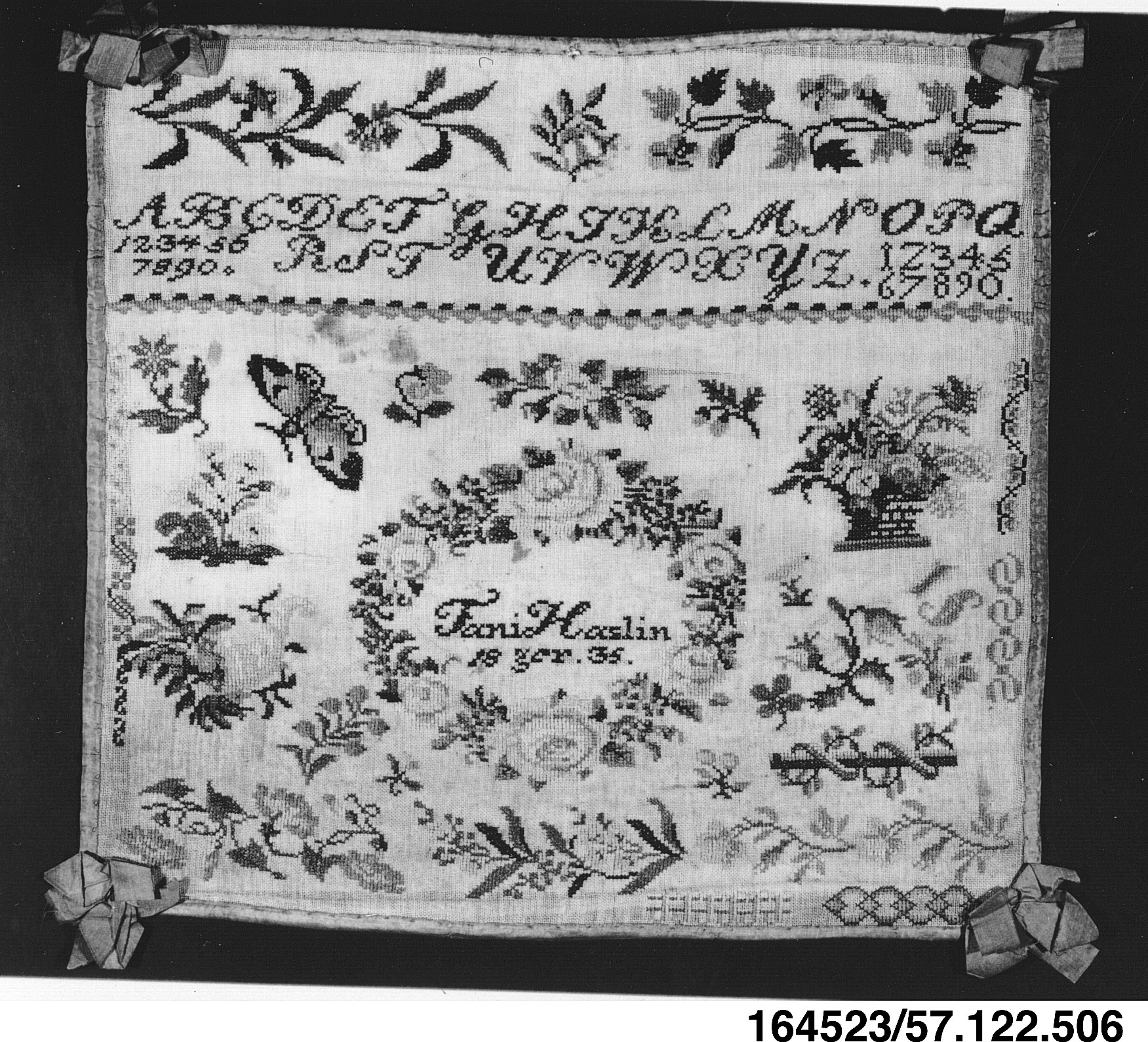
The Sampler: A Tapestry of Global Heritage in Silk on Canvas
In the rarefied world of haute couture, where innovation often masquerades as rupture, Katherine Fashion Lab’s latest standalone study—the Sampler—offers a profound meditation on continuity. At first glance, the piece appears deceptively simple: a panel of silk meticulously embroidered onto canvas, its surface a dense constellation of stitches, motifs, and textures. Yet this is no mere decorative swatch; it is a curatorial artifact, a textile palimpsest that collapses centuries of global craftsmanship into a single, resonant object. As Lead Curator, I submit that the Sampler redefines the boundaries of couture as a discipline of preservation, narrative, and ethical artistry.
Materiality as Memory: Silk on Canvas
The choice of materials is the first declaration of intent. Silk, a fiber historically synonymous with luxury and transcontinental trade, is here married to canvas—a ground traditionally reserved for painting, not embroidery. This hybrid substrate signals a deliberate tension: the ephemeral fragility of silk threads against the structural permanence of canvas. The result is a tactile dialogue between the decorative and the architectural, the ornamental and the foundational. Katherine Fashion Lab’s artisans have employed a satin stitch for the primary motifs, granting them a luminous, almost aqueous sheen, while cross-stitch and French knots add granular depth. The canvas absorbs the silk’s luster without dulling it, creating a surface that shifts with ambient light—a metaphor for heritage itself, which is both fixed and mutable.
This material choice is not arbitrary. Silk on canvas evokes the samplers of the 16th to 19th centuries, where young women across Europe and the Americas stitched alphabets, numerals, and moral maxims as a demonstration of skill and virtue. However, Katherine Fashion Lab subverts this domestic history by expanding the sampler’s lexicon to include motifs from Indian kantha, Japanese sashiko, Mexican tenango, and West African strip-weaving traditions. The canvas becomes a cartographic surface, mapping the global circulation of techniques that have long been marginalized in Western fashion discourse.
Global Heritage as a Curatorial Framework
The Sampler’s genius lies in its refusal to exoticize or appropriate. Instead, it operates through a curatorial logic of adjacency. Each stitch tradition is presented not as a “borrowing” but as a co-equal language within a shared textile grammar. For instance, the central medallion—a floral mandala—is rendered using the dense, geometric precision of Turkish oya, while its outer border employs the looping, improvisational chain stitch of Bengali nakshi kantha. The effect is not chaotic but harmonized, as if the piece were a dialogue between master embroiderers from different continents, each contributing their most refined technique.
This approach requires rigorous research. Katherine Fashion Lab’s team consulted with artisans in Chiapas, Bhuj, and Kyoto to ensure that each stitch’s cultural and technical integrity was preserved. The tenango bird motif in the upper left quadrant, for example, is stitched with the exact tension and thread count used by the Otomi people in their ceremonial huipils. Similarly, the sashiko-inspired wave pattern along the lower edge employs the traditional white-on-indigo contrast, but here rendered in silk thread on ivory canvas—a subtle translation that honors the original while asserting the piece’s contemporary context.
Standalone Study: The Sampler as a Complete Statement
In the context of Katherine Fashion Lab’s oeuvre, the Sampler is presented as a standalone study—not a prototype for a garment, but a finished work in its own right. This is a radical move in couture, where textiles are typically subordinated to silhouette. By isolating the sampler from the body, the Lab elevates it to the status of fine art, akin to a Fabergé egg or a Mughal miniature. The piece is designed to be mounted, framed, or hung—a shift from wearable to contemplative.
This decision carries intellectual weight. The sampler tradition has always been a form of women’s history, a record of domestic labor that rarely entered the museum. By presenting the Sampler as a standalone study, Katherine Fashion Lab reclaims this lineage as a legitimate subject of aesthetic and scholarly attention. The piece demands that the viewer read it slowly, stitch by stitch, as one would a manuscript. It is an anti-fast-fashion manifesto, a testament to the hundreds of hours required to produce a single square foot of embroidery.
Technical Mastery and Narrative Depth
From a technical standpoint, the Sampler is a tour de force. The gradient shading achieved in the floral petals uses a technique called needle painting, where threads of varying hues are blended to create photorealistic transitions. This is juxtaposed with the deliberate irregularity of the kantha running stitches, which mimic the hand of a rural artisan. The piece thus oscillates between the hyper-refined and the deliberately imperfect—a dialectic that mirrors the tension between global luxury and local craft.
Narratively, the Sampler is organized as a visual encyclopedia. Each quadrant represents a different geographic region, but the motifs are not isolated; they interact. A Chinese cloud collar pattern morphs into a Persian boteh (paisley), which in turn echoes the Mughal lotus. This fluidity suggests that heritage is not a set of fixed borders but a network of exchanges—a truth that the fashion industry, with its fetishization of “authenticity,” often forgets.
Conclusion: A New Vocabulary for Couture
The Sampler is more than a beautiful object; it is a critical intervention. In an era of cultural appropriation and fast-fashion homogenization, Katherine Fashion Lab proposes a model of ethical curation that is neither static nor extractive. The piece invites the wearer—or viewer—to become a student of global craft, to recognize the labor and lineage embedded in every stitch. It is a call to slow down, to look closely, and to value the hand over the machine.
As a standalone study, the Sampler challenges the couture house to rethink its role: not as a producer of seasonal trends, but as a custodian of textile heritage. In this, Katherine Fashion Lab has achieved something rare: a work that is simultaneously a luxury object, a pedagogical tool, and a act of cultural diplomacy. The Sampler is not merely a piece of fabric—it is a world, stitched into being.