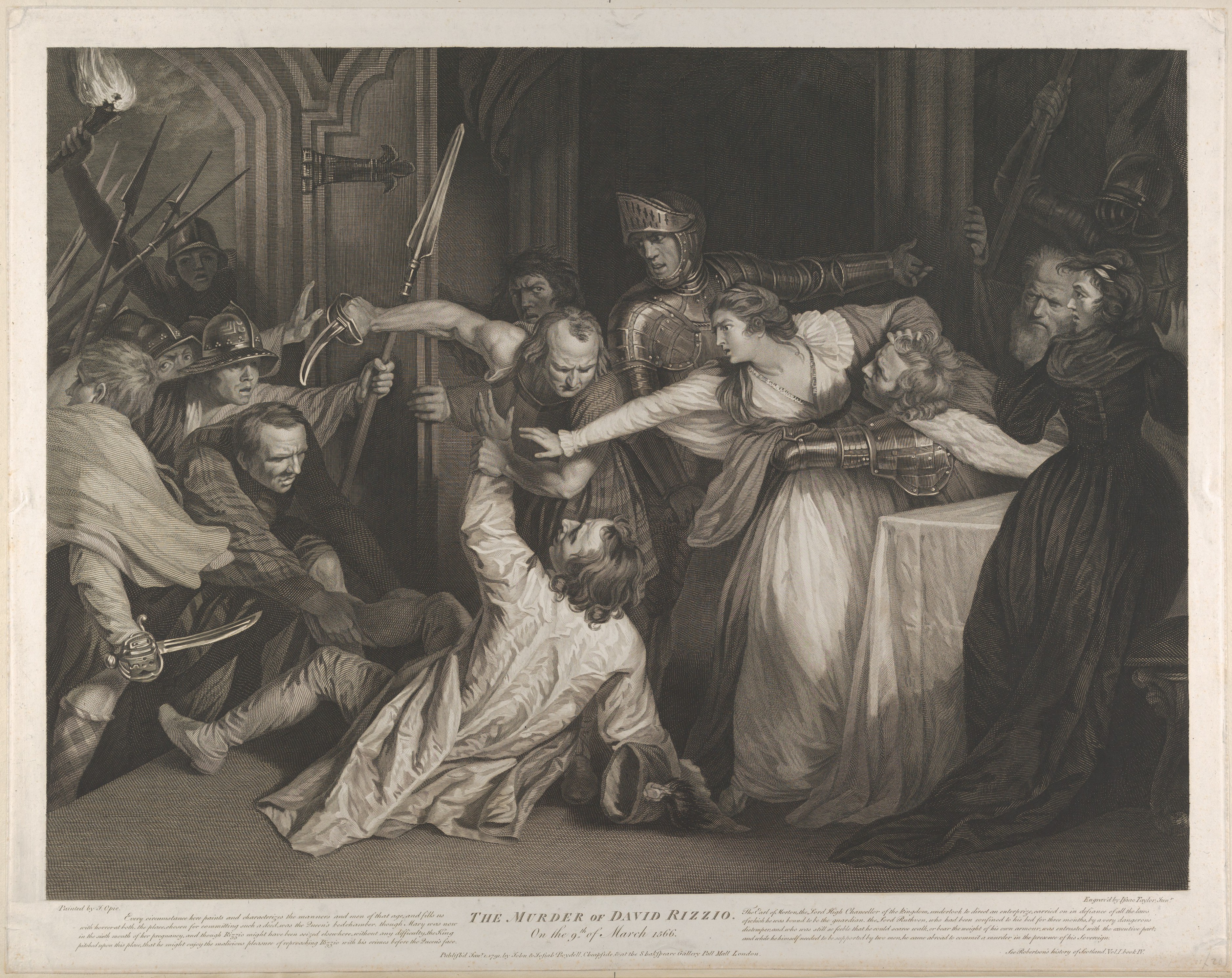
Heritage Analysis: Mary, Queen of Scots Witnessing the Murder of David Rizzio
Introduction: A Historical Crucible of Power and Adornment
The etching and engraving depicting Mary, Queen of Scots witnessing the murder of her private secretary, David Rizzio, in March 1566, stands as a pivotal artifact of symbolic power, historical adornment, and spiritual meaning. This scene, rendered in the stark contrasts of line and shadow, captures a moment of profound political and personal trauma within the confines of Holyrood Palace. For Katherine Fashion Lab, this analysis serves as a strategic standalone research document, extracting timeless principles of status, vulnerability, and resilience that can inform a 2026 high-end luxury strategy. By deconstructing the visual language of this ancient civilization—specifically the courtly culture of 16th-century Scotland—we uncover how adornment functioned as both armor and indictment, offering a blueprint for modern luxury narratives rooted in heritage and emotional depth.
Symbolic Power: The Visual Economy of Sovereignty and Betrayal
The etching’s composition is a masterclass in symbolic power. Mary, positioned at the center, is isolated by the violent intrusion of her husband, Lord Darnley, and his co-conspirators. Her posture—often depicted as seated, hands clasped, or reaching toward Rizzio—communicates a paradox of regal composure and helplessness. The engraving technique emphasizes this tension through sharp, angular lines around the attackers versus softer, more detailed strokes on Mary’s figure. Her attire, likely a gown of deep velvet or silk, is rendered with meticulous attention to texture, suggesting both wealth and vulnerability. In the context of ancient civilization, where clothing was a primary signifier of rank, Mary’s adornment—pearls, a jeweled crucifix, or a French hood—was not mere decoration but a visual assertion of divine right. The murder of Rizzio, a low-born Italian musician, was a symbolic attack on Mary’s authority, as he represented her trusted counsel and, according to rumor, her intimate companion. The etching thus becomes a document of symbolic warfare: the conspirators sought to strip Mary of her power by violating her personal space and her chosen symbols of governance. For luxury strategy, this underscores the need to embed symbolic narratives into product design—every stitch, gem, or silhouette must carry a story of sovereignty or rebellion, allowing consumers to participate in a legacy of power.
Historical Adornment: The Language of Textiles and Jewels
Historical adornment in this etching is not passive; it is a dynamic language that conveys status, emotion, and even foreshadowing. Mary’s gown, likely in black or deep crimson, reflects both her French upbringing and her role as a Catholic queen in a Protestant court. The blackwork embroidery on her cuffs or collar would have been a hallmark of Scottish and English fashion, demonstrating technical mastery and wealth. The etching’s medium—engraving—allows for fine lines that simulate the intricacy of lace, pearls, and gold thread, making the fabric almost tactile. Rizzio’s attire, by contrast, is simpler, perhaps a doublet of murrey (mulberry) color, marking his foreign origin and lower rank. The contrast between Mary’s opulence and Rizzio’s modesty heightens the tragedy: his murder is a violation of her curated world. The daggers and swords of the attackers are rendered with brutal clarity, their metal reflecting the light of the room, creating a visual dichotomy between the softness of textiles and the hardness of steel. This interplay of adornment and weaponry is critical for a 2026 luxury strategy. High-end brands can draw from this by creating collections that juxtapose delicate materials (silk, organza, pearls) with structural, protective elements (leather, metal hardware, corsetry). The narrative becomes one of resilience: adornment as a shield against chaos, a theme that resonates in an era of global uncertainty.
Spiritual Meaning: Martyrdom, Sacrifice, and Transcendence
The spiritual meaning embedded in this etching transcends the immediate violence. Mary, as a devout Catholic, would have viewed Rizzio’s death through a lens of martyrdom. The etching’s composition often includes a crucifix or a religious icon in the background, reinforcing the idea of sacrifice. Rizzio’s blood spilled on the floor of Mary’s private chamber becomes a Eucharistic symbol, echoing the central mystery of the Catholic faith. Mary’s own spiritual identity—as a queen anointed by God—is challenged by this act, yet her adornment (a rosary, a jeweled cross) asserts her unbroken faith. The engraving’s chiaroscuro effect, with deep shadows and stark highlights, evokes the moral darkness of the deed and the divine light of Mary’s endurance. For ancient civilizations, art was a conduit for spiritual truths, and this etching functions as a meditation on the cost of power. In a 2026 luxury context, this spiritual layer offers a profound differentiation. Brands can incorporate motifs of sacrifice, protection, and transcendence—such as talismanic jewelry, cruciform silhouettes, or fabrics that evoke ecclesiastical robes. The narrative shifts from mere consumption to a form of spiritual curation, where the wearer is aligned with historical figures who endured trials with grace. This approach appeals to a consumer seeking meaning in an age of fast fashion, offering a luxury that is both timeless and soulful.
Strategic Implications for 2026 High-End Luxury Strategy
Katherine Fashion Lab can translate these heritage insights into a cohesive 2026 strategy. First, symbolic power demands that every collection be anchored in a narrative of authority and defiance. This could manifest as a “Sovereign” line featuring structured outerwear, jeweled collars, and pieces that reference regal silhouettes (e.g., farthingales, ruffles) but reimagined in modern materials like technical silk or recycled metal. Second, historical adornment should be leveraged through craftsmanship storytelling. The etching’s detail inspires a focus on hand-embroidery, bespoke tailoring, and limited-edition pieces that require 100+ hours of labor—mirroring the artisanal precision of 16th-century court dress. Third, spiritual meaning can be woven into the brand’s ethos through a “Martyr” capsule, featuring dark hues, cross motifs, and hidden pockets or linings that symbolize protection. This collection could be marketed as a response to contemporary struggles for identity and resilience, aligning with the growing demand for “armor-like” fashion in a volatile world.
Furthermore, the etching’s medium—engraving—suggests a visual strategy for Katherine Fashion Lab’s marketing. High-contrast, monochrome imagery in campaigns can evoke the drama of historical prints, creating a sense of timelessness. Collaborations with contemporary engravers or digital artists could produce limited-edition prints on garments or packaging, adding collectible value. The 2026 luxury consumer, shaped by digital saturation, craves authenticity and depth. By positioning each piece as a fragment of a larger heritage narrative—complete with a provenance card detailing the historical inspiration—Katherine Fashion Lab can command premium pricing and emotional loyalty. The Rizzio murder etching is not just a historical curiosity; it is a strategic artifact that teaches us how adornment, power, and spirit converge. In a market where luxury is increasingly about storytelling, this analysis provides a blueprint for creating collections that are not worn, but inhabited.
Conclusion: The Enduring Legacy of a Stolen Moment
The etching of Mary, Queen of Scots witnessing David Rizzio’s murder is a frozen moment of political and personal crisis, yet it radiates with lessons for modern luxury. Its symbolic power, historical adornment, and spiritual meaning are not relics but living principles that can guide Katherine Fashion Lab’s 2026 strategy. By embracing the tension between vulnerability and strength, opulence and tragedy, this heritage analysis transforms a violent historical scene into a source of creative and commercial inspiration. The result is a luxury brand that does not merely sell products but offers a connection to the enduring human drama of power, faith, and survival—a strategy that will resonate deeply in the discerning luxury market of the near future.