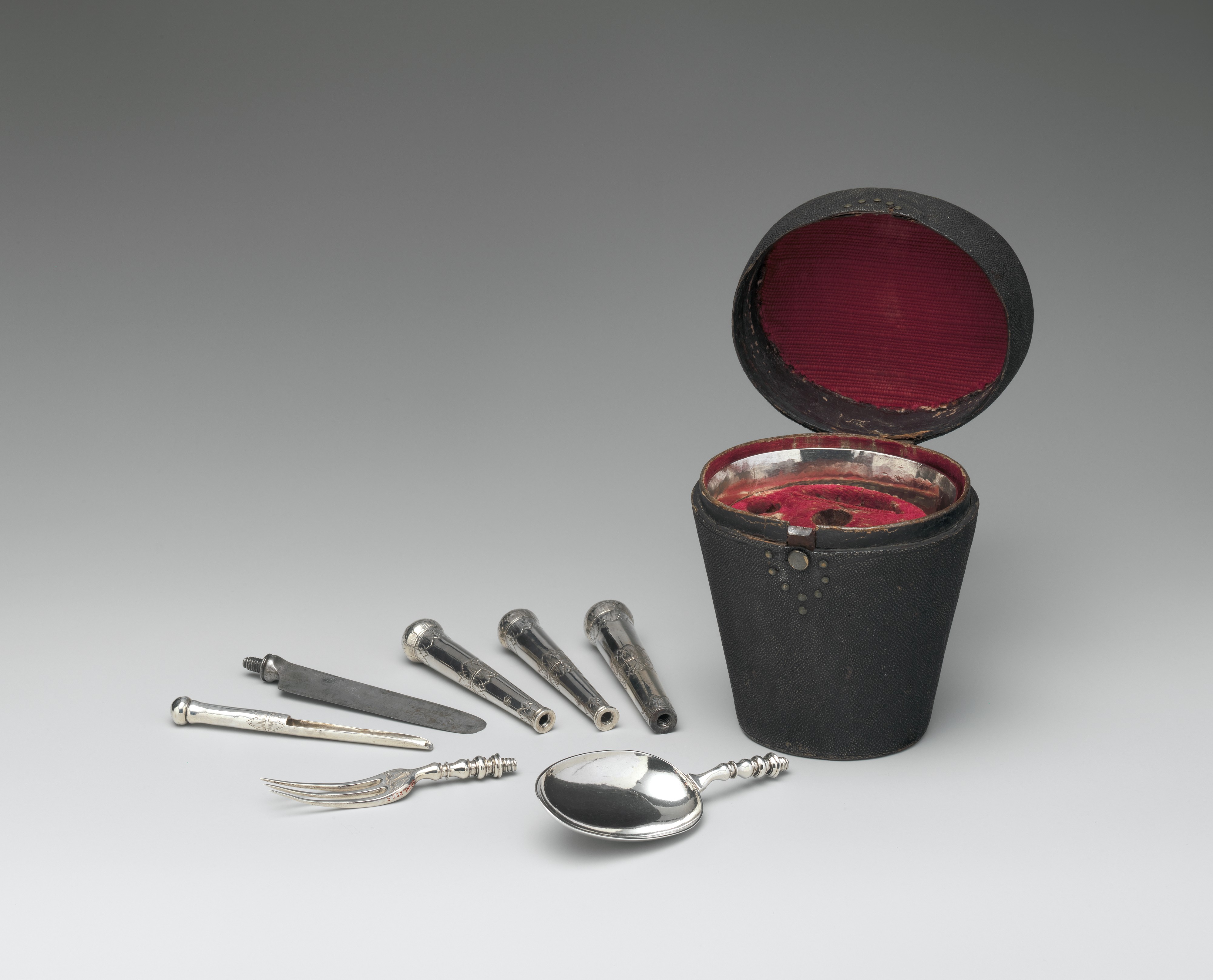
The Pocket Canteen: A Study in Portable Luxury
In the rarefied world of haute couture accessories, few objects command the quiet reverence of the pocket canteen traveling set. At Katherine Fashion Lab, we approach such artifacts not merely as functional relics but as living documents of global heritage, where materiality, craftsmanship, and cultural narrative converge. This particular set—a silver canteen housed in a shagreen-covered wooden case, complete with a removable wooden fitting lined in velvet and accented with silver braid—offers a masterclass in the art of portable luxury. Its analysis reveals a sophisticated dialogue between utility and ornament, a hallmark of the discerning traveler’s ethos.
Materiality as Memory: Silver and Shagreen
The choice of silver for the canteen itself is no accident. Silver has long been prized for its antimicrobial properties and its ability to preserve the purity of liquids, a critical consideration for the globetrotting elite of centuries past. Yet, beyond its practical virtues, silver serves as a canvas for expressions of wealth and taste. The cool, reflective surface captures light, transforming a simple drinking vessel into a beacon of refinement. In this context, the silver is likely hand-hammered or engraved with subtle motifs—perhaps a family crest or geometric patterns—that speak to the owner’s lineage or aesthetic preferences. The patina that develops over time adds a layer of narrative, each tarnish mark a testament to journeys taken.
The wooden case, however, is where the object’s global heritage truly shines. Covered in shagreen—a leather made from the skin of sharks or rays, often dyed in muted greens or blues—the case evokes the exotic trade routes of the 18th and 19th centuries. Shagreen was a material associated with the Ottoman Empire, the Far East, and the spice islands, prized for its durability and distinctive granular texture. Its application here is not merely decorative; it signals the owner’s access to far-flung resources and their appreciation for the artisanal traditions of distant cultures. The shagreen’s tactile quality—smooth yet subtly abrasive—invites touch, creating a sensory bridge between the user and the object’s origins.
The Art of Concealment: Velvet, Wood, and Silver Braid
Inside the case, the removable wooden fitting lined with velvet represents a triumph of bespoke engineering. The velvet—likely silk or fine cotton—serves as a protective cradle, cradling the silver canteen and any accompanying vessels, such as a cup or stopper. Its plushness absorbs shock during travel, while its rich hue (perhaps burgundy, emerald, or midnight blue) provides a striking contrast to the silver’s gleam. The choice of velvet is deliberate: it evokes the opulence of royal courts and the intimacy of private chambers, transforming the act of unpacking into a ritual of discovery.
The silver braid that edges the velvet and the wooden fitting adds a layer of structural elegance. Braided silver wire, meticulously applied, reinforces the seams while introducing a rhythmic pattern that echoes the canteen’s metallic finish. This detail is a hallmark of high-level craftsmanship, requiring the hands of a master silversmith or a specialist in passementerie. The braid not only prevents fraying but also unifies the interior and exterior aesthetics, ensuring that every component—visible or hidden—adheres to the same standard of excellence.
Global Heritage: A Convergence of Traditions
To understand this pocket canteen is to appreciate its role as a cultural crossroads. The silverworking techniques may trace back to European guilds, where silversmiths in London, Paris, or Augsburg perfected the art of portable vessels. The shagreen-covered case, however, borrows from Middle Eastern and Asian decorative arts, where such materials were used for bookbindings, weapon sheaths, and luxury boxes. The velvet lining recalls the textile traditions of Italy and France, while the overall form—a compact, multi-part traveling set—echoes the Grand Tour tradition, where young aristocrats carried such items as they journeyed through Europe and beyond.
This fusion of influences is what elevates the object from mere accessory to heritage artifact. It embodies a worldview that prized curiosity, connoisseurship, and the acquisition of tangible memories. For the modern collector, the pocket canteen offers a window into a time when travel was a deliberate, often arduous pursuit, and every object carried was a statement of identity and aspiration.
Design Principles: Proportion, Portability, and Poise
From a design perspective, the pocket canteen exemplifies the principles of proportion and portability. The case is compact, likely no larger than a modern tablet, allowing it to slip into a coat pocket or a saddlebag. The removable wooden fitting is a stroke of genius: it allows the user to extract the canteen and its cup for use while leaving the case behind, reducing weight and bulk. This modularity is a precursor to contemporary travel design, where efficiency and elegance must coexist.
The balance between the silver’s weight and the wood’s lightness is carefully calibrated. Too much silver, and the set becomes cumbersome; too little, and it loses its gravitas. The shagreen covering adds a layer of grip, preventing the case from slipping from the hand. Every curve, every join, every hinge is designed with ergonomic precision, ensuring that the object feels as good as it looks. This is not a piece for display alone; it is meant to be handled, used, and cherished.
Contextual Significance: A Standalone Study
Considered as a standalone study, this pocket canteen set transcends its original function. It becomes a microcosm of luxury travel, a testament to the human desire to carry a piece of home—or of aspiration—into the unknown. In an era of mass-produced travel accessories, the handcrafted canteen reminds us of the value of slow, intentional design. It speaks to a time when the journey was as important as the destination, and the objects we carried were extensions of our character.
At Katherine Fashion Lab, we view such artifacts as teaching tools for contemporary couture. The pocket canteen challenges designers to think beyond the garment, to consider the accessories that complete a lifestyle. It asks: How can we imbue modern travel pieces with the same sense of history, material integrity, and narrative depth? The answer lies in this very object—a silver canteen in a shagreen case, a velvet-lined dream of global heritage.