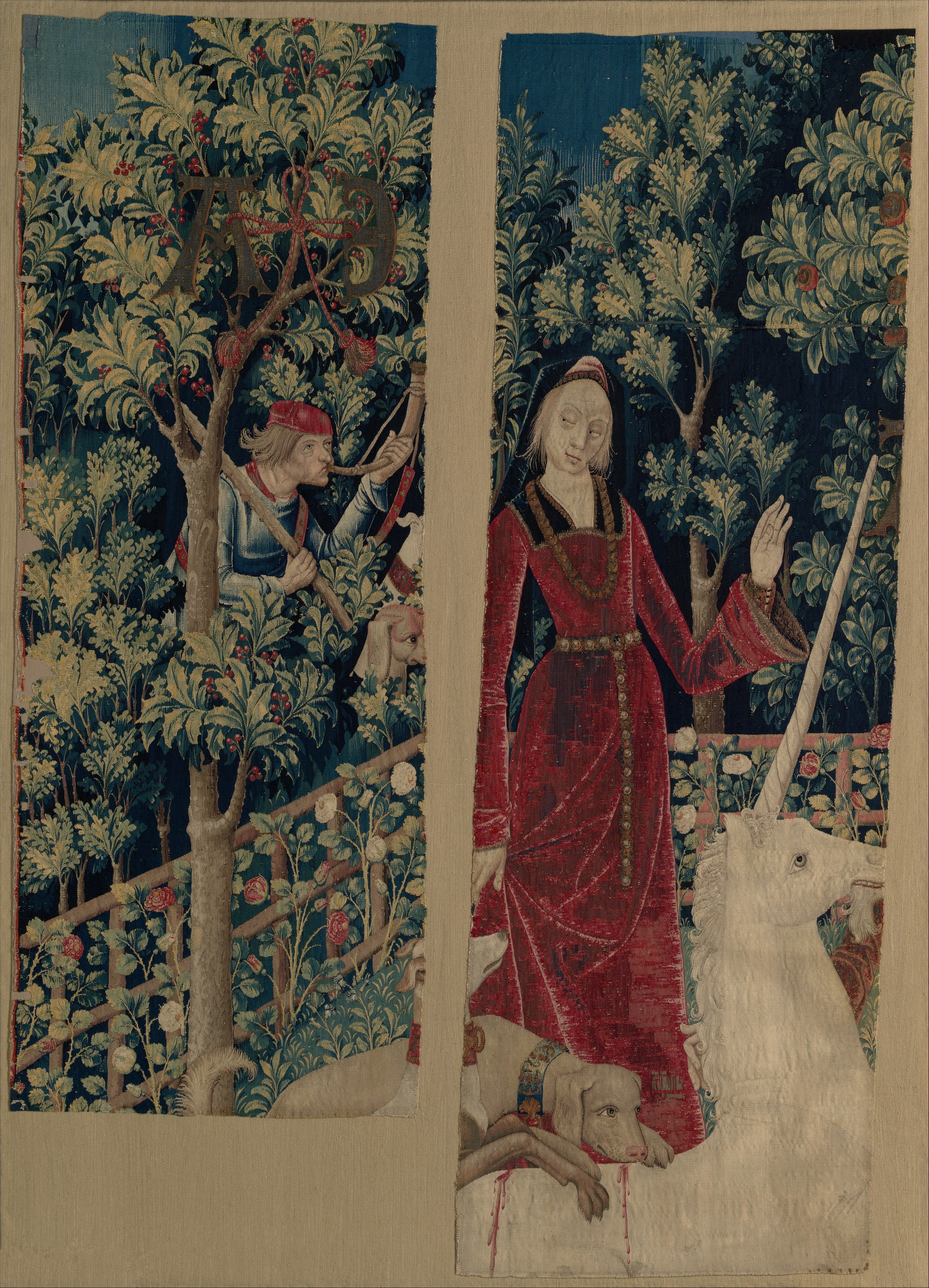
The Unicorn Surrenders to a Maiden: A Couture Analysis of Medieval Textile Mastery
Historical and Artistic Context
The Unicorn Tapestries, woven in the late 15th century in the South Netherlands, represent one of the most enigmatic and sophisticated achievements in textile art. Among the seven surviving panels, The Unicorn Surrenders to a Maiden occupies a pivotal narrative position, blending courtly love allegory with Christian symbolism. This standalone analysis examines the tapestry’s construction, materiality, and design as a precursor to modern couture principles, revealing how medieval weavers anticipated the haute couture ethos of precision, narrative depth, and material opulence.
The tapestry’s origin in the South Netherlands—specifically in the flourishing centers of Brussels, Bruges, or Tournai—places it within a tradition of luxury textile production that rivaled Italian silk weaving. These ateliers, often patronized by European nobility, operated with a division of labor analogous to today’s couture houses: master weavers, cartoon designers, and dyers collaborated to execute a singular vision. The wool warp provided structural integrity, while the wool, silk, silver, and gilt wefts introduced chromatic richness and tactile contrast—a technique that modern designers would recognize as texture layering.
Material Analysis: The Couture Grammar of Medieval Weaving
The choice of materials in The Unicorn Surrenders to a Maiden is not merely decorative but functional, serving both aesthetic and symbolic purposes. The wool warp and weft, sourced from local flocks, offered durability and a matte finish, grounding the composition in earthy tones. In contrast, the silk wefts introduced a luminous sheen, particularly in the maiden’s gown and the unicorn’s mane, drawing the viewer’s eye to the central figures. This interplay of matte and gloss mirrors the tactile juxtaposition in high-end fashion, where a cashmere bodice might be paired with a satin skirt to create visual hierarchy.
The inclusion of silver and gilt wefts elevates the tapestry to a level of material opulence that anticipates the use of metallic threads in couture embroidery. These precious metals, wrapped around silk cores, would have been reserved for the most sacred or regal elements: the maiden’s crown, the unicorn’s horn, and the millefleurs background. Their reflective quality not only signified wealth but also functioned as a light-capturing device, creating a dynamic, shimmering surface that changed with the viewer’s angle. In contemporary terms, this is analogous to the use of Lurex or metallic organza in evening wear, where light is manipulated to enhance form and narrative.
Design and Composition: Narrative Through Structure
The composition of The Unicorn Surrenders to a Maiden is a masterclass in visual storytelling, achieved through meticulous arrangement of figures, flora, and fauna. The unicorn, a symbol of purity and untamed nature, kneels before the maiden, who sits enthroned in a garden. This power dynamic is reinforced through scale and placement: the maiden’s figure is slightly elevated, her gaze direct, while the unicorn’s lowered head and folded legs signal submission. The surrounding millefleurs—a dense pattern of stylized flowers—creates a unifying field that both isolates and connects the figures, much like a background motif in a couture print.
Color theory plays a critical role. The maiden’s gown, woven in deep blue and crimson, contrasts with the unicorn’s white and silver body, establishing a chromatic dialogue of restraint versus radiance. The use of indigo and madder—expensive dyes sourced from trade routes—underscores the tapestry’s status as a luxury object. In couture, this would be analogous to the use of exclusive Pantone hues or custom-dyed silks to convey character and mood.
Techniques and Craftsmanship: The Precedent for Haute Couture
The technical execution of this tapestry reflects a systems-based approach to design, akin to the pattern-making and draping processes in a couture atelier. The weavers employed a weft-faced plain weave, where the wefts completely cover the warp, allowing for fine detail and color gradation. This technique, known as haute-lisse (high-warp) weaving, required the cartoon to be placed behind the warp threads, enabling the weaver to see the design in reverse. The slit tapestry method, where colors meet at vertical slits, was used for sharp color transitions—a precursor to intarsia in knitwear or piecing in garment construction.
The level of detail is staggering. The unicorn’s fur is rendered through hatching—alternating short wefts of white and gray—to suggest volume and texture. The maiden’s hair is built from dozens of fine silk threads, each individually placed to create a naturalistic flow. This micro-manipulation of thread is the medieval equivalent of hand-embroidery or beading in contemporary couture, where hours of labor are invested in a single square inch to achieve perfection. The tapestry’s reversible appearance—though intended for wall display—also hints at the inside-out finishing prized in high-end garment construction.
Symbolism and Cultural Resonance in Modern Fashion
The narrative of The Unicorn Surrenders to a Maiden resonates with fashion’s enduring fascination with allegory and transformation. The unicorn’s submission to a virgin—a reference to both courtly love and the Annunciation—parallels the metamorphosis inherent in couture: raw materials are tamed, shaped, and elevated into art. The maiden, as a figure of agency and grace, can be read as the muse or the designer herself, commanding the narrative through her presence.
Modern designers have drawn directly from this iconography. Alexander McQueen’s 1996 Dante collection, for instance, featured embroidered unicorns and medieval motifs, while John Galliano’s Dior collections often referenced tapestry-like textures through brocade and jacquard. The millefleurs pattern has been reinterpreted in prints by Erdem and Rodarte, proving that the tapestry’s visual language is as potent today as it was in the 15th century.
Conclusion: The Tapestry as Couture Artifact
The Unicorn Surrenders to a Maiden is more than a historical relic; it is a textbook example of how material, technique, and narrative converge to create a luxury object. Its wool, silk, silver, and gilt wefts are not merely components but active participants in a story of power, purity, and transformation. For the modern couturier, this tapestry offers a blueprint for sustainable luxury—where materials are chosen for their longevity and symbolism, and where craftsmanship is revered as the highest form of expression. In the hands of Katherine Fashion Lab, this analysis underscores the enduring relevance of medieval textile mastery as a foundation for contemporary haute couture innovation.