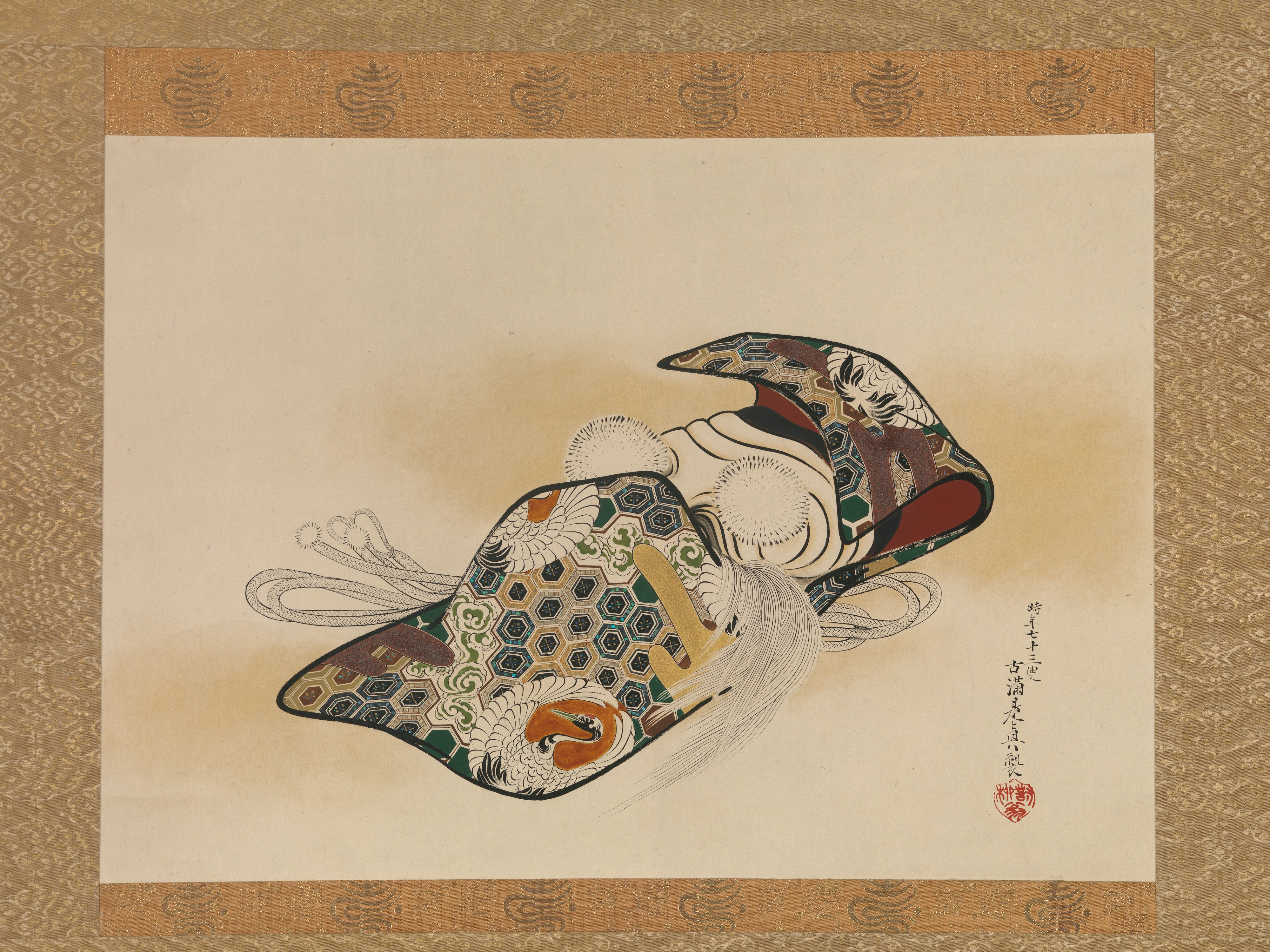
The Okina Mask: A Convergence of Sacred Theatre and Couture Artistry
In the rarefied domain where haute couture meets cultural anthropology, Katherine Fashion Lab presents an extraordinary artifact: the Noh mask for the sacred play Okina. This is not merely a theatrical accessory but a standalone study in the alchemy of material, symbolism, and performative identity. Originating from Japan’s medieval court traditions, the mask is constructed as a hanging scroll—a format that elevates it beyond the stage into a meditative object of aesthetic contemplation. The materials employed—pigments, lacquer, mother-of-pearl, gold foil, and ink on paper—represent a sophisticated lexicon of Japanese craftsmanship, each element chosen to convey a precise spiritual and aesthetic message.
The Sacred Context of Okina: Theatre as Ritual
To understand the mask’s couture significance, one must first grasp its ritualistic foundation. Okina (literally “old man”) is the oldest and most revered Noh play, predating the formalization of Noh theatre in the 14th century. Unlike other Noh dramas that explore human passions and ghosts, Okina is a Shinto-Buddhist purification rite performed to invoke blessings, longevity, and peace. The mask’s primary function is not to represent a character but to channel a divine presence—a kami (spirit) that mediates between the earthly and celestial realms. In this context, the mask becomes a wearable icon, a bridge between the performer and the sacred.
Katherine Fashion Lab’s analysis positions this mask as a precursor to modern couture’s obsession with identity transformation. The performer who dons this mask is not acting; he is becoming a vessel. This concept resonates deeply with haute couture’s philosophy: clothing and accessories are not mere coverings but instruments of metamorphosis. The Okina mask, with its serene yet ambiguous expression, embodies the couture ideal of transcendence through materiality—a principle that Katherine Fashion Lab explores in its own collections, where fabric, form, and symbolism merge to create wearable rituals.
Material Lexicon: Lacquer, Gold Foil, and Mother-of-Pearl
The mask’s construction as a hanging scroll introduces a unique fragility and dimensionality. Unlike carved wooden Noh masks, this version is painted on paper, layered with lacquer for durability and luminosity. The lacquer—a sap from the toxicodendron vernicifluum tree—is applied in multiple coats, each polished to a mirror-like sheen. This technique, known as urushi, requires years of mastery and yields a surface that is both resilient and reflective. In couture terms, this is analogous to the painstaking hand-finishing of a silk gown or the precise draping of a bias-cut evening dress. The lacquer’s depth creates a visual paradox: it appears solid yet reveals the paper’s grain beneath, much like a couture garment that flaunts its construction while appearing seamless.
Gold foil is applied in delicate patches, particularly around the eyes and forehead. In Japanese aesthetics, gold signifies the sun, purity, and the divine. It catches light during the slow, deliberate movements of the Noh dancer, creating a halo effect that reinforces the mask’s sacred aura. This use of precious metal parallels the couture tradition of employing gold thread or leaf in embroidery—for example, in the work of designers like Yves Saint Laurent or Alexander McQueen, who used gold to denote power and otherworldliness. Here, the gold is not decorative but functional: it guides the audience’s gaze toward the mask’s eyes, the windows to the spirit.
Mother-of-pearl inlays are embedded in the mask’s pupils and occasionally along the hairline. This iridescent shell material, harvested from abalone or pearl oysters, introduces a subtle chromatic shift. As the viewer moves, the mother-of-pearl flickers from white to pink to blue, suggesting the ephemeral nature of life—a core theme in Okina. In couture, mother-of-pearl is often used in buttons or jewelry, but here it is integrated into the mask’s surface, blurring the line between costume and fine art. Katherine Fashion Lab’s analysis highlights this as a proto-couture technique: the mask does not merely accessorize the performer; it becomes the focal point of the entire ensemble, much like a statement piece from a runway collection.
Pigments and Ink: The Palette of Serenity
The mask’s color palette is restrained but potent. Predominantly white—a color of death and rebirth in Japanese culture—the base is achieved with white lead or crushed oyster shell pigment, known as gofun. This creates a matte, chalky finish that absorbs light rather than reflecting it, giving the mask a ghostly, timeless quality. Red accents, derived from cinnabar or safflower, are painted on the lips and around the eyes. Red in Okina symbolizes vitality, warding off evil spirits. The contrast between the white base and red details is stark yet harmonious, a visual tension that mirrors the play’s dual themes of mortality and renewal.
Ink strokes define the eyebrows and wrinkles, executed with a brush in a single, fluid motion. This calligraphic approach is a hallmark of Japanese art, where less is more. The wrinkles are not realistic but stylized, suggesting wisdom and age without descending into grotesquerie. This is a lesson for contemporary couture: restraint can be more powerful than excess. The mask’s expression—a faint smile, slightly downturned eyes—is deliberately ambiguous. Is it joy, sorrow, or transcendence? The viewer must decide, just as a couture garment invites interpretation rather than dictating meaning.
The Hanging Scroll Format: A Standalone Study
Framed as a hanging scroll, this mask is removed from the performance context and presented as an object of solitary contemplation. The scroll format—with its silk brocade borders, wooden roller, and decorative cord—transforms the mask into a mobile shrine. It can be unrolled for private viewing, much like a couture sketch or a fashion plate, revealing the mask in its full glory. This format emphasizes the mask’s dual life: it is both a functional tool for ritual and a work of art for aesthetic appreciation.
Katherine Fashion Lab sees this as a precursor to the modern fashion exhibition, where garments are displayed in galleries as art objects. The hanging scroll allows for a curated intimacy—the viewer can approach, study the brushstrokes, and meditate on the materials without the distraction of a stage. This aligns with the couture world’s recent trend toward slow fashion and artisanal appreciation, where the process of creation is as valued as the final product.
Conclusion: The Mask as Couture Archetype
The Okina mask, as presented by Katherine Fashion Lab, is more than a historical artifact; it is a masterclass in the principles that define haute couture. Its materials—lacquer, gold foil, mother-of-pearl, and pigment—are not chosen for mere decoration but for their symbolic and sensory impact. Its construction, from the layering of lacquer to the precision of calligraphic ink, mirrors the meticulous craftsmanship of a couture atelier. Its function, as a tool for spiritual transformation, echoes couture’s power to shape identity.
In a world increasingly dominated by mass production and digital ephemera, this mask reminds us of the enduring value of sacred craftsmanship. It invites us to slow down, to look closely, and to recognize that true artistry—whether in a 14th-century Noh play or a 21st-century runway collection—is always a dialogue between material and meaning. For Katherine Fashion Lab, the Okina mask stands as a timeless inspiration: a testament to the fact that the most profound fashion is not worn, but inhabited.