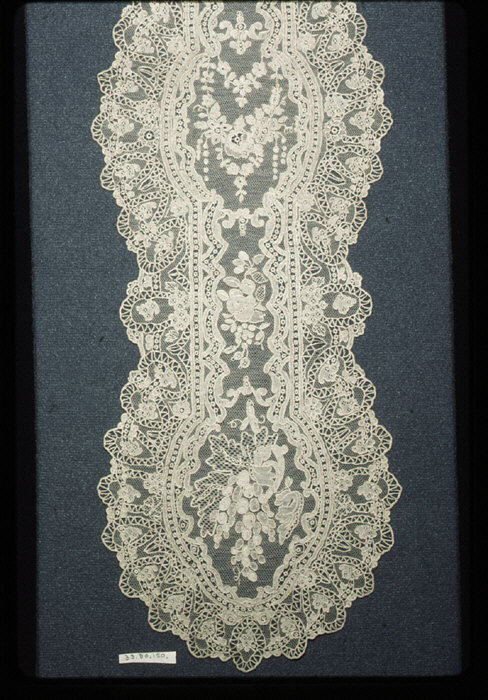
The Lappet Redefined: A Couture Analysis of Needle Lace and Point d’Alençon
In the rarefied world of haute couture, where craftsmanship meets cultural memory, the lappet emerges as a subject of profound sartorial significance. For Katherine Fashion Lab, this standalone study examines the lappet—a decorative, often elongated accessory historically worn as part of ecclesiastical or aristocratic attire—through the lens of global heritage and superlative materiality. The choice of needle lace, specifically point d’Alençon, elevates this artifact from a mere ornamental flourish to a testament of artisanal mastery and cross-cultural dialogue. This analysis dissects the lappet’s structural, aesthetic, and symbolic dimensions, positioning it as a microcosm of couture’s ability to honor tradition while catalyzing contemporary expression.
Historical and Cultural Precedents: The Lappet as a Global Artifact
The lappet’s lineage is as diverse as it is refined. Originating in medieval Europe, particularly within the vestments of clerics and the courtly dress of nobility, the lappet served both functional and hierarchical purposes—draping from mitres, headdresses, or cuffs to signify rank and devotion. Yet its resonance extends beyond Western borders. In East Asia, similar elongated silk panels adorned ceremonial robes, while in the Mughal courts, embroidered lappets graced turbans and shawls, denoting imperial favor. This global heritage imbues the lappet with a polysemous identity: it is simultaneously a relic of religious solemnity, a marker of dynastic power, and a canvas for regional textile traditions.
For Katherine Fashion Lab, the lappet is not merely resurrected but recontextualized. The studio’s approach strips the accessory of its original ecclesiastical or courtly confines, repositioning it as a standalone study in form and texture. By isolating the lappet from its traditional context—be it a chasuble or a ceremonial headdress—the analysis focuses on its intrinsic architectural qualities: the interplay of negative space, the rhythm of repeating motifs, and the tension between rigidity and fluidity inherent in lace construction. This decontextualization allows the lappet to speak to a global audience, transcending its specific origins to become a universal emblem of artisanal precision.
Material Mastery: Needle Lace and Point d’Alençon
At the heart of this study lies the material choice: needle lace, with a specific emphasis on point d’Alençon. Needle lace, distinguished by its construction using a single needle and thread to build intricate patterns on a parchment foundation, represents the zenith of handcrafted textile art. Unlike bobbin lace, which relies on multiple threads twisted and braided, needle lace achieves a sculptural, almost ethereal quality—each stitch a deliberate act of creation. Point d’Alençon, a variant originating in 17th-century France, is particularly revered for its fine, transparent ground (the réseau) and its raised, corded outlines (the brode), which lend the lace a three-dimensional, bas-relief effect.
In the context of the lappet, point d’Alençon offers a unique paradox: it is both delicate and durable, airy yet structured. The lace’s openwork—often featuring floral or geometric motifs—creates a play of light and shadow that animates the lappet’s surface. For Katherine Fashion Lab, the material’s heritage is not a constraint but a springboard. The studio’s artisans employ traditional techniques—such as picots (tiny loops along the edges) and brides (connecting bars between motifs)—to evoke a sense of historical continuity, while simultaneously experimenting with scale and asymmetry to introduce a modern sensibility. The result is a lappet that feels both ancient and avant-garde, a bridge between the ornate lace collars of Renaissance portraits and the minimalist, sculptural forms of contemporary design.
Structural and Aesthetic Analysis
From a structural standpoint, the lappet’s elongated, often tapered shape demands meticulous engineering. Unlike a flat collar or a symmetrical scarf, the lappet must maintain its form while draping dynamically—whether falling from a neckline, cascading from a shoulder, or suspended as a standalone piece. The use of point d’Alençon introduces a critical tension: the lace’s inherent transparency and flexibility must be balanced against the need for stability. Katherine Fashion Lab addresses this through a technique known as entourage, where a fine wire or horsehair thread is discreetly woven into the lace’s edges, allowing the lappet to hold its curve without sacrificing lightness. This intervention is invisible to the eye but essential to the piece’s architectural integrity.
Aesthetically, the lappet becomes a study in contrast. The opaque, densely stitched motifs—often floral rosettes or scrolling vines—stand in stark relief against the gossamer-thin réseau. This interplay creates a visual rhythm that guides the eye along the lappet’s length, from its broader base to its pointed tip. The color palette, typically ecru or ivory in traditional point d’Alençon, is here expanded to include subtle gradients—pale champagne, whisper-thin gray, or even a faint blush—achieved through the use of naturally dyed silk threads. These hues do not overwhelm the lace’s intricacy but rather enhance its depth, allowing the lappet to function as both a standalone objet d’art and a wearable accessory.
Symbolic and Contemporary Implications
Symbolically, the lappet in this standalone study transcends its historical associations with piety and power. Instead, it becomes a metaphor for connection and fragility—the delicate threads that bind individual stitches into a cohesive whole mirror the interconnections of global heritage itself. For Katherine Fashion Lab, the lappet is a meditation on preservation and innovation: it honors the centuries-old techniques of needle lace, threatened by industrialization and declining artisanal knowledge, while simultaneously reimagining the form for a modern audience. This dual focus aligns with the studio’s broader mission to position couture as a vehicle for cultural sustainability.
In contemporary fashion, the lappet offers a compelling alternative to the mass-produced accessories that dominate the market. Its creation requires hundreds of hours of handwork—each stitch placed by a trained artisan, often working in collaboration with lace conservators and textile historians. This labor-intensive process imbues the lappet with an intrinsic value that resists commodification. Moreover, its standalone nature—divorced from any specific garment—invites the wearer to engage with it as a sculptural statement: pinned to a modern dress, draped over a minimalist jacket, or even displayed as an art installation. The lappet thus challenges the boundary between fashion and fine art, between the functional and the purely aesthetic.
Conclusion: The Lappet as a Couture Paradigm
This analysis of the lappet, through the lens of Katherine Fashion Lab, reveals the profound potential of a single accessory to encapsulate global heritage, material mastery, and contemporary relevance. Needle lace, and point d’Alençon in particular, provides the technical and aesthetic foundation for a piece that is at once historically resonant and forward-looking. The lappet’s structural complexity, its play of light and texture, and its symbolic weight as a repository of artisanal knowledge position it as a paradigm for couture in the 21st century—a field where tradition is not ossified but revitalized. For the discerning collector or the fashion scholar, this standalone study reaffirms that the smallest details, when executed with precision and insight, can carry the greatest significance.