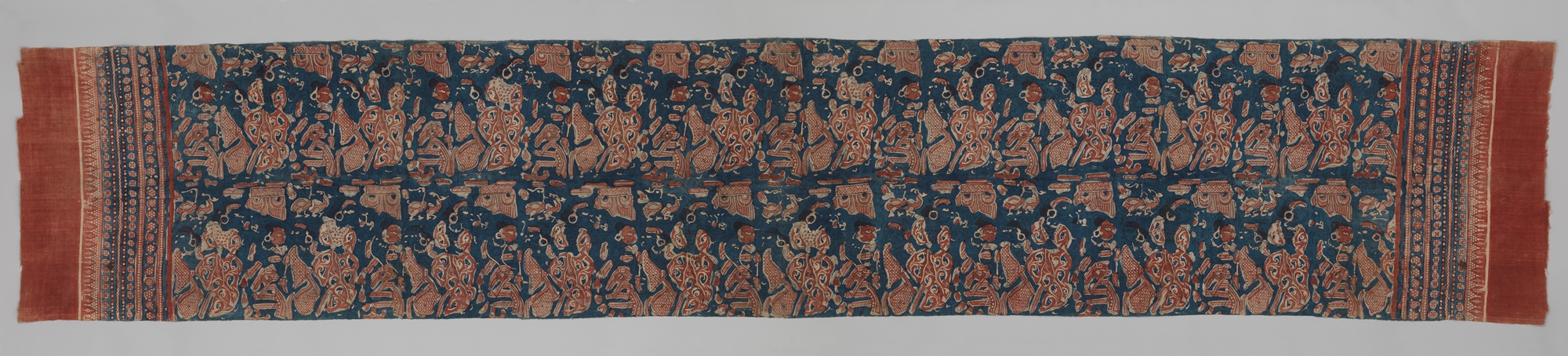
Strategic Heritage Analysis: Ceremonial Textile with Female Courtesans, Attendants, and Parrots
Introduction: The Textile as a Cultural Asset
The ceremonial textile from Gujarat, India, executed in plain-weave cotton with block-printed mordant and painted resist-dyed techniques, represents a pinnacle of pre-industrial craftsmanship and symbolic communication. Dated to the 18th or 19th century, this piece depicts female courtesans accompanied by attendants and parrots—a visual lexicon that transcends mere decoration. For Katherine Fashion Lab, this artifact offers a strategic reservoir of cultural capital, spiritual resonance, and historical adornment principles that can be translated into a 2026 high-end luxury narrative. This analysis examines the textile’s symbolic power, its role in historical adornment, its spiritual meaning, and a forward-looking luxury strategy that leverages its heritage without commodifying its sacredness.
Symbolic Power: The Courtesan as Sovereign of Desire and Status
In the cultural landscape of Gujarat, courtesans—known as tawaifs or devadasis—occupied a paradoxical position: they were both objects of aesthetic veneration and agents of social influence. The depiction of female courtesans on this ceremonial textile is not accidental but deliberate. These figures symbolize sovereignty over desire, economic independence, and cultural patronage. The courtesan in Indian tradition was often a connoisseur of music, dance, poetry, and textile arts, making her a living embodiment of refined taste. Her presence on a ceremonial cloth—likely used in weddings, religious processions, or courtly rituals—elevates the textile from a functional object to a talisman of power. The attendants reinforce her hierarchical status, while the parrots introduce a layer of symbolic complexity: in Indian iconography, parrots are associated with love, speech, and the divine messenger (often linked to the god Kama). Together, the courtesan and parrot form a dyad of allure and transcendence, positioning the textile as a mediator between earthly desire and spiritual aspiration.
Historical Adornment: Textile as Armor and Identity
The technical mastery of this textile—plain-weave cotton, mordant-dyed with block-printed and resist-painted elements—speaks to a sophisticated understanding of color, chemistry, and design. Historically, such textiles were not merely garments but extensions of the wearer’s identity. In Gujarat, block-printed cottons were traded across the Indian Ocean, influencing the aesthetics of Southeast Asia, the Middle East, and Europe. The courtesan motif, however, localizes this global commodity: it asserts a distinct regional identity. The use of mordants (alum, iron) to fix colors like madder red and indigo blue created a palette of permanence, symbolizing endurance and ritual purity. The resist-dye technique, where areas are painted with wax or clay to prevent color absorption, mirrors the courtesan’s role as a figure who simultaneously reveals and conceals—a strategy of adornment that Katherine Fashion Lab can reinterpret for modern luxury: adornment as a form of selective visibility. The textile’s composition—with the courtesan centrally positioned, flanked by attendants and parrots—creates a visual hierarchy that mirrors social structures, making it a document of power dynamics in pre-colonial Gujarat.
Spiritual Meaning: The Sacred and the Sensual in Dialogue
At first glance, the courtesan motif may seem secular, even profane. However, within the Hindu and Jain traditions of Gujarat, courtesans were often integrated into temple rituals as devadasis (servants of god). Their presence on a ceremonial textile thus carries profound spiritual meaning. The courtesan becomes a metaphor for the soul’s longing for the divine—a theme resonant in Bhakti poetry and Sufi mysticism. The parrot, as a creature capable of mimicry, symbolizes the devotee’s repetition of sacred names. The attendants, often depicted with offerings or musical instruments, suggest a ritual procession. This textile, therefore, is not a mere depiction of earthly pleasure but a visual meditation on the union of the human and the divine. The act of wearing or displaying such a cloth was believed to invoke blessings of fertility, prosperity, and spiritual grace. For Katherine Fashion Lab, this dualism—the sacred and the sensual—offers a powerful counter-narrative to the purely secular luxury of Western brands. It invites a luxury strategy that honors the spiritual dimension of adornment, positioning the wearer as a participant in a centuries-old dialogue between matter and meaning.
2026 High-End Luxury Strategy: Translating Heritage into Capital
To transform this heritage analysis into a viable 2026 strategy, Katherine Fashion Lab must adopt a curatorial approach to luxury—one that prioritizes narrative depth over surface aesthetics. The following strategic pillars emerge:
1. Symbolic Recontextualization
The courtesan motif should be abstracted into a visual language of empowerment. Rather than literal reproduction, the brand can use the parrot-and-courtesan dyad as a design code for limited-edition accessories (scarves, clutches, jewelry) that celebrate the courtesan as a symbol of autonomy and cultural patronage. This aligns with the 2026 luxury trend of narrative-driven exclusivity, where the story of the object is as valuable as the object itself.
2. Material Authenticity as Luxury
The textile’s mordant-dyed and resist-painted techniques are inherently sustainable—a key demand of the 2026 luxury consumer. Katherine Fashion Lab can partner with artisan cooperatives in Gujarat to produce a “Heritage Dye” capsule collection, using natural indigo and madder. The slow, labor-intensive process becomes a mark of luxury, akin to haute couture. Each piece would be accompanied by a digital provenance certificate detailing the symbolic meaning of its motifs, thereby creating an emotional premium.
3. Spiritual Experience as Brand Ecosystem
The sacred-sensual duality of the textile can be extended into a multisensory retail experience. For 2026, Katherine Fashion Lab could launch a flagship pop-up in Mumbai or London designed as a “ceremonial space,” where the textile’s motifs are reinterpreted through scent (sandalwood, rose), sound (classical Indian music), and tactile materials (block-printed silk, handwoven cotton). This transforms the purchase into a ritual of self-adornment, appealing to the growing demand for mindful luxury.
4. Strategic Storytelling and Collaboration
The brand should commission a heritage monograph in collaboration with textile historians from the Calico Museum of Textiles in Ahmedabad. This publication would serve as both a academic resource and a marketing tool, positioning Katherine Fashion Lab as a custodian of cultural heritage. Additionally, a co-created collection with a contemporary Indian artist (e.g., Bharti Kher or Nalini Malani) could reinterpret the courtesan motif, bridging historical symbolism with modern feminism.
5. Pricing and Positioning
The 2026 luxury consumer values intangible value—story, rarity, and ethical production. Katherine Fashion Lab should price the Heritage Dye capsule at a 40–60% premium over standard collections, justified by the artisan hours, material rarity, and narrative depth. The target audience is the “conscious connoisseur”: affluent, educated, and seeking brands that align with their values of cultural preservation and self-expression.
Conclusion: The Textile as a Living Archive
The ceremonial textile from Gujarat is not a relic but a living archive of symbolic power, historical adornment, and spiritual meaning. For Katherine Fashion Lab, it offers a strategic blueprint for a luxury that is both rooted and forward-looking. By honoring the courtesan as a figure of sovereignty, the parrot as a messenger of desire, and the textile as a vessel of ritual, the brand can craft a 2026 strategy that transcends fashion—becoming a cultural institution in its own right. The key is to approach this heritage not as a source of exoticism but as a source of wisdom: a reminder that true luxury has always been about meaning, not mere materiality.