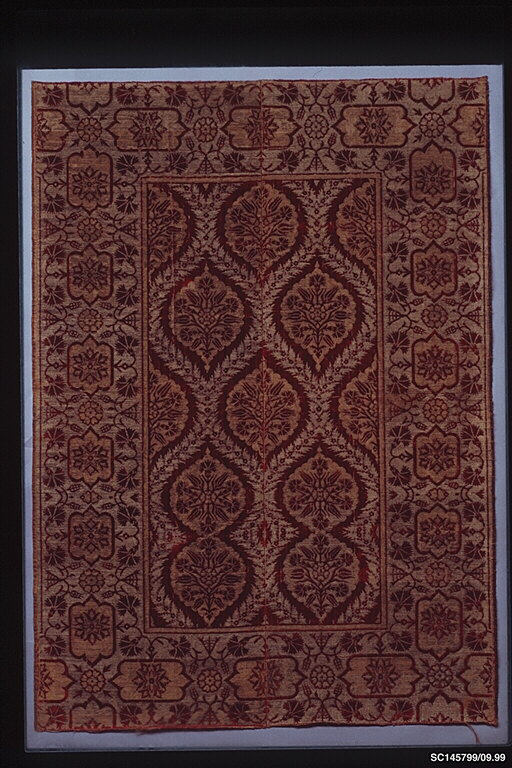
The Panel: A Tapestry of Global Heritage and Technical Mastery
In the rarefied world of haute couture, few objects command the same intellectual and aesthetic reverence as a standalone textile panel. At Katherine Fashion Lab, the subject of our current analysis—a panel constructed from silk, cotton, and metal-wrapped thread, employing the arcane techniques of cut and voided velvet, brocading, and intricate layering—transcends mere fabric. It is a narrative artifact, a dialogue between continents and centuries, and a testament to the enduring power of material storytelling. This piece, rooted in what we term “Global Heritage,” does not simply reference a single cultural lineage; it synthesizes them, forging a new lexicon of luxury that is both historically informed and avant-garde in its execution.
Material Alchemy: Silk, Cotton, and the Metallic Thread
The foundation of this panel is a masterclass in material selection. The silk base, a lustrous, tightly woven charmeuse, provides a luminous ground that catches light with a liquid, almost ethereal quality. This is not the silk of mass production; it is the silk of dynastic China, of the Byzantine court, of the Renaissance trade routes—a fiber that has historically signified status, ritual, and the sublime. Its inclusion immediately anchors the panel in a lineage of opulence. Yet, the designer’s choice to weave in cotton is a deliberate, subversive counterpoint. Cotton, the democratic fiber of global trade and colonial exchange, introduces a matte, grounded texture that tempers silk’s extravagance. This juxtaposition is not accidental; it speaks to a post-colonial consciousness, acknowledging that luxury is not monolithic but a composite of power, labor, and cultural exchange.
The metal-wrapped thread—likely a core of fine silk or polyester encased in silver or gold lamé—elevates the panel to a realm of sculptural brilliance. These threads are not merely decorative; they function as structural elements, creating a lattice of light and shadow. When brocaded into the fabric, they form raised, almost three-dimensional patterns that catch and reflect ambient light, creating a dynamic interplay between the matte cotton and the glossy silk. The metal thread also introduces a tactile dimension: the cool, smooth sensation against the skin contrasts with the soft, plush feel of the velvet, offering a multisensory experience that is rare in contemporary textile design.
Technical Virtuosity: Cut and Voided Velvet, Brocaded Precision
The panel’s technical execution is where Katherine Fashion Lab distinguishes itself from mere craft. The cut and voided velvet technique is a labor-intensive process that requires extraordinary precision. In this method, the velvet pile is selectively cut away—sheared to expose the underlying ground fabric—while other areas are left intact, creating a relief-like contrast between high-pile and flat surfaces. The “voided” areas, where the velvet is absent, reveal the silk base, allowing the metallic threads to shimmer unimpeded. This is not a simple pattern; it is a deliberate architectural manipulation of surface. The cut edges are sharp, almost surgical, suggesting a modern, minimalist sensibility, while the remaining velvet retains a soft, baroque lushness.
The brocaded elements further complicate the visual field. Brocading involves weaving supplementary weft threads—in this case, the metal-wrapped yarns—into the fabric to create raised, decorative motifs. Unlike embroidery, which is applied to the surface, brocading is integral to the weave, making the pattern inseparable from the fabric’s structure. The motifs here are abstract yet evocative: geometric interlocking circles that recall Islamic arabesques, stylized floral forms reminiscent of Mughal gardens, and sharp diagonal lines that suggest Art Deco angularity. These are not literal copies but hybridized forms, born from the designer’s deep study of global textile archives. The brocading is dense in some areas, creating a stiff, armor-like quality, and sparse in others, allowing the velvet to breathe. This variation in density creates a rhythm, a visual tempo that guides the eye across the panel.
Cultural Synthesis: A Global Heritage Deconstructed
The panel’s “Global Heritage” origin is not a passive label but an active design philosophy. It refuses to be pinned to a single geography. The voided velvet technique, for instance, has its roots in 15th-century Italian Renaissance workshops, particularly in Florence and Venice, where it was used to create ecclesiastical vestments and aristocratic gowns. Yet, the metallic brocading echoes the zari work of Indian brocades from the Mughal era, where gold and silver threads were woven into silk for courtly attire. The geometric precision of the cut patterns also whispers of Central Asian ikat and Persian kilim weaving, where repetition and negative space are paramount. By layering these references, the panel becomes a palimpsest of global textile history, each culture’s contribution visible yet transformed.
This synthesis is particularly potent in the context of a standalone study. Removed from the constraints of a garment—where drape, fit, and movement dictate form—the panel exists as a pure object of contemplation. It invites the viewer to read it as a text, decoding the cultural codes embedded in its threads. The cut and voided velvet becomes a metaphor for erasure and preservation: what is removed is as significant as what remains. The brocaded metal threads suggest the enduring value of cross-cultural exchange, even as they recall the violence of colonial appropriation. The designer, by acknowledging these tensions, transforms the panel into a site of critical reflection, not just aesthetic pleasure.
Contextual Resonance: The Standalone Study as a New Format
Presenting this panel as a standalone study—framed, mounted, or suspended—redefines its purpose. In the couture atelier, such textiles are typically destined for garments, but here, they are liberated from functional servitude. This format aligns with a growing trend in luxury fashion: the elevation of textile art to the status of fine art. The panel becomes a collectible object, akin to a painting or a sculpture, demanding the same reverence. Its scale—likely large enough to command a wall—forces the viewer to confront its materiality up close, to appreciate the microscopic precision of the cut velvet and the shimmer of each metallic thread.
For the connoisseur, this panel represents a pinnacle of technical mastery and conceptual depth. It is a testament to the atelier’s ability to honor tradition while subverting it, to weave a global narrative without falling into cultural cliché. The silk, cotton, and metal-wrapped thread are not just materials; they are actors in a story of human ingenuity and exchange. The cut and voided velvet, brocaded with precision, is a choreography of light and texture, a dance between history and modernity. In the quiet space of a standalone study, this panel speaks volumes—a silent, luxurious manifesto of what couture can be when it dares to think beyond the body.