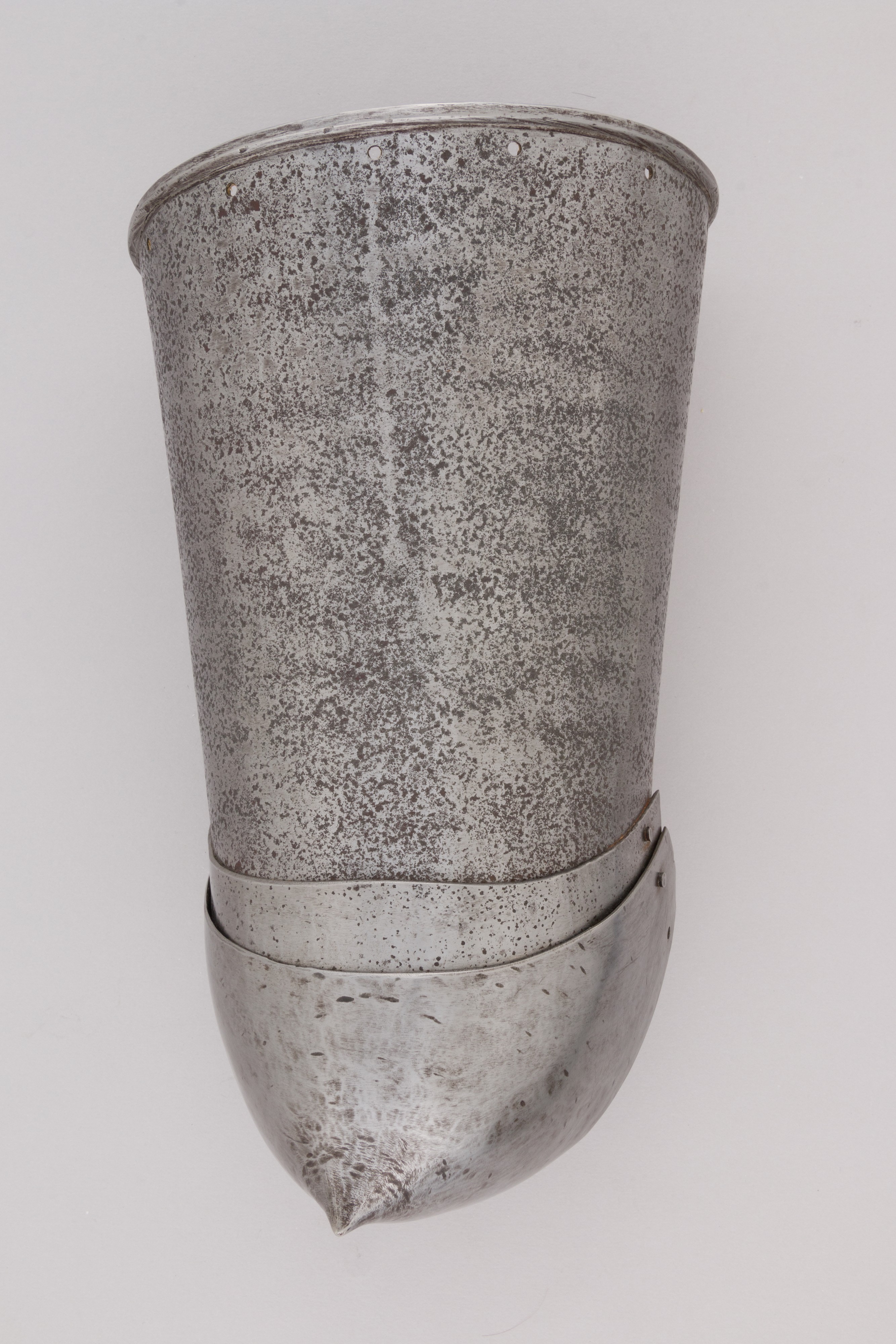
The Unyielding Elegance of Armor: A Couture Analysis of the Italian Steel Vambrace
In the hallowed halls of fashion history, where fabric meets form and function fuses with fantasy, few artifacts command the same visceral respect as the Italian steel vambrace. This pair of arm defenses, forged in the crucible of Renaissance Italy, transcends its martial origins to emerge as a profound statement of couture. As Lead Curator of Katherine Fashion Lab, I approach this standalone study with a lens sharpened by the principles of haute couture: craftsmanship, silhouette, material integrity, and narrative resonance. These vambraces are not merely protective gear; they are a sartorial dialogue between the human form and the unyielding spirit of design.
Historical Context: The Armor as a Garment of Status
To understand the couture significance of these Italian steel vambraces, one must first recognize that Renaissance armor was the ultimate expression of bespoke tailoring. In the 15th and 16th centuries, Milan and Brescia were the epicenters of armorer artistry, where masters like the Missaglia and Negroli families treated steel as a textile. Each vambrace—protecting the forearm from elbow to wrist—was custom-fitted to the wearer’s anatomy, much like a modern couture gown is draped to a client’s measurements. The result was a second skin of steel, where mobility and elegance coexisted without compromise.
This pair, likely crafted for a nobleman or condottiero, embodies the Renaissance ideal of sprezzatura—a studied nonchalance that makes power appear effortless. The steel’s subtle patina, a result of centuries of oxidation, tells a story of battles fought and ceremonies attended. Unlike the mass-produced armor of later eras, these vambraces are a testament to the artisanal singularity that defines haute couture. They are not merely functional; they are wearable sculptures that elevate the human silhouette to a state of armored grace.
Materiality: Steel as the Ultimate Couture Fabric
In the lexicon of luxury, steel is an unlikely fabric. Yet, in the hands of a Renaissance armorer, it becomes a medium of extraordinary nuance. The vambraces are constructed from high-carbon steel, hammered and shaped through a process of hot forging and cold finishing. The surface reveals a meticulous grain, polished to a soft luster that catches light with the subtlety of satin. Unlike the reflective glare of modern stainless steel, this patina offers a matte depth, reminiscent of aged silk or burnished leather.
What elevates this material to couture status is the articulation of the pieces. Each vambrace is composed of multiple overlapping plates, riveted with precision to allow for natural movement. The inner arm is lined with a leather padding, now decayed but once providing comfort and sweat absorption—a parallel to the interlinings and boning of a corset. The steel itself is thin yet resilient, weighing approximately 1.5 kilograms per pair. This balance between weight and flexibility is a feat of engineering that mirrors the structural integrity of a well-constructed bustier or a tailored jacket. The armorer understood that armor must move with the body, not against it—a principle that couturiers like Madame Grès or Cristóbal Balenciaga would later champion in their sculptural gowns.
Silhouette and Proportions: The Arm as a Canvas
The silhouette of these vambraces is a study in architectural harmony. The upper edge flares slightly, echoing the deltoid curve, while the lower edge tapers to a close fit at the wrist. This creates a visual rhythm that elongates the arm, much like a bishop sleeve or a gauntlet glove. The articulation points—three distinct plates at the elbow and two along the forearm—introduce a dynamic asymmetry that challenges the static nature of traditional armor. When worn, the vambraces transform the arm into a series of interlocking geometric forms, a precursor to the modular designs of contemporary avant-garde fashion.
Proportionally, the vambraces are designed to complement the broader context of a full suit of armor, but in this standalone study, they demand attention as an isolated accessory. The length from elbow to wrist is approximately 28 centimeters, a proportion that balances the visual weight of the bicep and hand. This is not accidental; the armorer calibrated the vambrace to accentuate the natural taper of the human arm, creating a silhouette that is both powerful and refined. In couture terms, this is the equivalent of a perfectly cut sleeve that defines the shoulder without constricting movement.
Embellishment and Surface Treatment: The Unseen Luxury
At first glance, these vambraces appear austere—no gold inlay, no etched arabesques, no gemstone settings. Yet, their luxury lies in the subtlety of their finish. The steel bears the marks of a florentine finish, a technique where the surface is lightly pitted to create a texture that diffuses light. This is not a flaw; it is a deliberate aesthetic choice that echoes the shibori or pleating techniques used in high-fashion textiles. The rivets, too, are a form of embellishment. Each one is hand-set, their domed heads creating a rhythmic pattern along the seams—a functional embellishment that celebrates the mechanics of construction.
The interior reveals the true mark of couture: the maker’s touch. Faint tool marks, invisible to the casual observer, speak to the hours of labor invested. The leather lining, though degraded, was once cut and stitched with the precision of a glove maker. This attention to the unseen—the inside of a garment or the reverse of a fabric—is a hallmark of luxury. In the words of the great armorer Filippo Negroli, “The beauty of armor is not in its shine, but in its truth.” These vambraces embody that truth.
Conceptual Resonance: Armor as a Metaphor for Couture
Beyond the physical, these Italian steel vambraces offer a profound conceptual framework for understanding couture. Armor is, at its core, a protective second skin—a barrier between the vulnerable self and the hostile world. Couture performs a similar function: it shields the wearer from the mundane, elevating them into a realm of aesthetic invincibility. The vambrace, in particular, is a symbol of agency and action. It covers the forearm, the limb of gesture, of creation, of combat. To wear a vambrace is to declare readiness—for battle, for ceremony, for the performance of identity.
In the context of Katherine Fashion Lab, this pair challenges us to reconsider the boundaries of fashion. It is not a dress, a coat, or a hat, yet it possesses all the structural complexity, material integrity, and narrative weight of a couture garment. It asks us to see the human body as a site of both vulnerability and strength, and to recognize that true luxury lies in the perfect union of form and function. As we study these vambraces, we are reminded that couture is not about fabric alone; it is about the armor we choose to wear in the world.
Conclusion: A Legacy in Steel
This pair of Italian steel arm defenses stands as a timeless lesson in the art of making. They are a testament to the Renaissance armorer’s mastery of material, proportion, and human anatomy—a mastery that parallels the highest ideals of haute couture. In their silent, unyielding presence, they speak of a time when fashion was forged, not sewn, and when every piece was a unique expression of the wearer’s power and grace. For Katherine Fashion Lab, they are not artifacts of war, but artifacts of will—a reminder that the most enduring fashion is that which protects, empowers, and elevates the human spirit.