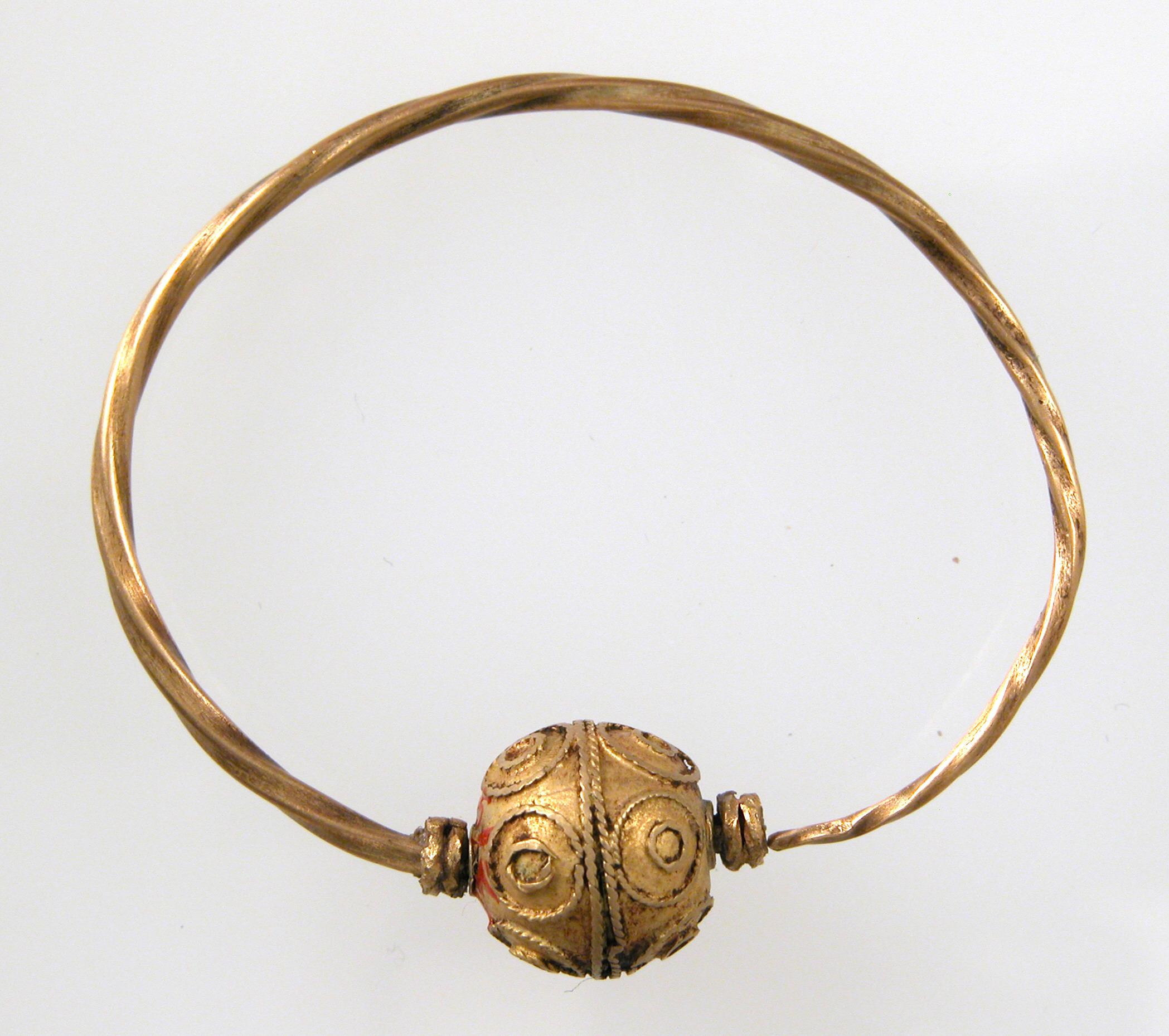
Langobardic Gold: From Warrior's Adornment to Luxury's Archetype
The Langobardic earring, a singular artifact wrought in gold, transcends its primary function as personal adornment to become a dense nexus of cultural identity, spiritual belief, and social power. For Katherine Fashion Lab, this object is not merely a relic but a resonant archetype, its symbolic DNA deeply correlating with our ongoing study, Mirror with Split-Leaf. That study contemplates the duality of presentation: the polished, idealized reflection versus the enduring, narrative-laden stone. The Langobardic earring exists precisely within this dialectic. It is both a mirror of status, crafted to reflect light and authority on the living wearer, and a narrative浮雕, a carved story interred with the dead, speaking of lineage, protection, and the journey beyond. This analysis decodes the earring's historical and symbolic lexicon to inform a forward-looking luxury strategy for 2026, transforming archaeological insight into contemporary desirability.
Decoding the Symbolic Power of the Langobardic Hoop
Emerging from the migratory crucible of the Early Middle Ages, the Langobards—a Germanic people who established a kingdom in Italy—used gold not as mere currency but as a primary medium for encoding their worldview. Their earrings, typically crafted from solid gold wires or sheets, often in hoop or crescent forms, were far more than decorative items. They were instruments of symbolic power. In a society where warrior aristocracy dominated, gold signified martial success, tributes, and spoils of conquest. Wearing substantial gold earrings was a direct, corporeal display of one's rank and valor. For women, these pieces often formed part of the parure (a matched suite), denoting familial wealth and high-status marriage alliances. The earring’s circular form itself held profound meaning, symbolizing eternity, cosmic cycles, and protection—a sacred geometry worn upon the body.
The spiritual meaning is equally potent. Langobardic art, including metalwork, is characterized by stylized animal motifs (zoomorphs) and intricate geometric interlace. These were not arbitrary designs but protective sigils. Creatures like birds or serpents could represent soul guides or chthonic powers, while interlacing patterns, perhaps echoing the Split-Leaf motif's complexity, were believed to ward off evil by confusing malignant spirits. The earring, positioned at the head's threshold, thus functioned as an amulet—a guardian for both the physical and metaphysical self. This transforms the object from accessory to talisman, a concept with immense resonance in modern luxury, where consumers seek objects with narrative and perceived intrinsic power.
Historical Adornment as a Framework for Contemporary Craft
The Langobardic approach to historical adornment provides a masterclass in material intentionality and symbolic communication. Their goldwork, while sometimes less technically refined than Byzantine or Roman pieces, possesses a raw, potent energy. The value was in the material's purity and mass, and in the unmistakable clarity of its symbols. This aligns with Katherine Fashion Lab’s exploration of duality: the Mirror with Split-Leaf contrasts a refined, precious surface with a deeper, carved narrative. Similarly, a Langobardic earring presents a polished, golden surface to the world—a mirror of status—while its iconography holds a colder, harder, more ancient story, like the stone relief.
For contemporary craft, this suggests a strategy moving beyond superficial historical revival. It calls for a methodology where material choice (the uncompromising use of high-carat gold) is non-negotiable, echoing Langobardic material sincerity. Form must follow symbolic function: a hoop is never just a hoop but a representation of continuity; a clasp is not merely a fastener but a symbolic juncture. Surface decoration, whether through granulation, filigree, or intaglio, must carry meaning, perhaps abstracting the zoomorphic interlace into modern glyphs that speak of protection, journey, and identity. The weight and physical presence of the piece on the wearer—a crucial aspect of historical adornment—must be recalibrated for modern comfort without sacrificing the sense of substance and consequence.
Strategic Integration: The 2026 High-End Luxury Archetype
Translating this heritage into a 2026 high-end luxury strategy requires operating at the intersection of archaeology and avant-garde desire. The market is increasingly driven by connoisseurship, intellectual engagement, and a quest for authenticity and rarity. Katherine Fashion Lab’s 2026 collection, informed by this research, should position itself not as "inspired by" but as a continuation of a symbolic lineage.
The core strategy rests on three pillars: Archetype, Amulet, and Archive. First, present the earring as a modern archetype. Develop a signature silhouette—a "Langobardic Hoop"—that is immediately identifiable, leveraging the primal power of the circle but refined to an architectural purity. Second, activate the amulet narrative. Each piece should be accompanied by a "Symbol Key," decrypting the design elements (e.g., "this knot pattern derives from Lombard border motifs, symbolizing safe passage"). This transforms the client into an initiate, wearing not just jewelry but a personal mythology. Third, embody the archive through material and craft storytelling. Utilize 22-karat gold to connect to historical material truth, and employ techniques like lost-wax casting or hand-chasing to introduce a palpable, human trace, contrasting with polished surfaces—the very Mirror with Split-Leaf duality.
Commercial execution should focus on ultra-limited editions or a permanent "Heritage Code" line within the collection. Marketing must be pedagogical, leveraging white papers, curator-led salons, and content that explores the Langobardic world and the Mirror with Split-Leaf study. Collaborations with historical institutions for capsule collections could cement authority. The price point must reflect not only the material but also the intensive research and symbolic depth, appealing to the luxury consumer who buys cultural capital and a timeless narrative, not just a seasonal trend.
In conclusion, the Langobardic gold earring offers Katherine Fashion Lab a profound blueprint. It teaches that true luxury is forged where material integrity, layered symbolism, and personal talismanic power converge. By interpreting its historical resonance—the duality of gleaming mirror and narrative stone—we can craft a 2026 strategy that answers the modern demand for meaning, offering not mere earrings, but wearable legacies that speak to both the past and the perpetual self.