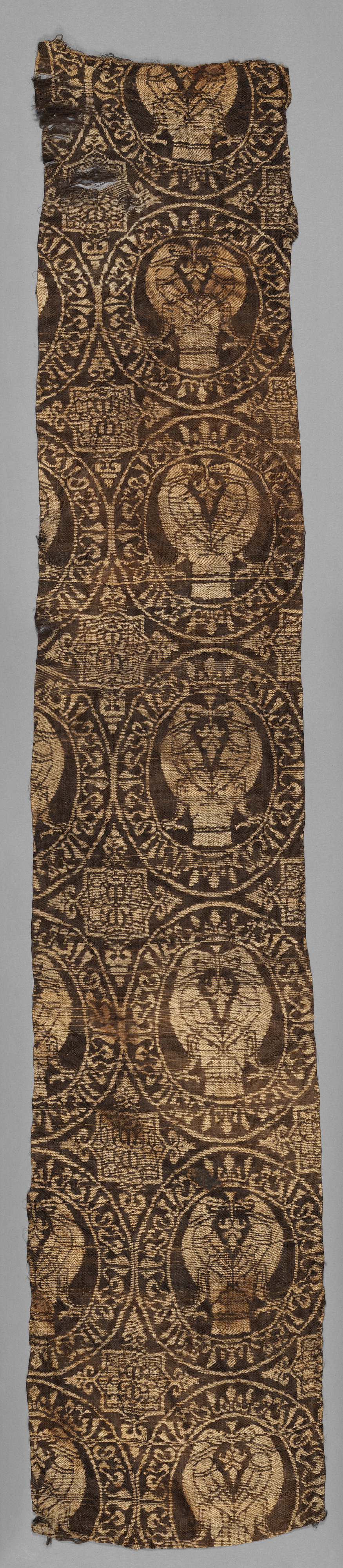
The Weft of Worlds: A Couture Analysis of the Lampas Fragment and Case
Introduction: The Textile as a Silent Archive
In the rarefied domain of haute couture, the study of historical textiles transcends mere antiquarian curiosity. For Katherine Fashion Lab, the Lampas Fragment and Case—a silk artifact of global heritage, examined as a standalone study—offers a profound lexicon of design, craftsmanship, and cultural memory. Lampas, a technique of intricate weft-faced patterning, emerged as a hallmark of luxury across Eurasian trade routes, from Byzantine workshops to Safavid looms and later European manufactories. This analysis dissects the fragment’s structural, aesthetic, and symbolic dimensions, arguing that it embodies a silent narrative of cross-cultural exchange, technological mastery, and enduring relevance for contemporary couture. By deconstructing its materiality and context, we uncover principles that inform modern draping, pattern-making, and brand storytelling.
Materiality and Technique: The Silk of Sovereignty
Silk has long been the fiber of empires—a material synonymous with power, labor, and artistry. The Lampas Fragment, woven in a compound structure, employs a warp of fine, tightly twisted silk and a weft of thicker, untwisted silk that floats across the surface to create raised, lustrous patterns. This technique, known as lampas weaving, involves a primary warp and weft for the ground fabric, with a secondary weft that interlocks only at specific intervals, allowing the design to emerge in relief. The result is a fabric that is both structurally robust and visually sumptuous, with a tactile depth that invites touch—a quality that couturiers prize for its ability to transform silhouette and movement.
The fragment’s palette, preserved through centuries, likely features crimson, gold, and deep indigo—hues derived from kermes insects, saffron, and woad. These colors were not merely decorative; they signaled status and origin. Crimson, for instance, was a monopoly of Byzantine and later Ottoman workshops, while gold threads (often silk wrapped in gilded silver) denoted royal or ecclesiastical patronage. In a standalone study, the absence of a complete garment forces us to focus on the micro-architecture of the weave: each thread is a carrier of cultural DNA, from the sericulture of China to the dyeing traditions of the Mediterranean.
Pattern and Symbolism: The Language of the Loom
The fragment’s design—whether floral, geometric, or figural—serves as a visual lexicon of global heritage. Lampas patterns from the 14th to 17th centuries often hybridized motifs: Chinese dragons intertwined with Persian arabesques, or Italian pomegranates rendered in Ottoman symmetry. This syncretism is not accidental; it reflects the mobility of artisans along the Silk Road and the voracious appetite of courts for exoticism. For Katherine Fashion Lab, analyzing such patterns offers a masterclass in motif adaptation. The repetition of a single floral spray, for example, can be scaled, mirrored, or rotated to create a rhythmic composition that guides the eye—a principle directly applicable to contemporary print design and embroidery placement.
Consider the case that accompanies the fragment. Often, these cases were utilitarian yet ornate, designed to protect the textile during travel or storage. Their construction—stitched with silk thread, lined with linen, and sometimes embroidered with matching motifs—reveals a holistic approach to preservation. In couture, the case becomes a metaphor for archival thinking: how do we protect and present heritage materials in a way that honors their integrity while allowing for reinterpretation? The fragment and its case together demonstrate that context is not merely physical but conceptual—a lesson for designers curating capsule collections or heritage-inspired lines.
Global Heritage and the Couture Dialogue
To label this fragment as “global heritage” is to acknowledge that its origins are not singular but plural. Silk was first domesticated in China, but lampas weaving flourished in Persia and later in Italy, where Lucchese and Venetian looms produced fabrics for European aristocracy. The fragment may have traveled from a Safavid workshop to a French court, or from a Byzantine monastery to an Ottoman palace. This deterritorialized identity challenges the notion of cultural ownership in fashion. Instead, it invites a dialogical approach: how can contemporary couture engage with such artifacts without appropriation? The answer lies in transparency—acknowledging the lineage of techniques and materials, and using them as a springboard for innovation rather than replication.
For Katherine Fashion Lab, this fragment becomes a pedagogical tool. Its study encourages designers to look beyond seasonal trends and toward the longue durée of textile history. The lampas technique, for instance, can inform modern jacquard weaving, while its color palette inspires dyeing processes that prioritize natural pigments. The fragment’s standalone status—removed from its original garment—allows for a pure focus on craft, free from the distractions of silhouette or function. This is a luxury in itself: the ability to contemplate the thread as a sovereign entity.
Structural Analysis: Weave, Weight, and Wear
A technical deconstruction of the fragment reveals its engineering for endurance. The lampas weave typically employs a 5-end satin ground, which provides a smooth, reflective surface, while the pattern wefts are bound in a twill or tabby structure. This dual system creates a fabric that is dense yet supple—ideal for garments that require drape without sagging. The fragment’s weight, likely between 200 and 300 grams per square meter, suggests it was used for outerwear or ceremonial vestments, where the fabric’s body could hold shape. Wear patterns—frayed edges, faded highlights, and subtle creases—offer clues about its past use. A crease at a 45-degree angle might indicate a sleeve fold, while uneven fading suggests exposure to light on one side, perhaps from a window or altar.
This forensic analysis is directly transferable to couture construction. Understanding how a fabric behaves under stress informs pattern cutting, seam allowance, and lining selection. For instance, a lampas fragment’s tendency to ravel at the edges would necessitate a French seam or Hong Kong finish in a modern garment, preserving the integrity of the weave. The case, often padded with cotton or wool, teaches us about interfacing and structure—how to support a textile without compromising its hand.
Couture Implications: From Archive to Atelier
The standalone study of the Lampas Fragment and Case yields actionable insights for the Katherine Fashion Lab atelier. First, material sourcing: the fragment validates the use of pure silk and natural dyes in high-end production, aligning with sustainability trends that reject synthetic substitutes. Second, pattern development: the fragment’s repeating motifs can be adapted for digital jacquard looms, allowing for limited-edition runs that honor historical precision. Third, narrative design: the fragment’s journey—from raw silk to woven artifact to archival object—can be woven into a brand’s story, offering consumers a sense of cultural continuity and exclusivity.
Moreover, the fragment challenges the fast-fashion paradigm of disposability. Its survival for centuries underscores the value of craftsmanship over volume. For a couture house, this translates into collections that prioritize heirloom quality, where each piece is designed to be passed down. The case, as an accessory, suggests that packaging and preservation are integral to luxury—a lesson for limited-edition launches and bespoke commissions.
Conclusion: Weaving Past and Future
The Lampas Fragment and Case is far more than a relic; it is a textile manifesto. In its threads, we read the ambitions of empires, the ingenuity of artisans, and the enduring allure of silk. For Katherine Fashion Lab, this standalone study reaffirms that couture is not a break from history but a continuation of it. By deconstructing the fragment’s technique, symbolism, and materiality, we equip ourselves with a vocabulary of excellence that transcends time. The lampas weaver’s hand, though long still, guides our own—reminding us that in every stitch lies a story, and in every story, a world. The fragment, preserved in its case, waits not for replication but for revelation—a silent teacher in the atelier of the future.