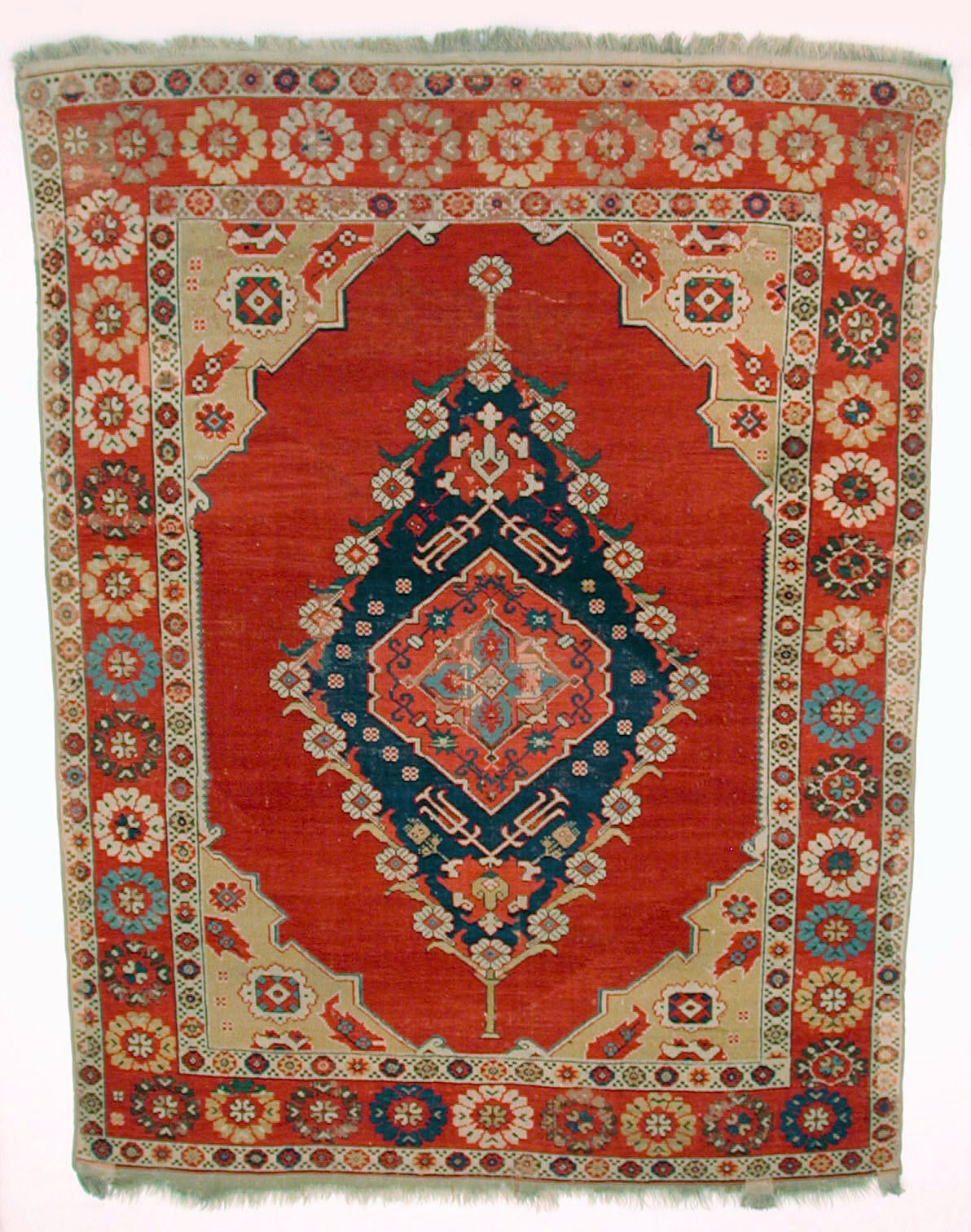
Heritage Analysis: The 'Transylvanian' Carpet
Symbolic Power and Historical Adornment
The 'Transylvanian' carpet, a misnomer rooted in 19th-century European collecting practices, represents a pinnacle of ancient weaving artistry. Despite its name, this carpet originates not from the Carpathian basin but from the ancient civilizations of Anatolia and Persia, dating to the 15th–17th centuries. Its wool medium—warp, weft, and symmetrically knotted pile—embodies a technological and symbolic sophistication that transcends mere floor covering. In its original context, the carpet functioned as a portable sanctum, a marker of status, and a conduit for spiritual protection. The symmetrically knotted pile, known as Turkish knot, ensured durability and precision, allowing for intricate geometric and floral motifs that communicated cosmological order.
Historically, these carpets adorned the courts of Ottoman sultans, Safavid shahs, and, later, the churches and castles of Transylvanian nobility. Their presence in Eastern European Gothic and Renaissance interiors signified a cross-cultural exchange of luxury and power. The carpet’s symbolic power lies in its ability to encode divine geometry: repeating stars, octagons, and medallions represent celestial bodies and the eternal cycle of life. The wool, sourced from mountain flocks, was dyed with natural pigments—madder red, indigo blue, and saffron yellow—each hue carrying spiritual resonance. Red symbolized life force and protection; blue, heaven and truth; yellow, divine light. Thus, the 'Transylvanian' carpet was not merely an object of adornment but a woven talisman, grounding the home or sacred space in cosmic harmony.
Spiritual Meaning and Cultural Resonance
The spiritual meaning of the 'Transylvanian' carpet is deeply embedded in its design lexicon. Ancient weavers imbued their creations with protective symbolism against evil forces. The elibelinde (hand-on-hip) motif, often found in borders, represents fertility and motherhood. The göz (eye) pattern wards off the nazar (evil eye). The central medallion, often a star or sunburst, symbolizes the axis mundi—the connection between earth and the divine. In Islamic mysticism, the carpet’s geometric precision mirrors the unity of existence, where each knot is a prayer, and the entire piece is a map of the soul’s journey toward enlightenment.
In Transylvanian churches, these carpets were hung on walls or draped over pews, transforming them into sacred textiles. They were not walked upon but revered as icons, akin to religious paintings. This practice highlights a critical shift in cultural resonance: from utilitarian object to ceremonial artifact. The carpets became symbols of wealth, piety, and transcontinental connection, linking the Ottoman East with the Christian West. Their spiritual meaning thus evolved from Islamic cosmology to a hybrid sacred ornament, embodying both the artisan’s devotion and the patron’s prestige.
2026 High-End Luxury Strategy: A Heritage-Driven Approach
For Katherine Fashion Lab, the 'Transylvanian' carpet offers a strategic blueprint for 2026 high-end luxury positioning. The modern luxury consumer seeks authenticity, narrative depth, and spiritual resonance. The carpet’s heritage provides a compelling story of cross-cultural exchange, artisanal mastery, and symbolic protection. To leverage this, the brand must adopt a three-pronged strategy: Heritage Curation, Material Innovation, and Experiential Storytelling.
Heritage Curation: Position the carpet as a limited-edition collectible, not a mass-produced commodity. Each piece should be accompanied by a provenance dossier detailing its design origins, symbolic motifs, and historical journey. Collaborate with museum curators and textile historians to authenticate and interpret the carpet’s cultural significance. This elevates the object from decoration to investment-grade art, appealing to connoisseurs who value rarity and intellectual depth.
Material Innovation: Reinterpret the carpet’s ancient wool medium through sustainable, high-performance luxury standards. Source wool from ethical, heritage breeds (e.g., Karakul or Merino) and use natural dyes from historical recipes. Incorporate modern technology—such as antimicrobial treatments or modular weaving—without compromising traditional craftsmanship. The symmetrical knotting technique can be adapted for contemporary interiors, offering bespoke sizing and color palettes while preserving the original geometric integrity. This fusion of old and new positions the carpet as a timeless luxury asset.
Experiential Storytelling: Create immersive brand experiences that connect consumers to the carpet’s spiritual and historical roots. Host curated exhibitions in flagship stores, featuring virtual reality reconstructions of ancient weaving workshops or Transylvanian churches adorned with these carpets. Offer private consultations where clients learn the symbolism of each motif and choose custom elements that align with their personal narratives (e.g., protection, prosperity, or legacy). Develop a digital archive—a password-protected platform where owners can trace their carpet’s provenance, view restoration guides, and access exclusive content on ancient symbolism.
The 2026 luxury market will demand emotional and spiritual value alongside aesthetic excellence. By positioning the 'Transylvanian' carpet as a heritage object with protective power, Katherine Fashion Lab can differentiate itself in a saturated market. The carpet becomes a status symbol of cultural fluency, not mere wealth. It appeals to the discerning global elite who seek to own pieces that tell a story of human connection, sacred geometry, and artisanal resilience.
Conclusion: Strategic Implications for Katherine Fashion Lab
The 'Transylvanian' carpet is more than an artifact; it is a strategic asset for high-end luxury positioning. Its symbolic power, historical adornment, and spiritual meaning provide a rich narrative that resonates with contemporary luxury consumers. By curating, innovating, and storytelling around this heritage, Katherine Fashion Lab can create a distinctive brand identity rooted in authenticity, craftsmanship, and cosmic symbolism. The 2026 strategy must prioritize exclusivity, education, and emotional connection, transforming the carpet from a floor covering into a sacred legacy. In doing so, the brand not only honors the ancient weavers but also secures its place as a leader in heritage-driven luxury.