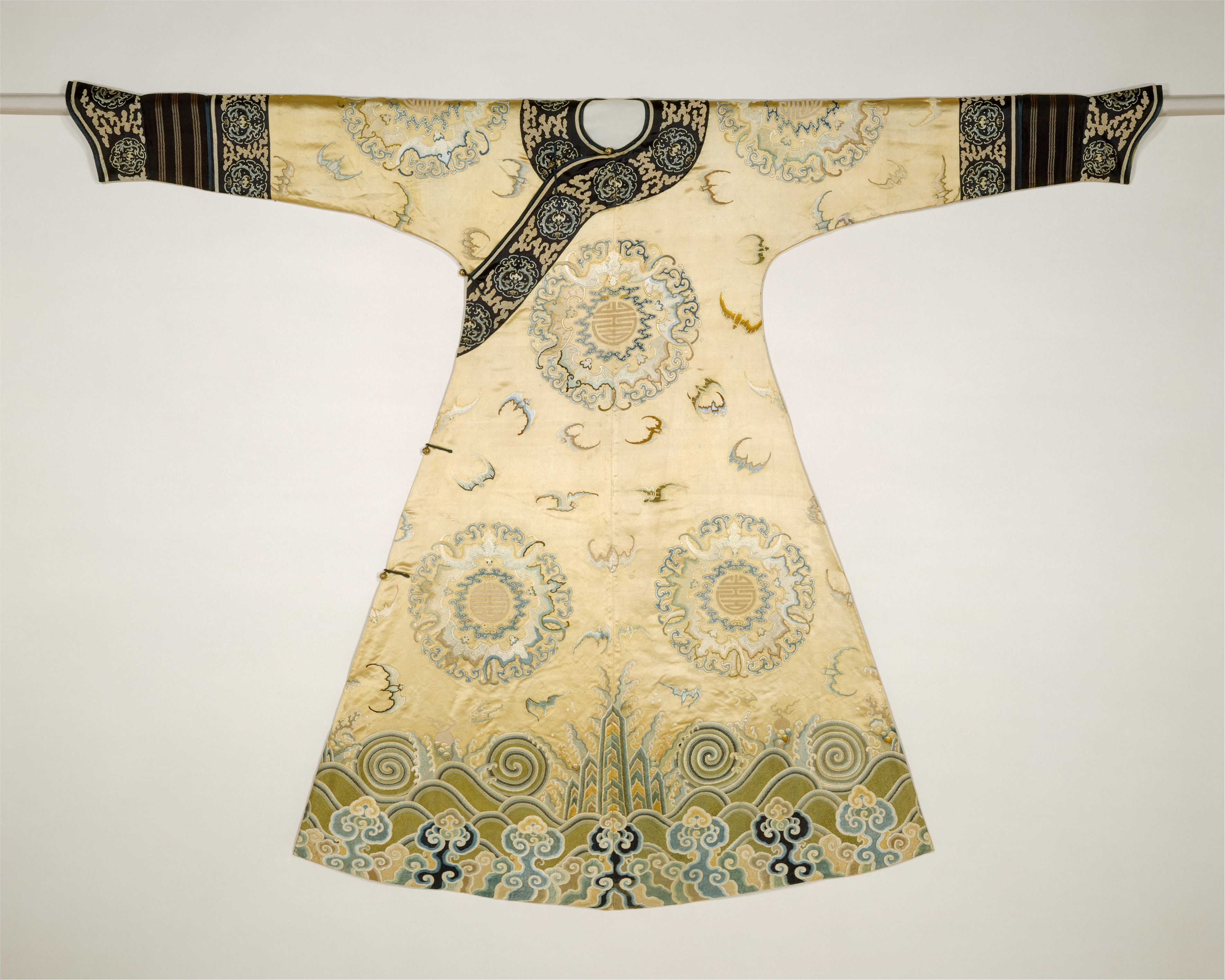
The Ceremonial Robe: A Study in Silk, Symbolism, and Sartorial Sovereignty
In the rarefied domain of haute couture, few garments command the gravitas of a ceremonial robe. At Katherine Fashion Lab, our curatorial lens is fixed upon a singular artifact: a woman’s ceremonial robe from China, meticulously crafted from silk satin and adorned with intricate metallic thread embroidery. This is not merely a garment; it is a cartography of cultural memory, a testament to artisanal virtuosity, and a dialogue between tradition and the contemporary luxury market. As a standalone study, this robe invites us to dissect its materiality, semiotics, and commercial resonance within the global fashion ecosystem.
Material Elegance: The Foundation of Luxury
The robe’s primary fabric—silk satin—establishes an immediate lexicon of opulence. Silk, historically synonymous with Chinese imperial power and trade, remains a benchmark for luxury textiles due to its unparalleled luster, drape, and tactile softness. Satin weave, with its high thread count and glossy face, amplifies the fabric’s ability to reflect light, creating a shifting play of shadows that mimics the fluidity of water or the sheen of precious metal. This choice is deliberate: silk satin not only elevates the garment’s aesthetic but also signals a lineage of craftsmanship that dates back millennia. The weight and hand feel of the satin suggest a medium-to-heavy grade, ideal for structured yet flowing silhouettes that command presence without sacrificing movement.
The metallic thread embroidery introduces a second layer of material complexity. Composed of fine strands of silk wrapped in gold or silver alloy, these threads are painstakingly hand-stitched onto the satin base. The technique, often referred to as “golden thread embroidery” or “jin xiu” in Chinese textile traditions, requires a mastery of tension and precision to prevent fraying or distortion. The metallic elements catch and refract light differently than the satin, creating a dynamic visual texture that shifts with the observer’s angle. This interplay is not accidental; it is a calculated design strategy to evoke notions of divinity, wealth, and eternal splendor—qualities historically reserved for imperial courts and religious ceremonies.
Symbolic Lexicon: Decoding the Embroidery
Beyond material, the robe’s embroidery serves as a visual narrative. While the specific motifs are not detailed in this study, traditional Chinese ceremonial robes often feature dragons, phoenixes, peonies, or clouds—each laden with meaning. Dragons symbolize imperial authority and cosmic power; phoenixes represent grace and renewal; peonies denote wealth and honor; clouds signify transcendence and the celestial realm. The metallic thread elevates these symbols from mere decoration to talismanic emblems, reinforcing the robe’s role as a conduit for status and spiritual protection.
The placement of these motifs is equally deliberate. Typically, a ceremonial robe’s embroidery concentrates on the chest, shoulders, and hem—zones that frame the wearer’s face and movements. This strategic positioning ensures that the symbolism is immediately legible to an audience, transforming the garment into a wearable declaration of identity. For the modern collector or couture client, this semiotic density offers a form of cultural capital: wearing the robe signals not only aesthetic discernment but also an appreciation for historical depth and cross-cultural dialogue.
Artisanal Provenance: The Human Hand as Luxury
In an era of mass production, the handcrafted nature of this robe constitutes its most valuable asset. Each stitch of metallic thread represents hours of labor by a master embroiderer—a skill increasingly rare and thus highly coveted. The embroidery’s density and complexity suggest a timeline of weeks or even months, a fact that imbues the garment with an intangible aura of dedication and time. This aligns with the contemporary luxury market’s pivot toward “slow fashion” and “artisanality,” where consumers seek authenticity and narrative over speed and volume.
Katherine Fashion Lab’s curation of this robe as a standalone study underscores its role as an object of connoisseurship. Unlike a ready-to-wear piece, this ceremonial robe is not intended for daily wear but for moments of profound significance—weddings, rites of passage, or ceremonial gatherings. Its preservation requires specialized care: controlled humidity, minimal light exposure, and acid-free storage. This fragility enhances its exclusivity, positioning it as an heirloom rather than a commodity. For the luxury client, owning such a piece is an investment in cultural legacy and artistic preservation.
Commercial and Cultural Resonance in the Global Arena
The robe’s provenance—China—adds a layer of geopolitical and cultural significance. As China’s luxury market continues to expand, with consumers increasingly valuing heritage craftsmanship, this garment serves as a bridge between tradition and modernity. It speaks to a global audience that seeks “cultural authenticity” in luxury goods, a trend that has propelled brands like Guo Pei and Laurence Xu to international acclaim. However, the robe’s ceremonial nature also raises questions about appropriation versus appreciation. Katherine Fashion Lab’s role as a curator must navigate this tension by contextualizing the robe within its original cultural framework—highlighting its use in specific rituals, its regional variations, and its evolution over centuries—rather than presenting it as a mere exotic artifact.
From a market perspective, the robe’s value is determined by a confluence of factors: material rarity (high-grade silk and metallic thread), craftsmanship (hand-embroidery by a recognized atelier), condition (minimal wear, intact stitching), and provenance (documented history of ownership or exhibition). In auction houses or private sales, such a piece could command five to six figures, depending on these variables. For Katherine Fashion Lab, positioning this robe as a standalone study allows for a focused narrative that educates clients on these valuation criteria, elevating their understanding beyond superficial aesthetics to informed investment.
Conclusion: The Robe as a Living Archive
This woman’s ceremonial robe is more than a sum of its parts—silk, metallic thread, embroidery, and silhouette. It is a living archive of Chinese cultural memory, a testament to the enduring power of handcraft, and a strategic asset in the luxury market’s quest for meaning. At Katherine Fashion Lab, we view this garment through a dual lens: as an object of aesthetic wonder and as a pedagogical tool for understanding the intersection of tradition, commerce, and identity. To wear or own such a robe is to participate in a centuries-old conversation about power, beauty, and the human desire to transcend the ordinary. In a world of fast fashion and fleeting trends, this robe stands as a quiet, luminous rebuttal—a reminder that true luxury is not consumed but inherited.