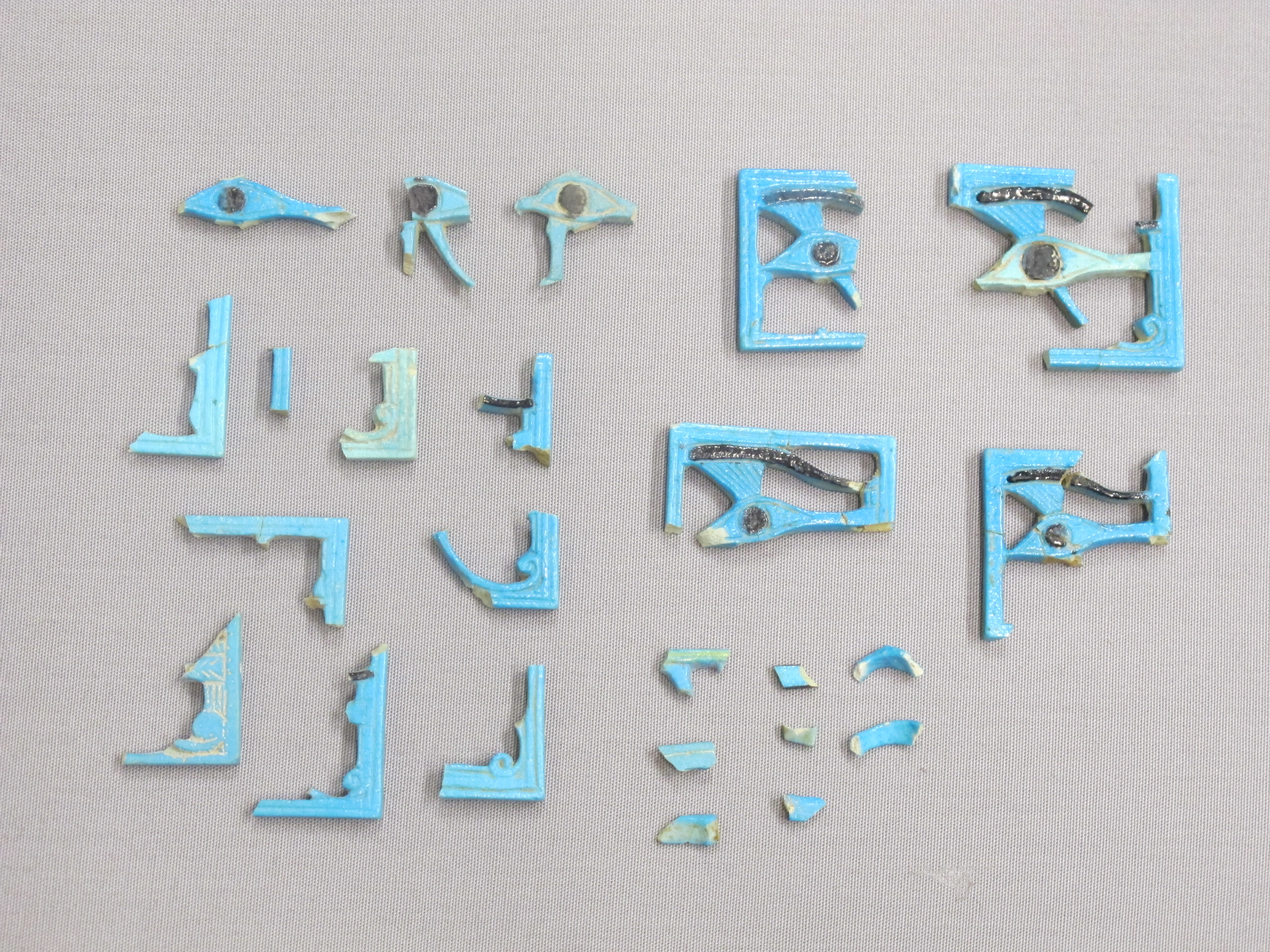
Strategic Heritage Analysis: The Wedjat Eye Amulet as a Foundational Code for Katherine Fashion Lab
This strategic standalone research paper examines fragmented wedjat eye amulets from ancient Egyptian civilization, crafted in faience, as a profound source of symbolic capital for Katherine Fashion Lab. Moving beyond superficial aesthetic appropriation, this analysis deconstructs the artifact’s intrinsic values to architect a legitimate and potent heritage narrative. The objective is to translate millennia-old principles of protection, wholeness, and spiritual authority into a coherent 2026 high-end luxury strategy, establishing an immutable brand code rooted in authenticated cultural symbolism rather than transient trend.
Deconstructing the Artifact: Symbolic Power and Historical Adornment
The wedjat eye, or Eye of Horus, is not merely an icon but a complex semiotic system. As a faience amulet, its materiality is the first layer of meaning. Faience, a sintered-quartz ceramic with a vitreous glaze, was revered not for its monetary value but for its luminous, symbolic properties. Its shimmering blue-green hue evoked the life-giving waters of the Nile and the fertile heavens, making it a substance of creation and rebirth. The choice of faience over gold signals that the amulet’s power was inherent, not contingent on precious metal value—a crucial distinction for a luxury brand seeking depth.
The amulet’s function was multifaceted: a protective talisman, a medical symbol for healing, and a guarantee of spiritual integrity. It represented the eye of the falcon-god Horus, wounded in battle and restored by the god Thoth, thus embodying the concepts of sacrifice, restoration, and made-whole-again perfection. This narrative of fragmentation and subsequent, divine reassembly is critically relevant. The fragments in our study are not failures; they are testaments to a cycle of damage and repair, loss and recovery. In historical adornment, these amulets were worn by all strata of society, from pharaohs to commoners, integrated into jewelry, sewn onto garments, and placed within mummy wrappings. This universal appeal across social hierarchies speaks to a democratization of spiritual protection, a concept that can be translated into a luxury strategy addressing both exclusivity and universal aspiration.
Spiritual Meaning and the Modern Psyche: From Amulet to Emotional Architecture
The core spiritual meaning of the wedjat eye operates on three levels that resonate powerfully with the contemporary luxury consumer. First is Protection: In an era of digital exposure and constant scrutiny, the desire for a personal, symbolic shield is acute. The amulet serves as an ancient analog for modern anxieties. Second is Wholeness: The myth of restoration addresses a fragmented postmodern identity. Luxury is increasingly framed as a pursuit of completeness—wellness, self-actualization, and curated authenticity. The wedjat eye becomes a metaphor for the integration of self. Third is Royal Authority & Divine Favor: It channels the sovereignty of Horus and the favor of the gods. In modern terms, this translates to self-empowerment, agency, and a sense of destined success—key emotional drivers for the high-net-worth individual.
For Katherine Fashion Lab, the fragment is the key. A complete eye is a closed symbol; a fragment is an invitation. It suggests a story still unfolding, a piece of a larger, personal mythology that the wearer completes. This aligns with the modern luxury paradigm where the consumer is a co-creator of meaning. The fragment is not broken; it is activated, requiring the wearer’s narrative to restore its symbolic power.
2026 High-End Luxury Strategy: The Fragment as Foundational Code
By 2026, luxury will be defined by radical authenticity, intellectual heritage, and personalized symbolism. Katherine Fashion Lab’s strategy, derived from this analysis, must be the systematic integration of the wedjat fragment as a living code, not a seasonal motif.
Strategic Pillar 1: The Iconography of Integrity
Design language must treat the fragment with archaeological rigor, not decorative whimsy. This means:
Material Innovation: Develop a proprietary "Katherine Faience"—a modern composite with crushed quartz, ceramic, and sustainable luminous glaze, patenting its texture and spectral quality. This creates tangible heritage through material science.
Asymmetric Integration: Fragments appear as deliberate, unfinished elements: a clasp on a cashmere cape, the heel of a leather boot, the pivot point on a minimalist watch. Their placement should feel discovered, not applied.
Strategic Pillar 2: Narrative Adornment and Client Journey
Each piece containing the fragment code is accompanied by a "Cartouche Certificate," detailing the symbolic attributes (e.g., "This fragment aligns with the 1/64th portion of the wedjat, representing Thoth’s magic of healing"). The atelier offers a service to "complete the eye" over time—through the acquisition of complementary pieces or through bespoke engraving of the client’s personal "restorative moment" in hieroglyphic script. This transforms the product into a spiritual portfolio.
Strategic Pillar 3: The Wholeness Ecosystem
The fragment philosophy expands beyond hard luxury into a curated ecosystem. This includes:
High-Performance Apparel: Tailoring with hidden fragment motifs in seam structures, offering a sense of armored protection.
Experiential Programming: "The Restoration Retreats"—exclusive journeys to locations of historical restoration (e.g., Italian monasteries, Japanese kintsugi masters), framing the brand as a patron of personal and cultural wholeness.
Cultural Patronage: Strategic partnerships with institutions like the Grand Egyptian Museum, funding the restoration of actual faience artifacts. This creates a legitimate, virtuous circle between the brand’s inspiration and its real-world cultural impact.
Conclusion: From Archaeological Fragment to Immutable Brand Value
The fragmented wedjat eye amulet provides Katherine Fashion Lab with a profound strategic foundation. It moves the brand beyond fashion into the realm of symbolic utility. In 2026, the ultimate luxury is meaning. By authentically engaging with the artifact’s layers—its faience materiality, its universal history of adornment, and its deep spiritual grammar of protection and wholeness—the Lab can architect a luxury proposition that is intellectually defensible, emotionally resonant, and commercially distinctive. The fragment becomes the brand’s keystone: a symbol that the most powerful beauty is that which has been restored, and the most valuable possession is that which protects the journey toward becoming whole. This is not a marketing story; it is a mythological framework upon which a lasting luxury house can be built.