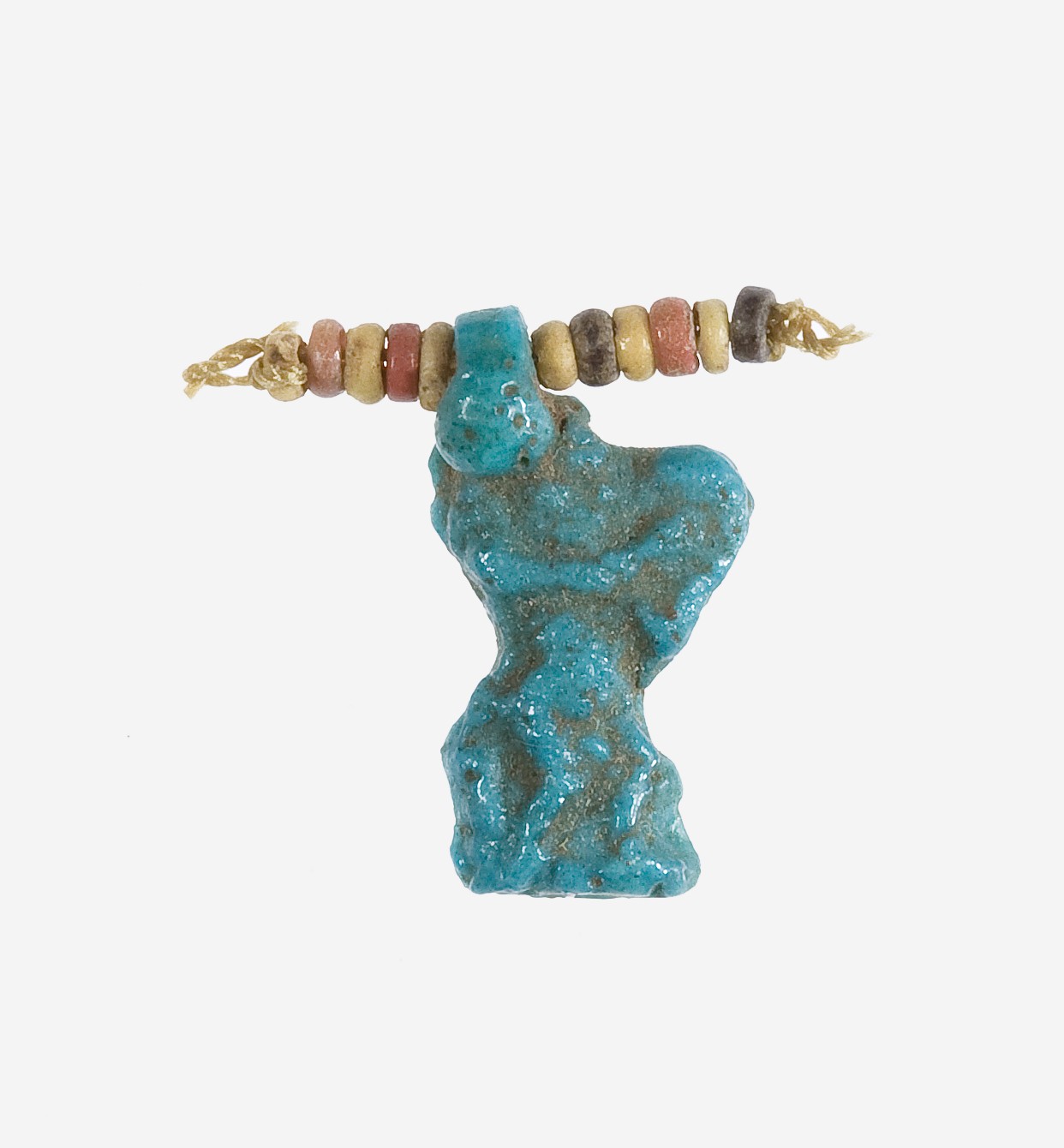
Executive Heritage Analysis: The Amulet of Bes with a Tambourine
This strategic standalone research paper, prepared for Katherine Fashion Lab, examines the Amulet of Bes with a Tambourine, a faience artifact from ancient Egyptian civilization. The analysis focuses on its symbolic power, historical adornment practices, spiritual meaning, and the implications for a 2026 high-end luxury strategy. As a Lead Heritage Curator, I position this object not merely as a decorative relic, but as a potent cultural asset with enduring resonance for modern luxury branding.
Symbolic Power: The Protective Deity in Miniature Form
The amulet depicts Bes, a dwarf god with leonine features, a protruding tongue, and a tambourine in hand. Unlike the formal, anthropomorphic deities of the Egyptian pantheon, Bes was a household god, accessible and intimately tied to daily life. His symbolic power derives from his role as a guardian against evil spirits, particularly those threatening women during childbirth and children in their early years. The tambourine, a percussive instrument, was not merely a musical accessory; it was a weapon of sonic apotropaism. The rhythm and noise were believed to scare away malevolent forces, creating a protective soundscape around the wearer.
For Katherine Fashion Lab, this symbology offers a profound narrative: the amulet is a talisman of active defense, not passive luck. It represents a proactive, even aggressive, posture against negativity. In a 2026 luxury context, where consumers increasingly seek objects that confer psychological security and empowerment, the Bes amulet translates into a brand emblem of resilience and protection. Its power is not abstract; it is performative, rhythmic, and audible—qualities that can inspire sensory design elements in jewelry, accessories, or even ambient store experiences.
Historical Adornment: Faience as a Medium of Status and Accessibility
Material Significance of Faience
Faience, a non-clay ceramic material composed of crushed quartz or sand, coated with a vitreous alkaline glaze, was a hallmark of ancient Egyptian craftsmanship. Its brilliant blue-green hue, achieved through copper compounds, mimicked turquoise and lapis lazuli, stones associated with rebirth and the divine. Despite its humble composition, faience was highly valued for its luminous, reflective quality, which was believed to capture the sun’s rays and channel protective energy.
Historically, amulets of Bes were worn as pendants, sewn into garments, or placed in domestic shrines. They were democratic in distribution—available to both elite and commoners—yet the finest examples, like the one under study, exhibit meticulous craftsmanship that signals status. The choice of faience over precious metals or stones was deliberate: it offered durability, affordability, and symbolic color, making protective adornment accessible to all social strata.
Adornment as a Ritual Act
Adorning oneself with a Bes amulet was a ritualized act of self-care and spiritual hygiene. It was not merely decorative; it was a functional tool for navigating a world filled with supernatural dangers. For Katherine Fashion Lab, this historical practice underscores the importance of intentional design. A luxury piece inspired by this amulet must not only be beautiful but also carry a clear, protective function—whether through material, form, or narrative. The 2026 consumer will value objects that serve a dual purpose of aesthetic pleasure and psychological fortification.
Spiritual Meaning: The Intersection of Joy and Defense
The spiritual meaning of the Bes amulet is uniquely dualistic. Bes is both a fearsome guardian and a joyful entertainer. His tambourine, often accompanied by dance and music, evokes laughter, celebration, and the dispelling of sorrow. This paradox—protection through joy—is a sophisticated spiritual concept. In Egyptian cosmology, the chaotic forces of the universe could be countered not only by solemn rituals but by active, positive expression. The amulet thus represents a holistic approach to well-being: defending against harm while inviting happiness.
This duality is highly relevant for a 2026 luxury strategy. The modern affluent consumer, particularly in the post-pandemic era, seeks brands that offer emotional and spiritual wellness. The Bes amulet provides a template for a luxury product that is simultaneously protective and celebratory. It suggests a brand identity that is not austere or intimidating, but approachable, protective, and life-affirming. The spiritual meaning can be translated into campaign narratives of empowerment through joy, where the act of wearing the piece becomes a daily affirmation of resilience and optimism.
2026 High-End Luxury Strategy: From Artifact to Brand Icon
Positioning the Amulet as a Heritage Signature
For Katherine Fashion Lab, the Amulet of Bes with a Tambourine offers a unique opportunity to create a heritage signature piece that bridges ancient wisdom and contemporary luxury. The strategy should center on three pillars: Authenticity, Transformation, and Experience.
Authenticity requires rigorous historical accuracy in design inspiration. Rather than a literal reproduction, the luxury piece should reinterpret the amulet’s form, color, and symbolism through premium materials—for example, a hand-carved jade or enamel pendant with a hidden, finely tuned tambourine mechanism. The faience’s blue-green glaze can inspire a signature “Bes Blue” colorway, exclusive to the brand.
Transformation involves updating the amulet’s function for modern life. The protective symbolism can be recontextualized as digital protection—perhaps a wearable tech accessory with a sound module that emits a low-frequency “protective” hum, or a limited-edition perfume with notes of frankincense and myrrh, mimicking ancient temple scents. The tambourine’s rhythm can inspire a signature jingle or haptic feedback pattern in smart jewelry, offering a sensory reminder of safety.
Consumer Segmentation and Narrative
The target audience for this strategy is the “Culturally Conscious Connoisseur”—affluent individuals aged 30–55 who value history, craftsmanship, and emotional resonance. They are not merely buying a product but an artifact of meaning. The narrative should emphasize the amulet’s role as a personal talisman, with marketing materials that tell stories of ancient Egyptian households, childbirth rituals, and the god Bes as a protector of joy.
Collaborations with Egyptologists and contemporary artists can lend credibility, while limited-edition releases create scarcity. The amulet can be launched as part of a “Sacred Sound” collection, with each piece accompanied by a bespoke soundscape or meditation track, blending ancient rhythms with modern ambient music. This aligns with the 2026 trend of sensory luxury, where brands engage multiple senses to deepen emotional connection.
Retail and Digital Integration
The retail experience should be immersive. Flagship stores could feature sound installations that mimic the tambourine’s protective rhythm, while holographic displays show the amulet’s historical context. Digital platforms can offer augmented reality (AR) try-ons that reveal the amulet’s “protective aura” through visual effects. A blockchain-based certificate of authenticity could trace the piece’s design journey from ancient artifact to modern luxury item, appealing to the tech-savvy luxury buyer.
Conclusion: A Timeless Asset for Modern Luxury
The Amulet of Bes with a Tambourine is more than a historical curiosity; it is a strategic asset for Katherine Fashion Lab’s 2026 luxury positioning. Its symbolic power of active protection, its historical use of faience as a medium of accessible luxury, and its spiritual duality of joy and defense offer a rich foundation for brand storytelling. By translating these elements into authentic, transformative, and experiential products, the lab can create a heritage-driven luxury line that resonates with the modern consumer’s desire for meaning, protection, and sensory delight. This amulet, once a humble guardian of ancient households, can become a signature emblem of Katherine Fashion Lab’s commitment to timeless, protective beauty.