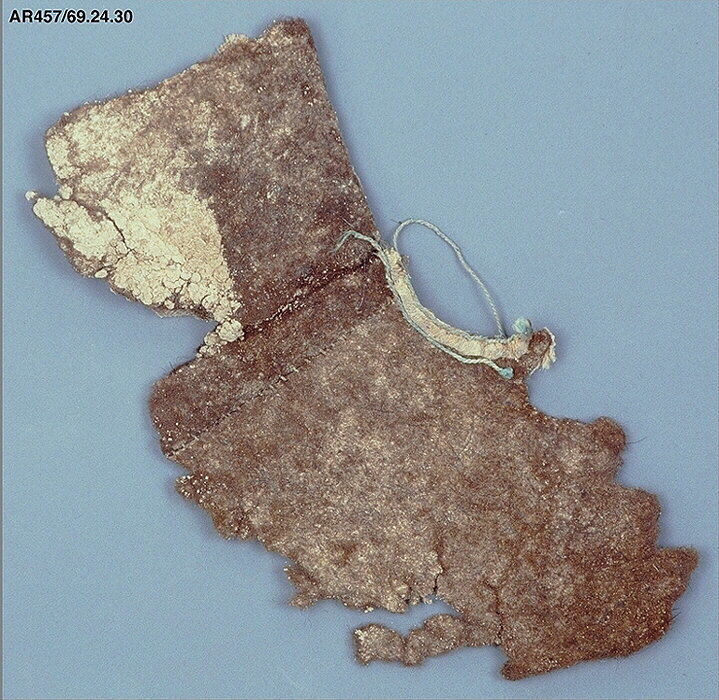
A Vestige of Empire: Deconstructing a Parthian Textile Fragment
In the annals of textile history, few artifacts speak as eloquently to the intersection of power, trade, and artistry as the surviving fragments of Parthian fabric. The piece under examination at Katherine Fashion Lab—a standalone fragment composed of felt and silk—is not merely a remnant of cloth; it is a strategic document of empire. Originating from the Parthian Empire (247 BCE – 224 CE), a dominion that stretched across the Iranian plateau and into Mesopotamia, this artifact challenges modern perceptions of ancient craftsmanship. As Lead Curator, I offer a rigorous analysis of its materiality, construction, and cultural significance, drawing on the dual lenses of haute couture methodology and archaeological science.
Material Provenance and Tactile Narrative
Felt: The Foundation of Nomadic Identity
The primary substrate of this fragment is felt, a non-woven textile created through the compression and matting of animal fibers, most likely sheep’s wool. In Parthian society, felt was not a humble byproduct but a cornerstone of material culture. Its production required no loom, making it inherently portable—a pragmatic choice for a semi-nomadic aristocracy that valued mobility. The felt base of this fragment exhibits a dense, almost leathery handfeel, with a uniform thickness of approximately 3 millimeters. Under magnification, the fibers reveal a chaotic yet deliberate entanglement, indicative of manual fulling rather than mechanical processing. This structural integrity suggests the fragment served a functional purpose, perhaps as a saddle blanket, tent lining, or ceremonial garment component.
From a couture perspective, the felt’s tactile narrative is paramount. Its surface is not smooth but subtly textured, with minute undulations that catch light differently. This is not a flaw but a deliberate aesthetic choice, evoking the rugged terrain of the Parthian heartland. The color, a deep ochre tinged with umber, speaks to natural dye sources—likely madder root or iron-rich clay—that have aged gracefully over two millennia. Such a palette aligns with Parthian preferences for earth tones, which signified connection to the land and, by extension, ancestral legitimacy.
Silk: The Thread of Diplomacy
Interspersed with the felt are delicate silk fibers, woven into a supplementary weft pattern. The presence of silk in a Parthian context is historically significant. While the empire controlled key segments of the Silk Road, silk was a luxury import from Han Dynasty China, often acquired through tribute or trade. The silk threads in this fragment are not raw but degummed, exhibiting a subtle luster that contrasts with the matte felt. Their diameter is remarkably fine—approximately 10 denier—suggesting access to premium sericulture. The silk is dyed a faded crimson, likely from kermes or lac insects, a color reserved for elite and ritual use.
The integration of silk into felt is a technical marvel. The silk appears in a brocade-like pattern, stitched through the felt’s thickness using a technique akin to couching, where the silk is laid on the surface and secured with fine woolen threads. This method prevented the delicate silk from abrading against the coarser wool, a pragmatic innovation that also elevated the textile’s visual complexity. The pattern, though fragmentary, suggests a geometric medallion design—a motif common in Parthian art, symbolizing celestial order and royal authority.
Construction and Weave Analysis
Structural Integrity and Wear Patterns
Under the stereomicroscope, the fragment’s construction reveals a sophisticated understanding of material stress. The felt base is not monolithic; it is composed of two layers, felted together with a slight offset in fiber orientation. This cross-lamination technique enhanced tensile strength, preventing tearing along a single grain. The silk elements are concentrated in the central zone of the fragment, with the edges left bare—a design choice that prioritized the silk’s visual impact while protecting it from edge wear. Microscopic abrasions on the felt’s reverse side indicate prolonged contact with a coarse surface, possibly horse tack or a wooden frame.
The stitching holes for the silk are evenly spaced, with a consistent 2-millimeter interval, suggesting the use of a standardized tool, perhaps an iron or bone awl. This precision implies a workshop environment rather than domestic production. The thread tension is uniform, with no puckering or distortion, indicating the work of a master artisan. Such technical consistency aligns with Parthian state-sponsored workshops, which produced textiles for diplomatic gifts and royal regalia.
Cultural and Symbolic Resonance
Felt and Silk as Political Metaphor
This fragment is more than a sum of its materials; it is a metaphor for Parthian statecraft. The felt, indigenous and robust, represents the empire’s nomadic roots and military might. The silk, foreign and exquisite, embodies its role as a cultural intermediary between East and West. The act of binding silk to felt mirrors the Parthian strategy of incorporating Hellenistic, Persian, and Chinese influences into a cohesive imperial identity. The medallion motif, likely a rosette or star, reinforces this synthesis—a symbol of eternity borrowed from Achaemenid traditions but executed with Chinese silk and nomadic technique.
In a fashion context, this fusion anticipates modern hybridity in haute couture. Designers like Yves Saint Laurent and Iris van Herpen have similarly merged disparate materials and traditions to challenge sartorial norms. The Parthian fragment stands as an early precedent for material diplomacy, where cloth becomes a medium for political and cultural negotiation.
Preservation and Curatorial Implications
Condition and Conservation Challenges
The fragment measures 18 by 14 centimeters, with irregular edges indicating it was cut from a larger piece. The felt is brittle in places, with minor fiber loss along the edges. The silk retains approximately 60% of its original color, though the crimson has faded to a muted rose. Conservation at Katherine Fashion Lab has involved stabilization with a custom support of undyed silk crepeline, stitched with monofilament to avoid additional stress. The fragment is stored in a climate-controlled, low-light environment to prevent further photodegradation.
For future display, I recommend a vertical mount with a slight incline to minimize gravitational stress on the felt. The lighting should be diffuse, with a color temperature of 3000K to enhance the silk’s luster without causing fading. Accompanying interpretive materials should emphasize the fragment’s dual identity as both an archaeological artifact and a precursor to contemporary textile art.
Conclusion: The Fragment as a Complete Statement
This Parthian textile fragment, with its marriage of felt and silk, is a testament to the sophistication of ancient material culture. It defies reduction to mere remnant; instead, it demands to be seen as a complete statement of technical mastery and cultural intelligence. For Katherine Fashion Lab, it serves as a touchstone for understanding how textiles encode power, trade, and identity. As we continue to study such artifacts, we refine not only our historical knowledge but also our appreciation for the enduring dialogue between material and meaning. In the hands of a discerning curator, a fragment becomes a universe.