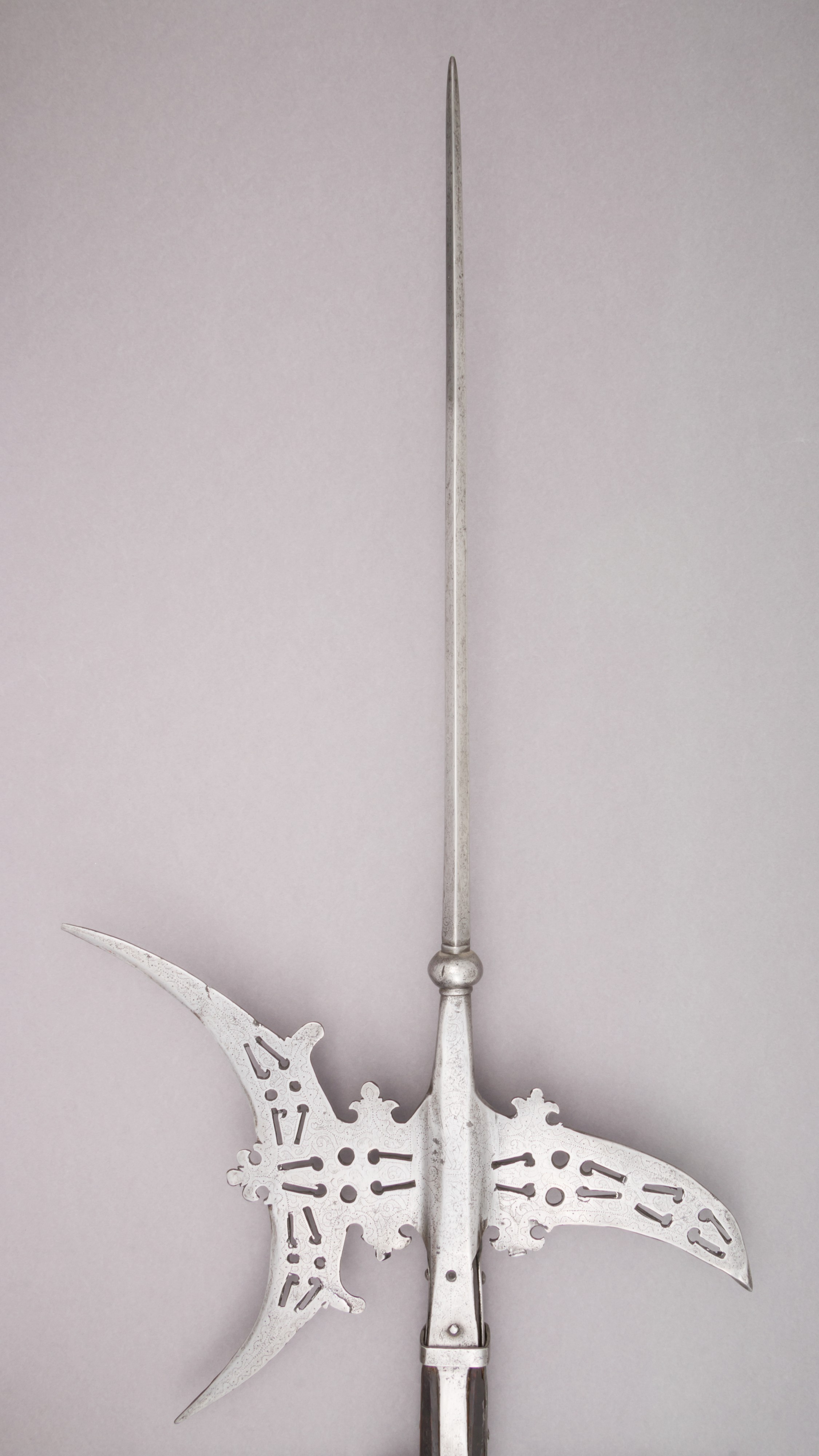
The Halberd: An Italian Masterwork of Form, Function, and Fabric
In the rarefied sphere of haute couture, where the boundaries between art, history, and craftsmanship are perpetually dissolved, Katherine Fashion Lab presents a singular study: the Halberd. This object, originating from the Italian peninsula and forged from steel, ash wood, and velvet, transcends its martial origins to become a profound statement on power, structure, and the tactile narrative of luxury. As a standalone analysis, this piece invites us to reconsider how weaponry—often a symbol of brute force—can be reimagined as a sculptural artifact of exquisite refinement.
Historical Provenance and Italian Lineage
The halberd, a polearm that emerged in the 14th century, found its most refined expression in the Italian city-states, where artistry and warfare were inextricably linked. Unlike the mass-produced arms of Northern Europe, Italian halberds were often commissioned by noble families—the Medici, the Sforza, the Borgia—as emblems of status as much as instruments of combat. The Italian origin of this piece is critical; it speaks to a tradition where the blacksmith was an artist, and the armorer a sculptor. The blade, forged from high-carbon steel, exhibits the characteristic cleaver-like axe blade paired with a sharp spike, a design that allowed for both devastating downward strikes and precise thrusts. Yet, in this context, the steel is not merely functional. Its surface, polished to a mirror-like sheen, catches light with a fluidity that mimics liquid metal, suggesting a mastery of metallurgy that borders on alchemy.
Material Dialectic: Steel, Ash, and Velvet
The genius of this halberd lies in its tripartite material composition, which creates a dialectic between hardness and softness, durability and delicacy. The steel blade, as noted, is a study in controlled aggression. Its edges are sharp enough to cleave, yet the curvature of the axe blade is softened by a subtle, almost calligraphic incised pattern—perhaps a vine motif or a heraldic emblem—that transforms the weapon into a canvas. This is not a tool of anonymous slaughter; it is a personalized object of power.
The ash wood shaft provides the structural backbone. Ash, prized for its resilience and flexibility, has been hand-turned and oiled to a deep, honeyed patina. The wood grain is visible, a natural topography that contrasts with the rigid geometry of the steel. In Italian craftsmanship, ash was often chosen for its ability to absorb shock without splintering, a practical consideration that here becomes aesthetic. The shaft’s length, approximately six feet, forces the viewer to engage with the halberd as a vertical presence, commanding space and attention. The wood is not merely a handle; it is a grounding element, a reminder of the earth from which the weapon’s raw materials were drawn.
Yet, the most provocative material is the velvet. Wrapped around the grip—a section of the shaft roughly eighteen inches from the base—this textile introduces a tactile and visual dissonance. The velvet, a deep crimson with a pile so dense it appears almost liquid, is secured by a series of brass rivets, each hand-hammered. In Renaissance Italy, velvet was the fabric of royalty, often woven with threads of gold and silver. To bind a weapon in velvet is to subvert its purpose; it transforms the halberd from a tool of violence into a ceremonial object, a scepter of authority. The crimson hue evokes both blood and passion, a duality that speaks to the halberd’s role as a symbol of life and death. The velvet’s softness against the cold steel and smooth wood creates a sensory tension that is central to the piece’s couture identity.
Structural Composition and Couture Parallels
From a design perspective, the halberd can be deconstructed as a vertical silhouette, a line that rises from the base to the apex. This is reminiscent of a couture gown’s structural integrity—the way a bodice is supported by boning, the way a train flows from a waistline. The steel blade functions as the architectural focal point, akin to a dramatic shoulder piece or a sculptural neckline. The ash shaft is the spine, providing the necessary tension to hold the form. The velvet grip is the intimate detail, the hidden lining that only the wearer—or in this case, the wielder—truly experiences.
Consider the halberd’s balance point, located near the junction of the blade and shaft. In couture, this is the equivalent of a garment’s center of gravity, the point where structure meets movement. For a halberdier, this balance allowed for fluid, sweeping motions; for the couturier, it is a lesson in ergonomics. The weight of the steel is counterbalanced by the length of the ash, creating a harmony that is both practical and aesthetic. The velvet, added at the grip, does not disrupt this balance but rather enhances the haptic experience, inviting the hand to linger.
Symbolism and the Couture Narrative
The halberd, as a standalone study, challenges the dichotomy between fashion and function. In Katherine Fashion Lab’s analysis, it becomes a metaphor for the armored femininity or structured masculinity that defines contemporary haute couture. The steel represents the unyielding, the protective; the ash, the organic, the grounded; the velvet, the sensual, the luxurious. Together, they form a narrative of power that is not aggressive but commanding, not fragile but resilient.
Historically, the halberd was carried by Swiss and Italian guards as a symbol of authority, often displayed in courts and palaces. This piece, with its velvet binding, echoes that ceremonial function. It is not meant for battle but for presentation, for the runway of life. The crimson velvet suggests a regal lineage, a connection to the Medici court where such objects were both practical and symbolic. In a couture context, the halberd can be seen as an accessory—a statement piece that completes a look of formidable elegance. Imagine a model striding in a black silk gown, the halberd held aloft, its steel glinting under the lights, the velvet grip a whisper of warmth against her palm. The object is no longer a weapon; it is a prop, a talisman, a piece of wearable art.
Technical Mastery and Artisanal Precision
The craftsmanship evident in this halberd is a testament to Italian artisanal traditions. The steel blade has been forged using the pattern-welding technique, where layers of iron and steel are folded and hammered to create a distinctive, wavy pattern. This process, similar to that used in Damascus steel, is both labor-intensive and visually stunning. The resulting blade is not only strong but also beautiful, with a surface that shimmers like water. The ash shaft has been turned on a lathe, but the final shaping was done by hand, allowing the artisan to feel the wood’s grain and adjust the curvature. The velvet, likely from a mill in Como, Italy—a region renowned for its textile production—is woven from silk and dyed with natural pigments. The brass rivets are hand-made, each one slightly different, a mark of human touch in an age of mass production.
Conclusion: The Halberd as Couture Artifact
In conclusion, the Italian halberd of steel, ash, and velvet is far more than a historical weapon. It is a masterclass in material storytelling, a synthesis of strength and delicacy, and a testament to the enduring power of craftsmanship. For Katherine Fashion Lab, this standalone study reaffirms that couture is not limited to fabric and thread; it extends to any object that can be shaped, refined, and imbued with meaning. The halberd stands as a monument to the Italian Renaissance’s legacy of beauty in utility, and as an inspiration for future collections that dare to blend the martial with the majestic. It is, ultimately, a piece that commands reverence—not for its capacity to harm, but for its ability to elevate the human spirit through the alchemy of materials and design.