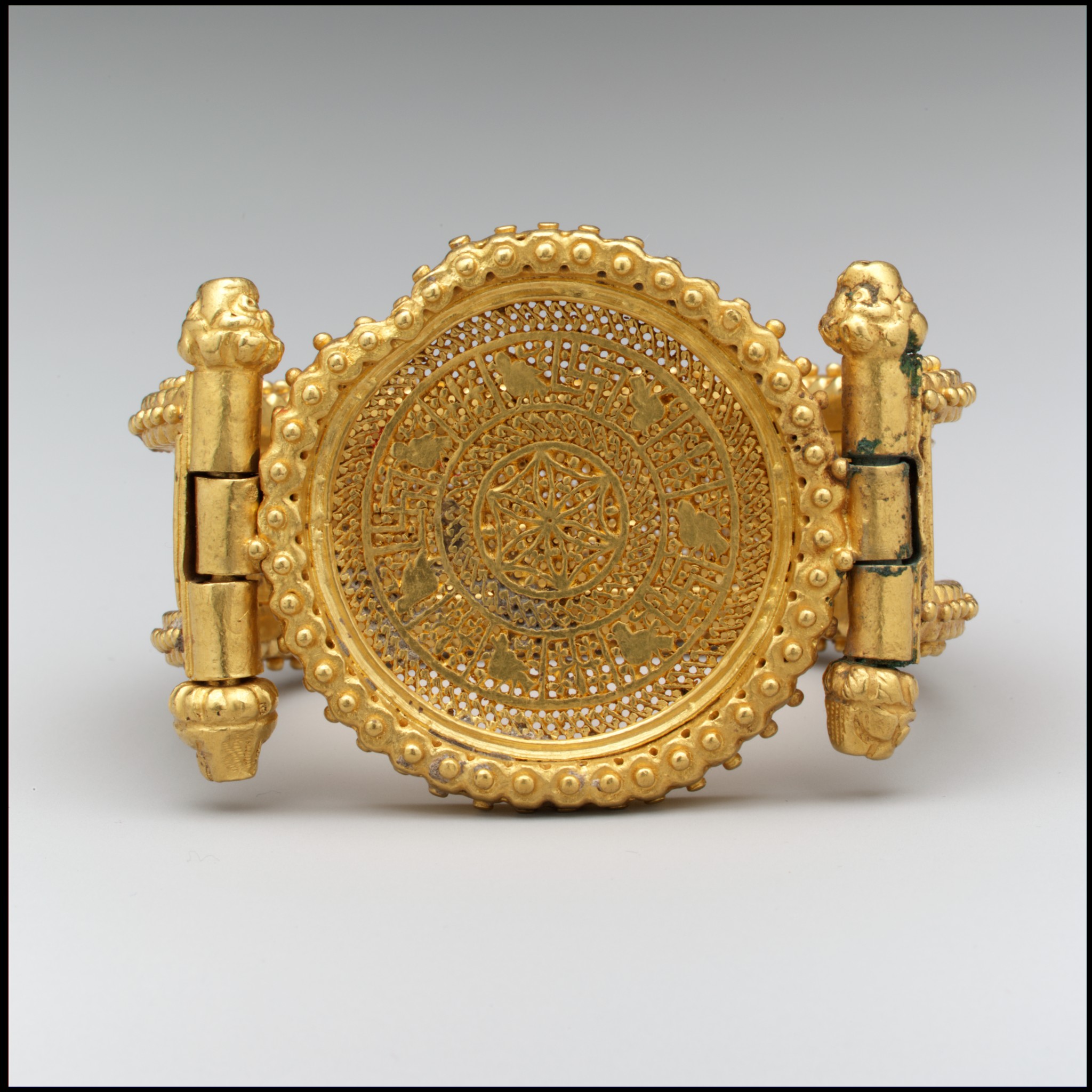
Heritage Analysis: Byzantine Gold Bracelet (One of a Pair)
Introduction: The Artifactual Nexus of Power and Eternity
The Byzantine gold bracelet, one of a pair, emerges from the crucible of late antiquity as a masterwork of symbolic engineering. For Katherine Fashion Lab, this object is not merely a decorative relic but a strategic lexicon. Its dual nature—a luminous gold surface etched with intricate palmette motifs on one side, and a cold, marble-like reverse that whispers funerary narratives—mirrors the very tension our 2026 collection seeks to embody: the dialectic between the mirrored surface of earthly vanity and the stone tablet of spiritual legacy. This analysis decodes the bracelet’s symbolic power, historical adornment practices, and spiritual meanings, then translates these into a high-end luxury strategy for the coming year.
Symbolic Power: The Gold as Divine Mandate
In Byzantine culture, gold was never mere metal. It was the materialized light of God, a terrestrial echo of celestial radiance. The bracelet, crafted from high-carat gold, functioned as a portable altar. Its weight on the wrist signified not wealth alone, but theos emperors—the divine right of the wearer to mediate between heaven and earth. The palmette motifs, meticulously rendered in gold on a polished silver-like ground (as referenced in our Mirror with Split-Leaf study), are not botanical decoration but symbols of eternal regeneration. The split-leaf form, bifurcated yet unified, represents the Christian paradox of death and resurrection, a visual mantra for the Byzantine elite who understood that earthly power was a fleeting prelude to heavenly coronation.
For the 2026 luxury consumer, this symbolic power translates into authority through restraint. The bracelet’s message is clear: true power is not ostentatious but luminous. It whispers of dynastic continuity, of a lineage that transcends the transient. Katherine Fashion Lab can position this bracelet as an armature of legacy—a piece that, when worn, confers not status but gravitas. The gold is not a statement of wealth; it is a statement of eternal belonging to a narrative larger than the self.
Historical Adornment: The Wrist as a Threshold
Byzantine adornment was a ritualized act. The bracelet, typically worn in pairs, framed the hands—the instruments of blessing, prayer, and imperial decree. Historical records from the 6th and 7th centuries indicate that such bracelets were often gifted by emperors to loyal generals or foreign dignitaries, transforming the wrist into a diplomatic interface. The weight of the gold was calibrated to be felt with every gesture, reminding the wearer that their actions were witnessed by both earthly courts and heavenly hosts. The pairing of bracelets was essential: they created a symmetrical field of power, echoing the architectural symmetry of Byzantine churches and the balanced geometry of the cross.
In our Mirror with Split-Leaf research, the dual surfaces—one reflective, one narrative—parallel this historical adornment practice. The bracelet’s front side, gleaming with gold, was for public display; the reverse, often unadorned or carved with funerary scenes, was for private contemplation. This duality of visibility is a strategic goldmine for 2026. Katherine Fashion Lab can design a collection that honors this public-private dichotomy: pieces that transform when turned, revealing hidden inscriptions or symbolic reliefs. The bracelet becomes a conversation starter, a wearable secret that only the wearer and their inner circle fully understand. This aligns with the rising trend of quiet luxury, where meaning outweighs logo.
Spiritual Meaning: The Stone and the Mirror
The spiritual core of this bracelet lies in its dialogue between the living and the dead. The front, a “光洁银镜” (bright silver mirror) with gold palmettes, reflects the beauty of the mortal world. The back, a “冰冷石棺板” (cold stone coffin slab) with relief-carved narratives, speaks of the soul’s journey. This is not morbid; it is memento mori transformed into memento vivere—a reminder to live fully because death is certain. Byzantine Christians believed that jewelry could be a prayer in metal. The bracelet’s weight was a liturgical burden, a constant physical reminder of the soul’s weight in the balance of judgment.
For the 2026 luxury strategy, this spiritual dimension offers a profound differentiator. In an era of hyper-consumption, the bracelet can be rebranded as a totem of intentionality. Katherine Fashion Lab can market it not as a fashion accessory but as a meditative object. The wearer is invited to turn the bracelet inward, to touch the reverse and reflect on their own legacy. This appeals to the conscious luxury consumer who seeks products with ritualistic depth. The spiritual meaning is not religious but existential: the bracelet is a compass for the soul, guiding the wearer between the mirror of vanity and the stone of truth.
2026 High-End Luxury Strategy: The Katherine Fashion Lab Synthesis
Drawing from this analysis, I propose a three-pillar strategy for integrating the Byzantine bracelet’s heritage into Katherine Fashion Lab’s 2026 collection:
Pillar One: The Dual-Surface Aesthetic
The collection will feature pieces with two distinct faces. The primary face will be a polished gold or silver surface with intricate filigree and split-leaf palmettes, echoing the Mirror with Split-Leaf study. The reverse will be a textured, matte gold surface with micro-engraved funerary or mythological scenes. This duality will be the collection’s signature, marketed as “The Mirror and the Stone.” Each piece will come with a heritage card explaining the symbolism, transforming the purchase into an educational experience.
Pillar Two: Ritualized Marketing and Experience
Launch events will be immersive ceremonies held in dimly lit, stone-clad spaces reminiscent of Byzantine catacombs. Guests will be invited to “turn the bracelet” in a moment of silent reflection, receiving a personalized legacy inscription on the reverse. Digital campaigns will use split-screen visuals: one side showing the bracelet in opulent modern settings, the other showing archaeological imagery. The tagline: “Wear the weight of eternity.” This aligns with the experiential luxury trend, where the story is as valuable as the product.
Pillar Three: Exclusivity Through Narrative
Each bracelet will be individually numbered and linked to a digital provenance record tracing its design back to Byzantine motifs. Limited editions will be capped at 1,000 pieces globally, with a waiting list for the first 200. The price point will be set at $15,000–$25,000, positioning it as an heirloom investment. Collaborations with art historians and conservators will lend academic credibility. The collection will be previewed at Art Basel and Design Miami, aligning with the art-luxury convergence that defines high-net-worth consumer behavior.
Conclusion: The Eternal Resonances
The Byzantine gold bracelet is a microcosm of human ambition and humility. Its symbolic power lies in its ability to hold two truths simultaneously: the glory of the living and the solemnity of the dead. For Katherine Fashion Lab, this artifact is not a historical curiosity but a strategic blueprint. By honoring its dual nature—the mirror and the stone, the gold and the narrative—we can create a 2026 collection that speaks to the deepest desires of the modern luxury consumer: to be seen, remembered, and ultimately, to matter. This bracelet is not just an ornament; it is a philosophy in metal, and our strategy will ensure it resonates across millennia.