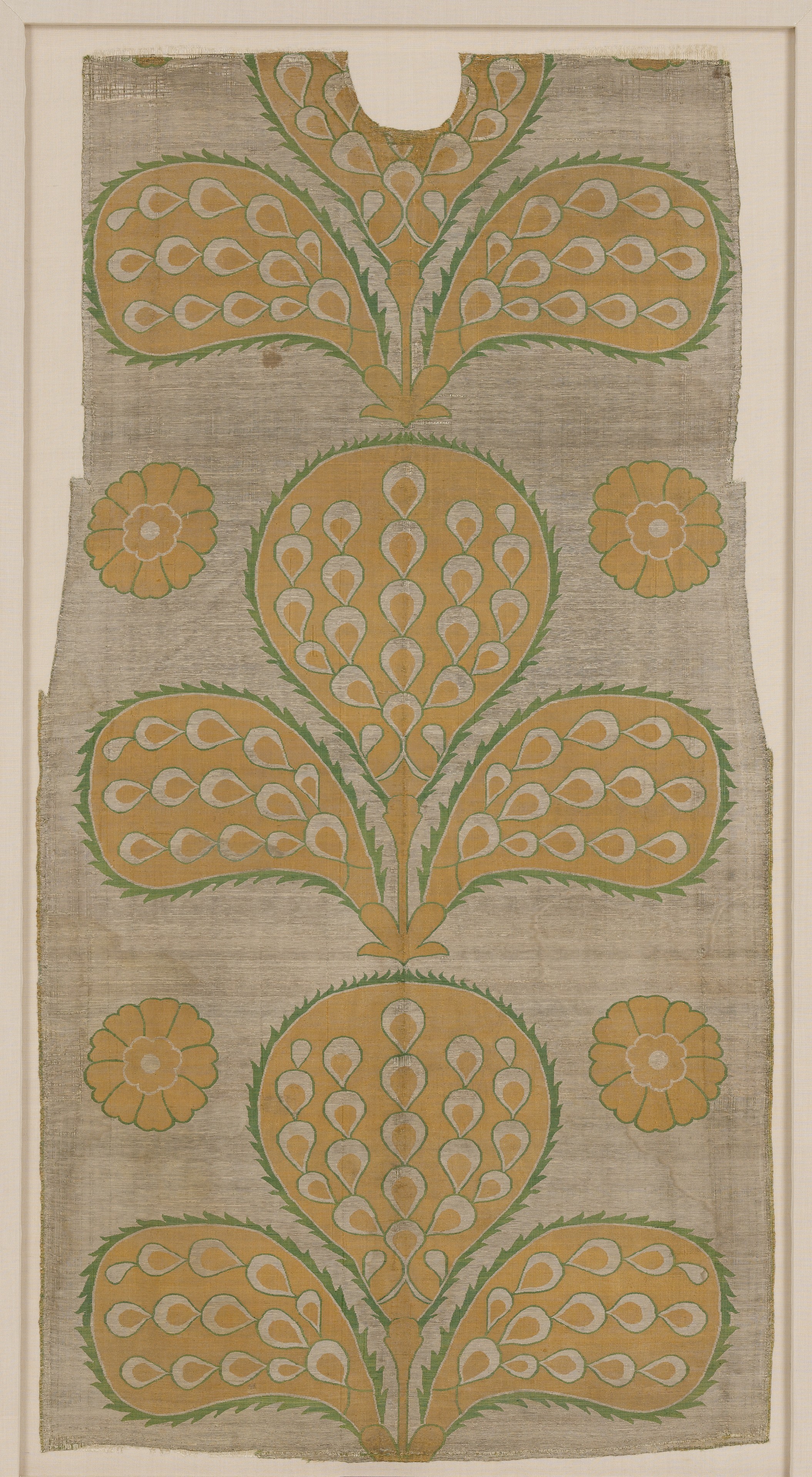
Fragment of a Kaftan Back: A Study in Global Heritage and Technical Mastery
The study of a single garment fragment, particularly one as historically charged as the back panel of a kaftan, offers a concentrated lens through which to examine the confluence of artistry, trade, and cultural identity. At Katherine Fashion Lab, we approach such artifacts not merely as remnants of a past era, but as living texts that encode the technical, aesthetic, and economic narratives of their time. This particular fragment, executed in the demanding technique of taqueté (seraser)—a compound weave structure utilizing silk and metal-wrapped thread—demands a rigorous analysis that bridges material science with art historical context. Its origin, designated as “Global Heritage,” underscores the kaftan’s role as a transnational signifier, a garment that traversed the courts of the Ottoman Empire, Safavid Persia, and Mughal India, absorbing and refracting local traditions while maintaining a core lexicon of luxury and power.
Material Lexicon: The Alchemy of Silk and Metal
The fragment’s material composition is its first and most eloquent statement. The ground weave, executed in silk, provides a luminous, absorbent base that captures and diffuses light. Silk’s natural protein fibers, with their triangular prismatic structure, create a subtle, shifting luster that is distinct from the sharper reflectivity of synthetics. This quality is essential for the visual rhythm of the kaftan’s back, where the fabric would have fallen in deep, sculptural folds, catching highlights and shadows as the wearer moved. The choice of silk is not merely aesthetic; it is a declaration of status. In the pre-industrial world, sericulture was a closely guarded secret, and the importation of raw silk from China or the Caspian region represented a significant economic investment. The presence of silk in this fragment signals a patron of considerable means, likely within the upper echelons of a courtly or mercantile elite.
The metal-wrapped thread—typically a fine strip of silver or silver-gilt (gold over silver) wound around a silk or linen core—introduces a different order of material and symbolic value. In the technique of taqueté (seraser), these metal threads are not merely embroidered onto the surface but are integral to the weave itself. Taqueté, a weft-faced compound weave, employs a pattern weft of metal thread that is bound by a supplementary warp, creating a dense, brocaded effect. The term “seraser,” from the Persian sar ā sar meaning “head to head” or “all over,” denotes a fabric where the metal thread covers the entire surface, creating a shimmering, armor-like field. This is not a decorative accent; it is a totalizing statement of opulence. The weight and stiffness of the metal threads would have imparted a particular drape—a structured, almost architectural quality—that distinguished these garments from lighter, more fluid silks. The interplay between the soft, absorbent silk and the rigid, reflective metal creates a dialectic of texture: intimacy and grandeur, warmth and brilliance.
Technical Precision: The Art of Taqueté
The fragment’s execution in taqueté reveals a mastery of complex loom technology and a sophisticated understanding of color and light. In a taqueté weave, the warp threads are typically divided into a ground warp and a binding warp. The ground warp, often in a neutral or complementary color, provides the structural foundation. The pattern wefts—in this case, the metal thread and perhaps a colored silk weft—are introduced in sequence. The binding warp, working in a plain-weave or twill relationship, secures the pattern wefts to the ground. This structure allows for the creation of intricate, repeating motifs that appear to float on a metallic ground. The density of the weave is critical: a high thread count ensures that the metal threads lie flat and reflect light uniformly, while a looser weave might create a more textured, matte effect. The fragment’s preserved condition suggests a high degree of tension and precision, indicating a workshop with access to advanced drawlooms and highly skilled weavers.
The color palette of the fragment, though likely faded, speaks to the original design’s chromatic sophistication. The silk ground may have been a deep crimson, sapphire blue, or emerald green—colors derived from costly natural dyes such as cochineal, indigo, or madder. These hues, when juxtaposed with the silver or gold metal thread, would have created a dramatic contrast: the vibrant, saturated color of the silk against the cool, reflective brilliance of the metal. In Ottoman court kaftans, for example, a crimson ground with silver-gilt thread was a favorite combination, symbolizing both royal authority and divine light. The motifs, likely floral or geometric, would have been rendered in the metal thread, creating a pattern that shifts and shimmers as the viewer’s angle changes. This dynamic quality is a hallmark of taqueté: the fabric is never static; it is a living surface that interacts with its environment.
Global Heritage: The Kaftan as a Transcultural Object
The designation “Global Heritage” for this fragment is not a vague attribution but a precise acknowledgment of the kaftan’s role as a vehicle for cross-cultural exchange. The kaftan, a long, coat-like garment with wide sleeves, originated in Central Asia and was adopted by the Islamic courts of the Middle East, North Africa, and South Asia. It was a garment of investiture, given as a robe of honor (khil‘a) by rulers to their subjects, diplomats, and allies. As such, it carried political and symbolic weight. The back panel of a kaftan, often the most expansive and least interrupted surface, was the primary field for displaying the most intricate and costly weaving. A fragment of the back, therefore, offers a concentrated sample of the garment’s highest expression of artistry.
The technical vocabulary of taqueté was itself a product of global exchange. The technique, known in the Byzantine Empire and early Islamic world, was refined in Safavid Persia and later adopted by Ottoman workshops. The metal threads, often made from silver mined in the Americas and shipped to Europe, were then gilded and exported to the East. The silk might have come from the Caspian Sea region or from China via the Silk Road. The dyes were sourced from India, the Mediterranean, and the New World. A single fragment thus embodies a network of trade routes, labor, and capital that spanned continents. To study it is to trace the lines of a global economy that operated centuries before the term “globalization” was coined.
Context and Conservation: A Standalone Study
As a standalone study, this fragment is liberated from the constraints of a complete garment. It invites us to focus on the weave structure, the material integrity, and the design logic without the distraction of silhouette or fit. This is a forensic approach, akin to analyzing a single brushstroke in a painting. The fragment’s edges, likely cut from the larger garment, reveal the raw ends of the warp and weft, offering a cross-section of the fabric’s construction. The wear patterns—fading, creasing, and perhaps slight fraying—provide clues about how the kaftan was worn and stored. A darker area along one edge might indicate where the fabric was folded or where it contacted the wearer’s body, absorbing oils and perspiration over time.
Conservation of such a fragment requires a delicate balance between preservation and interrogation. The metal threads are particularly vulnerable to tarnishing and corrosion, especially if exposed to humidity or pollutants. The silk, while durable, can become brittle and fragile over centuries. Any analysis must be non-invasive, relying on microscopic examination, X-ray fluorescence (XRF) to identify metal composition, and spectral imaging to reveal faded dyes. The goal is not to restore the fragment to an imagined original state, but to document its current condition as a record of its journey through time.
Conclusion: The Fragment as a Microcosm
This fragment of a kaftan back, woven in silk and metal-wrapped thread using the taqueté technique, is far more than a decorative remnant. It is a microcosm of global heritage, a tangible link to the courtly cultures of the early modern world. Its materiality speaks to the economic networks that supplied raw materials, the technical expertise that transformed them into fabric, and the aesthetic sensibilities that prized such opulence. For the scholar and the designer at Katherine Fashion Lab, it serves as a reminder that luxury is never merely about abundance; it is about the mastery of craft, the intentionality of design, and the stories that objects carry across time and space. In studying this fragment, we honor the hands that wove it, the patrons who commissioned it, and the cultures that cherished it. It is a lesson in humility and awe—a testament to the enduring power of textile art.