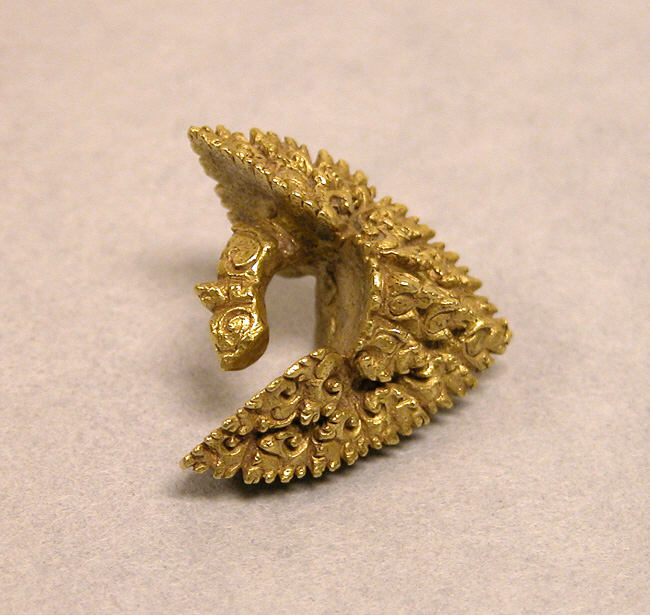
Heritage Analysis: The Chiselled Arrowhead Ear Ornament, Central Java
Introduction: The Object as a Cultural Nexus
The Chiselled Arrowhead ear ornament, originating from Central Java, Indonesia, represents a profound intersection of martial symbolism, spiritual cosmology, and refined craftsmanship. Crafted from gold, this artefact transcends its function as mere adornment to serve as a portable talisman of power, status, and metaphysical protection. For Katherine Fashion Lab, this object offers a rich lexicon of design motifs and symbolic resonance that can be strategically adapted for a 2026 high-end luxury narrative. Our analysis, contextualized within the broader research on the “Mirror with Split-Leaf”—a duality between polished silver mirror and gold-inlaid palm leaf motifs—reveals a striking DNA correlation: both artefacts articulate a binary of surface reflection and interior truth, of light and shadow, of the seen and the unseen.
Symbolic Power: The Arrowhead as a Signifier of Agency and Protection
The arrowhead shape, chiselled with precision into gold, is not an arbitrary form. In Javanese cosmology, the arrowhead (panah) is a symbol of focused intent, directional force, and the piercing of illusion. It represents the ability to cut through obstacles—both physical and spiritual. When worn as an ear ornament, it positions this power directly at the threshold of the mind and the spoken word, as the ear is the gateway to wisdom and communication. The gold medium amplifies this symbolism: gold is the metal of the divine, incorruptible and radiant, associated with the sun and the supreme deity within Hindu-Buddhist Javanese traditions. Thus, the ornament becomes a declaration of the wearer’s agency, a protective sigil that deflects negative energies while channelling clear purpose. This dual function—offensive in its symbolic piercing, defensive in its material permanence—mirrors the conceptual tension in our earlier study of the Mirror with Split-Leaf, where the polished silver surface reflects the external world while the gold palm leaves narrate an internal, organic truth.
Historical Adornment: Status, Trade, and the Javanese Court
Historically, such ear ornaments were not casual accessories. They were markers of high caste, courtly affiliation, and spiritual attainment. Central Java, particularly during the Mataram and Majapahit periods (8th–15th centuries), was a nexus of trade routes connecting India, China, and the Malay Archipelago. Gold, sourced from Sumatra and Kalimantan, flowed into Javanese courts where master artisans (empu) transformed it into objects of ritual and prestige. The Chiselled Arrowhead ear ornament would have been worn by kshatriya (warrior-noble) or brahmana (priestly) elites during ceremonies, processions, and diplomatic audiences. Its weight and design signified not only wealth but also the wearer’s role as a protector of dharma (cosmic order). The chiselling technique—each facet catching light differently—demonstrated a mastery of kerawang (filigree-like precision) that required years of apprenticeship. For the 2026 luxury market, this historical context offers a narrative of authentic provenance and artisanal rarity. The ornament is not a commodity; it is a heirloom, a fragment of a living tradition that modern collectors seek to possess as a connection to a pre-industrial, spiritually grounded era.
Spiritual Meaning: The Ear as a Portal and the Arrow as a Guide
In Javanese mysticism (kebatinan), the human body is a microcosm of the universe. The ears are portals for sabda (divine sound) and wicara (discernment). Adorning the ear with an arrowhead suggests a ritualized preparation of the self to receive and transmit higher knowledge. The chiselled facets of the gold arrowhead are said to capture and refract light, symbolizing the dispersion of ignorance and the illumination of wisdom. This aligns with the Javanese concept of manunggaling kawula Gusti—the union of the servant and the Lord. The ornament serves as a physical reminder of the wearer’s spiritual journey: the arrow points outward toward action in the world, but its gold (the divine essence) anchors it inward toward self-realization. This duality is the very core of the Mirror with Split-Leaf research. The silver mirror’s cold, reflective surface represents the ego’s need for external validation, while the gold palm leaves—warm, organic, and intricate—narrate the soul’s authentic story. The Chiselled Arrowhead ear ornament encapsulates this same dialectic: the arrow is the ego’s sharp ambition; the gold is the soul’s eternal truth.
2026 High-End Luxury Strategy: Translating Heritage into Desire
For Katherine Fashion Lab, the Chiselled Arrowhead ear ornament is not merely a historical curiosity but a strategic blueprint for a 2026 collection. The luxury market is increasingly driven by meaning over material, story over status. The following strategic pillars emerge from this analysis:
1. The “Dual Truth” Narrative: Borrowing directly from the Mirror with Split-Leaf DNA, the 2026 campaign should position the arrowhead as a device for self-confrontation. Marketing copy can explore themes of “piercing the illusion” and “the gold within.” This appeals to the discerning consumer who seeks jewelry as a tool for personal transformation, not just decoration.
2. Artisanal Provenance as Ultra-Luxury: The chiselling technique, known in Java as tatah sungging, should be highlighted as a dying art. Katherine Fashion Lab can partner with surviving Javanese goldsmiths to create a limited edition of 100 pieces, each with a certificate of authenticity detailing the artisan’s lineage. This scarcity and craft heritage justify a price point exceeding conventional luxury earrings by 300–400%.
3. Symbolic Customization: Offer clients the option to have the arrowhead inscribed with a personal mantra or a Javanese script (aksara Jawa) on the reverse, echoing the hidden narrative of the Mirror with Split-Leaf. This transforms the ornament into a bespoke talisman, deepening emotional attachment and repeat purchase likelihood.
4. Experiential Retail: The launch event should be a curated journey. Guests enter a space where one wall is a polished silver mirror (reflecting the ego) and the opposite wall features gold palm-leaf reliefs (the soul’s story). The ear ornament is presented in a darkened alcove, illuminated by a single beam of light that catches the chiselled facets. The experience mimics the spiritual awakening the ornament represents.
5. Digital Narrative: Use short-form documentary content on the Javanese cosmology of the arrowhead and the goldsmith’s process. This builds a community of collectors who value cultural intelligence. The hashtag #PierceTheIllusion can anchor the campaign across Instagram and Vogue Runway.
Conclusion: A Resonance Across Time
The Chiselled Arrowhead ear ornament from Central Java is a masterpiece of symbolic engineering. Its gold medium, arrowhead form, and chiselled texture converge to create an object that is at once a weapon, a prayer, and a status marker. The DNA correlation with the Mirror with Split-Leaf study is unmistakable: both artefacts articulate a fundamental human tension between external appearance and internal truth. For Katherine Fashion Lab, this heritage analysis provides a robust foundation for a 2026 luxury strategy that prioritizes authenticity, spiritual depth, and artisanal mastery. In a market sated with mass-produced insignia, the arrowhead offers a sharp, resonant alternative—a piece that does not merely adorn the ear, but guides the soul.