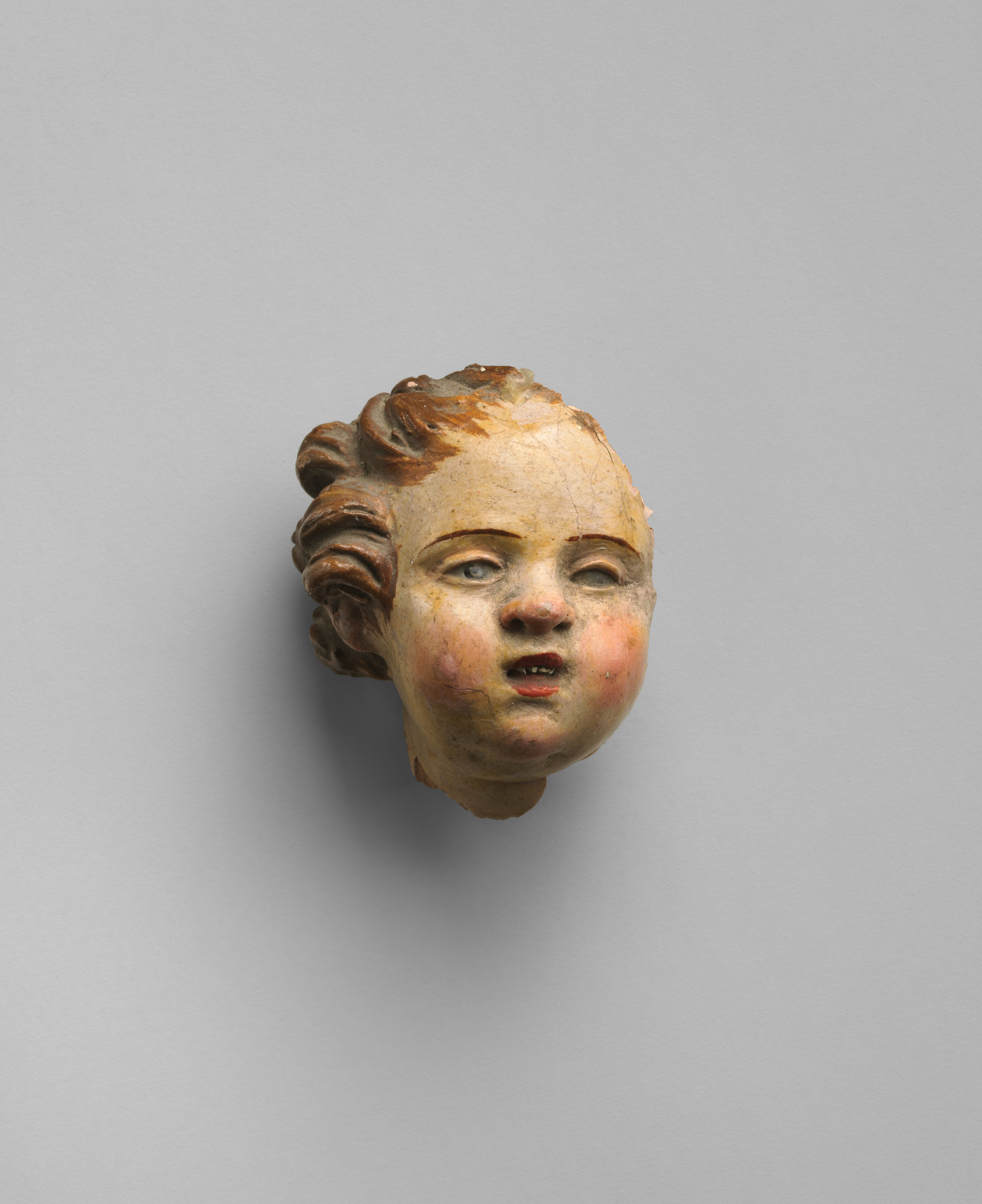
The Cherub Head Fragment: A Study in Global Heritage and Terracotta Couture
In the rarefied world of haute couture, the dialogue between antiquity and modernity is a constant source of inspiration. At Katherine Fashion Lab, we approach this dialogue not merely as aesthetic appropriation but as a deep, scholarly investigation into the materiality and symbolism of heritage artifacts. The subject of this analysis—a cherub head fragment, rendered in terracotta and sourced from the global heritage continuum—offers a profound case study in the intersection of artisanal craft, cultural narrative, and contemporary design language. This fragment, a standalone piece devoid of its original architectural or sculptural context, becomes a powerful catalyst for reimagining the boundaries of fashion as a form of material storytelling.
Deconstructing the Fragment: Materiality and Provenance
Terracotta as a Medium of Endurance and Fragility
The choice of terracotta for this cherub head is not arbitrary. This earthenware clay, fired at relatively low temperatures, embodies a paradox central to couture: the tension between durability and delicacy. The warm, ochre tones of the terracotta—ranging from burnt sienna to pale umber—speak to a global lineage that spans ancient Greek Tanagra figurines, Roman architectural reliefs, and Renaissance devotional art. Its porous surface, now weathered by centuries or perhaps deliberate patination, carries the tactile memory of the artisan’s hands. In a fashion context, terracotta evokes the raw, unglazed finish of a hand-molded textile, reminiscent of raw silk or unbleached linen. The fragment’s incomplete nature—a cherub’s head, severed from a larger composition—amplifies its narrative power. It is not a pristine object but a survivor, a witness to time’s passage, which aligns with the contemporary fashion trend toward deconstruction and the celebration of imperfection.
Global Heritage: A Syncretic Iconography
The cherub, a chubby, winged child often associated with divine love and innocence, is a motif that transcends specific cultural boundaries. While deeply rooted in Judeo-Christian iconography, similar representations of infantile, celestial beings appear in Greco-Roman mythology as Erotes, in Islamic art as houri-like figures, and in East Asian traditions as celestial attendants. This fragment’s Global Heritage origin suggests a syncretic blending of these influences, perhaps from a colonial-era missionary site, a trade route sanctuary, or a modern reinterpretation. The cherub’s rounded cheeks, curly hair, and serene expression are universal archetypes of youth and purity, yet the specific modeling—the tilt of the head, the depth of the eye sockets, the articulation of the wings—reflects a particular cultural hand. For Katherine Fashion Lab, this fragment becomes a standalone study in how a single motif can traverse geographies and epochs, much like a couture silhouette that adapts to different bodies and contexts while retaining its core identity.
Artisanal Craft and the Language of Form
Modeling and Texture as Couture Techniques
Examining the fragment’s surface reveals a masterclass in sculptural technique. The terracotta has been worked with a combination of coiling, slab-building, and fine detailing. The cherub’s hair is rendered as tight, spiral curls, each individually carved with a loop tool, creating a rhythmic, textural pattern that echoes the complexity of a hand-embroidered brocade or a pleated organza in high fashion. The skin, in contrast, is smooth and burnished, suggesting a polished finish achieved through repeated rubbing with a stone or cloth. This juxtaposition of textures—rough against smooth, matte against sheen—is a foundational principle in couture construction. The fragment’s broken edge, where the neck meets the body, is a raw, jagged contour that invites the viewer to imagine the missing form. In a garment, this would correspond to a deliberately unfinished hem or an asymmetrical cut, a nod to the Japanese aesthetic of wabi-sabi and the contemporary trend of deconstructed luxury.
Proportion and the Cherub’s Anatomy
The cherub’s proportions are deliberately infantile: a large head relative to the body, chubby cheeks, a small nose, and wide-set eyes. These features are designed to evoke an instinctive nurturing response, a biological trigger that transcends culture. In fashion, such proportions are translated into exaggerated silhouettes—puffed sleeves, oversized collars, balloon hems—that play with scale and volume. The fragment’s serene expression, with slightly parted lips and half-closed eyes, suggests a state of blissful repose, a mood that could inform a collection’s color palette (soft creams, dusty pinks, and muted golds) and fabric choices (cashmere, silk charmeuse, and tulle). The wings, though partially broken, are rendered as layered feathers, each incised with delicate lines. This feather motif is a perennial favorite in couture, from the feathered headdresses of the 1920s to the avian-inspired gowns of Alexander McQueen. Here, the terracotta feathers are static, frozen in clay, but they inspire dynamic movement in a fabric version—perhaps through marabou trim, ostrich plumes, or laser-cut leather that mimics the layered, organic quality of the original.
Contextualizing the Fragment: From Object to Garment
The Standalone Study as a Design Brief
As a standalone study, this cherub head fragment is liberated from its original context—be it a fountain, a church pediment, or a garden urn. This liberation is precisely what makes it relevant to couture. A garment, too, is a fragment of a larger narrative: the wearer’s identity, the designer’s vision, the cultural moment. The fragment invites us to ask: What if the cherub were not a static object but a living form, draped in fabric? The terracotta’s earthy tones could be translated into a color story of terracotta, sienna, and ochre, accented with gilded details to mimic the gilding often found on such sculptures. The cherub’s curly hair could inspire a textile pattern of spiral embroidery or a three-dimensional appliqué using coiled cords or tubular pleats. The broken edge could be reimagined as a raw-edge seam or a cut-out detail in a bodice, revealing the wearer’s skin as the fragment reveals the clay beneath the surface.
Cultural Resonance and Ethical Sourcing
Katherine Fashion Lab’s commitment to Global Heritage requires a nuanced approach to sourcing and representation. This fragment, if acquired from a legitimate provenance—such as a museum deaccession, an ethical auction, or a cultural heritage trust—becomes a bridge between past and present. It is not a colonial trophy but a collaborator. The design process would involve consulting with art historians, conservators, and community representatives to ensure that the cherub’s iconography is respected and reinterpreted without appropriation. For instance, the cherub’s wings could be reimagined as a cape or a train, symbolizing flight and transcendence, while the terracotta’s earthiness grounds the garment in material reality. The final piece might be a gown that incorporates actual terracotta shards as jewelry or buttons, or a jacket with a printed pattern derived from the fragment’s texture. The goal is not to replicate the cherub but to let it speak through the language of fashion, creating a dialogue between the ancient and the avant-garde.
Conclusion: The Fragment as a Couture Catalyst
The cherub head fragment, in its humble terracotta form, is a microcosm of the couture process. It embodies the tension between permanence and transience, the universal and the specific, the sacred and the profane. For Katherine Fashion Lab, this standalone study serves as a reminder that fashion is not merely about clothing but about the stories we wear. The fragment’s broken edges, its weathered surface, and its enduring iconography challenge us to create garments that are not perfect but meaningful—pieces that carry the weight of history while flying toward the future. In the hands of a skilled designer, this cherub becomes more than a relic; it becomes a muse, whispering secrets of clay, fire, and human longing, translated into silk, thread, and the living body. This is the essence of couture as cultural archaeology: a relentless pursuit of beauty through the fragments of time.