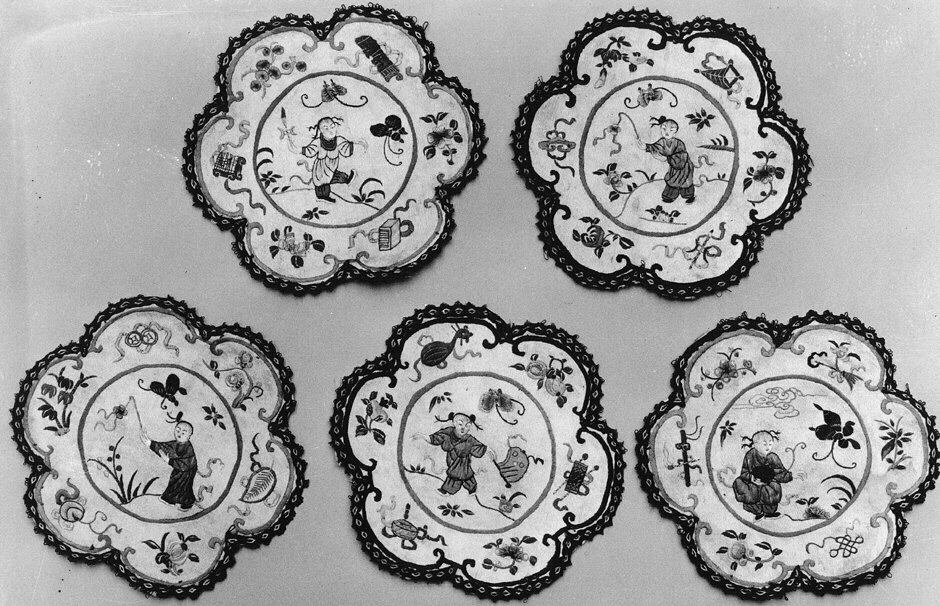
The Medallion Motif: A Silk-Bound Lexicon of Power and Permanence
Within the vast tapestry of global ornament, the medallion stands as a sovereign form. For Katherine Fashion Lab’s standalone study, we isolate this potent motif, tracing its lineage to China and its most exquisite partnership: silk-upon-silk. This is not merely decorative analysis; it is an investigation into how a circular emblem, through material and craftsmanship, became a sophisticated language of cosmology, authority, and artistic ambition. The Chinese silk medallion represents a unique confluence where form, ground, and technique achieve a state of indivisible unity, creating a self-referential universe of pattern that has influenced couture’s approach to ornament for centuries.
Cosmology Woven in Thread: The Symbolic Architecture of the Roundel
The Chinese medallion, or roundel, is fundamentally an architectural device in textile form. Its primary geometric structure—a central circle, often within a square or enclosed by rhythmic borders—mirrors the ancient Chinese concept of Tiān Yuán Dì Fāng (Heaven is round, Earth is square). This is not passive symbolism but an active ordering principle. On the silk ground, which itself was a symbol of the cultivated, ordered world, the medallion acts as a microcosm. It organizes space, creating a focal hierarchy that dictates the entire composition of the textile. Within its bounded realm, a universe unfolds: paired dragons chase the pearl of wisdom, phoenixes and qilin (mythical hooved creatures) enact celestial harmony, or intricate floral arabesques (bao xiang hua) burst with auspicious meaning.
This symbolic weight transforms the garment or hanging from a simple covering into a heraldic and talismanic object. When rendered in silk-upon-silk—through kesi (slit-tapestry) weaving, intricate embroidery, or luxurious brocade—the motif gains tactile depth. The medallion is not printed; it is built into the very structure of the fabric, making its message of cosmic order and protective power inseparable from its physical substance. For couture, this legacy challenges the superficial application of motif, arguing for designs where pattern is structurally integrated and symbolically resonant.
Silk-upon-Silk: The Apotheosis of Material Unity
The specification of "silk; on silk" is critical. This is a monomaterial dialogue of supreme sophistication. Unlike appliqué or mixed-media embellishment, the silk-upon-silk technique—whether in the sublime pictorial weft of kesi or the layered brilliance of embroidery with silk floss—creates a unified field of luxury. The ground and the motif share the same essential nature: luminosity, strength, and a sublime drape. This unity achieves several profound effects.
First, it creates a play of texture through technique alone. The slight raise of a satin-stitch dragon within a medallion against a plain silk twill ground captures light differently, defining the form through shadow and sheen rather than color contrast alone. Second, it represents the pinnacle of technical virtuosity and resource intensity. The ability to depict complex, curvilinear medallions in woven silk, a process requiring countless individual bobbins for weft threads, signaled immense imperial patronage and artistic mastery. The motif’s perfection was direct proof of the weaver’s skill and the commissioner’s power. In a couture context, this translates to a philosophy where the value lies not in the obvious addition of foreign ornament, but in the elevation of the base material itself to its most expressive, labor-intensive form.
From Imperial Robe to Couture Grammar: A Legacy of Framing and Flow
The deployment of the medallion in Chinese costume, particularly on dragon robes (longpao) and rank badges, provides a masterclass in contextual placement for power dressing. The medallion was never scattered; it was strategically positioned—centered on the chest and back, aligned over the knees—to amplify the wearer’s physical and social stature. This teaches couture the power of amplification through focal points. The motif draws the eye to the body’s core, commanding attention and asserting centrality.
Furthermore, the medallion rarely existed in isolation. It was often the anchor within a rhythmic, all-over pattern or the climax of a vertical axis. This creates a dynamic tension between the static, perfect circle and the flowing movement of the silk garment and its surrounding patterns. The design lesson is one of balanced dynamism: how to use a static, symmetrical motif to ground a composition without stifling the inherent fluidity of the luxury fabric. Modern couturiers from Yves Saint Laurent (whose 1970s collections directly referenced Chinese motifs) to contemporary designers like Guo Pei have drawn on this principle, using medallion-like forms as structural anchors on otherwise fluid silhouettes, creating wearable art that speaks of history and hierarchy.
Conclusion: The Medallion as a Modern Couture Code
Katherine Fashion Lab’s study concludes that the Chinese silk medallion is far more than a historical artifact; it is a perennial code for luxury. It encodes principles of cosmological symbolism, material integrity, technical supremacy, and strategic placement. In an era of fast fashion and digitally printed patterns, the medallion’s legacy insists on depth: the depth of meaning, the depth of craftsmanship, and the physical depth of texture achieved through monomaterial excellence.
For the future-facing couture house, this analysis suggests a path forward. It encourages exploring roundels not as exotic pastiche, but as sophisticated frameworks—architectural devices to organize a garment’s narrative. It champions techniques that build motif into fabric, celebrating the hand and the time required. Ultimately, the Chinese silk medallion teaches that true luxury in ornamentation arises from a perfect, considered marriage of profound idea, impeccable material, and relentless technical execution. It is a standalone study that, in its circular perfection, offers a complete and endlessly resonant philosophy of design.