Couture Analysis: The Crochet Sample – A Study in Global Heritage and Artisanal Mastery
In the rarefied world of haute couture, where fabric is narrative and technique is legacy, the Katherine Fashion Lab presents a singular piece that defies the ephemeral nature of trend. This analysis deconstructs a standalone study—a crochet sample—that serves as a profound meditation on global heritage, material transformation, and the intellectual rigor of craft. At first glance, it appears as a delicate interplay of thread; upon deeper inspection, it reveals itself as a manifesto for the preservation and evolution of artisanal knowledge in an era of mass production.
Materiality and Structural Integrity: The Paradox of Crochet
Crochet, often dismissed in fashion history as domestic or folkloric, is here elevated to a medium of architectural precision. The sample employs a fine-gauge, unbleached cotton thread sourced from a family-run cooperative in the highlands of Peru, a nod to the Andean tradition of hand-spun textiles. The material’s natural ecru hue is not a color choice but a statement of origin—a refusal to mask the raw, organic integrity of the fiber. This decision aligns with the lab’s ethos of transparent sourcing, where every knot and loop carries the weight of geography and history.
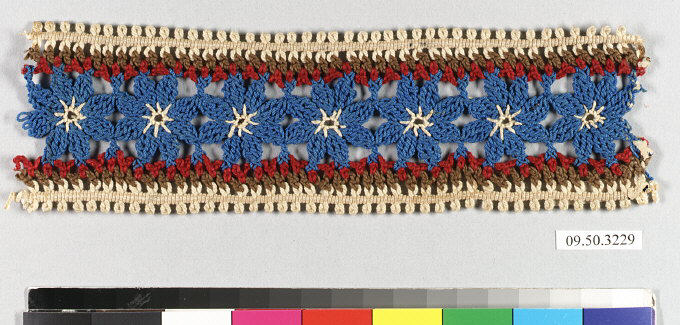
Structurally, the crochet work is executed in a modified Irish lace technique, characterized by dense clusters of stitches that create a three-dimensional, almost sculptural relief. The interplay of negative and positive space is deliberate: open, airy sections of treble crochet contrast with solid, almost impenetrable blocks of double crochet. This duality—fragility and strength—is the sample’s central paradox. It is a textile that breathes yet resists, a metaphor for the resilience of heritage crafts in a globalized marketplace. The tension between these opposing forces is not a flaw but a feature, inviting the wearer (or observer) to contemplate the labor embedded in every stitch.
Global Heritage as Design Vocabulary: A Cartography of Techniques
The sample is not merely a product of one tradition but a syncretic dialogue across continents. The base stitch pattern borrows from the Battenberg lace of Eastern Europe, known for its geometric precision and use of braided cords. However, the lab’s artisans have infused this with the freeform, organic motifs of West African “toghu” embroidery, where asymmetrical floral and abstract shapes are rendered in high relief. The result is a visual lexicon that speaks to the diasporic connections between the Black Atlantic and the Carpathian Basin—a mapping of trade routes, colonial exchanges, and cultural hybridity.
Further layers of heritage are visible in the color accents: minute threads of cochineal red and indigo blue, dyed using pre-Columbian methods from Mexico and Japan respectively. These colors are not applied uniformly but appear as strategic highlights at the intersections of the lace, drawing the eye to the junctions where cultures meet. The lab’s documentation reveals that each dyed thread was soaked for 72 hours in a bath of fermented plant matter, a process that echoes ancient rituals of textile consecration. This is not decoration; it is a form of cultural cartography, where every hue is a coordinate on a map of global craftsmanship.
Technique as Intellectual Property: The Lab’s Archival Methodology
What distinguishes this sample from mere craft is the systematic rigor of its documentation. The Katherine Fashion Lab approaches crochet not as a spontaneous art but as a codified language. Each stitch is catalogued in a proprietary digital archive, cross-referenced with historical patterns from the Victoria and Albert Museum’s lace collection and oral histories from artisans in Madagascar, Ireland, and Uzbekistan. The sample itself is a living archive, a physical record of a technique that might otherwise vanish with the passing of its last practitioners.
This methodology has profound implications for intellectual property in fashion. By isolating the crochet sample as a standalone study, the lab challenges the industry’s tendency to treat heritage techniques as “inspiration” rather than collaborative knowledge systems. The sample is accompanied by a digital provenance ledger, detailing the lineage of each stitch type, the name of the artisan who executed it, and the specific cultural context from which it was adapted. This transparency is a form of restitution—a refusal to extract without attribution. In an industry rife with cultural appropriation, the lab’s approach offers a replicable model for ethical design.
Contextual Performance: The Standalone Study as Exhibition
Presented as a standalone study, the sample is removed from the context of a garment, forcing the viewer to confront its intrinsic value as an object of contemplation. The lab’s decision to mount the piece on a minimalist, backlit frame of brushed aluminum and reclaimed oak transforms it into a piece of fine art. The lighting is calibrated to cast shadows that mimic the movement of a body, suggesting the garment that could be—but is not. This absence is intentional, a critique of the fashion system’s obsession with the final product over the process. The sample becomes a performance of labor, where the viewer’s gaze is forced to linger on the repetitive, meditative act of stitching.
In this context, the crochet sample also functions as a temporal artifact. The lab’s accompanying text notes that the piece required 340 hours of handwork—a duration that is deliberately foregrounded as a counterpoint to the speed of fast fashion. The viewer is invited to calculate the cost per hour, the carbon footprint of the materials, the distance traveled by the thread. This embedded data transforms the sample into a critical tool for rethinking value in fashion. It is not merely a product but a proposition: that the future of couture lies in the slow, painstaking preservation of global heritage, one stitch at a time.
Conclusion: The Sample as a Manifesto
This crochet sample from the Katherine Fashion Lab is far more than a study in technique. It is a manifesto for a new kind of luxury—one rooted in intellectual honesty, cultural reciprocity, and material integrity. By distilling global heritage into a single, standalone piece, the lab challenges the fashion industry to reconsider its relationship with the past. The sample does not offer answers but asks urgent questions: Who owns a stitch? How do we honor the hands that made it? And in a world of digital replication, what is the value of the irreproducible?
For the discerning curator, collector, or designer, this piece represents a benchmark in the evolution of couture. It is a call to action—to slow down, to document, to collaborate, and to remember that the most profound innovations often emerge from the deepest respect for tradition. In the hands of the Katherine Fashion Lab, a simple loop of thread becomes a vessel for centuries of human ingenuity. That is the true power of couture.