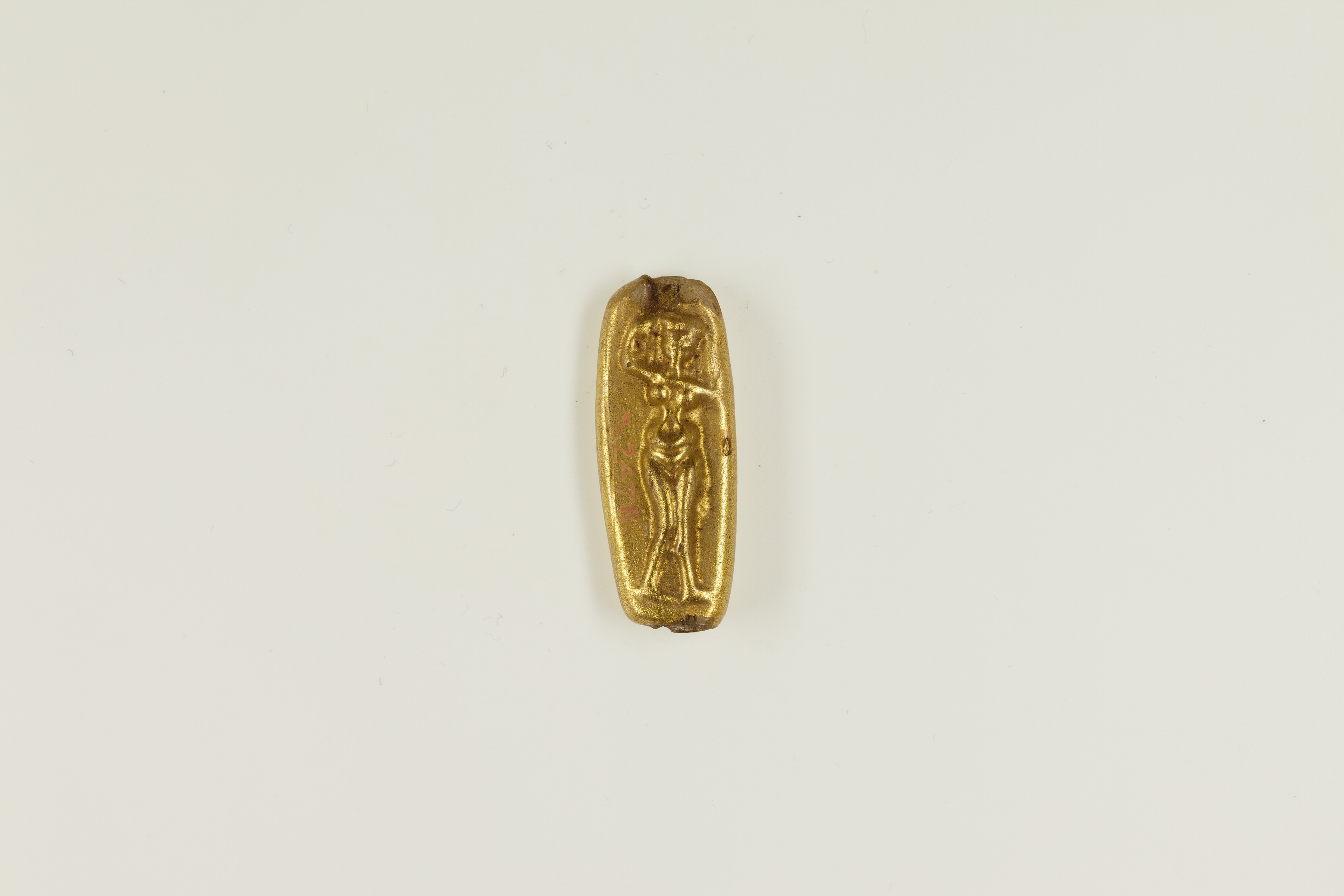
Heritage Analysis: The Bead with Figure of a Goddess (Aphrodite Anadyomene)
Introduction: Artifact as Strategic Asset
This heritage analysis examines a singular glass bead, inlaid with gold foil, featuring the figure of a goddess—most likely Aphrodite Anadyomene, the goddess of love, beauty, and procreation rising from the sea. Originating from an ancient civilization, likely Hellenistic or Roman-era Eastern Mediterranean (circa 3rd century BCE to 1st century CE), this artifact represents a convergence of material mastery, spiritual devotion, and social signaling. For Katherine Fashion Lab, this bead is not merely a historical curiosity but a strategic blueprint for 2026 high-end luxury positioning. The following analysis deconstructs its symbolic power, historical adornment function, spiritual meaning, and offers actionable insights for a luxury brand strategy rooted in authenticity, rarity, and narrative depth.
Symbolic Power: The Goddess as Brand Icon
The figure of Aphrodite Anadyomene—depicted wringing seawater from her hair—embodies a universal archetype of feminine allure, transcendence, and regenerative power. In the context of this bead, the goddess is miniaturized yet magnified: her image, rendered in glass and gold, becomes a portable talisman of divine favor. The choice of glass, a material that mimics precious gemstones while being accessible to a broader elite, signals a sophisticated hierarchy of value. The gold foil beneath the glass amplifies luminosity, creating a halo effect that elevates the wearer’s status.
For Katherine Fashion Lab, this symbolic power translates directly into brand iconography. The goddess motif can serve as a recurring emblem—a signature cipher—that communicates exclusivity and timeless beauty. In 2026, where luxury consumers seek meaning beyond logos, embedding a deity’s narrative into product design (e.g., a pendant, a clasp, or a textile pattern) offers a layer of intellectual prestige. The bead’s dual materiality—glass and gold—also suggests a balance between fragility and permanence, a tension that high-end clients find compelling in an era of disposable fashion.
Historical Adornment: The Bead as Social Capital
In ancient civilizations, beads were not mere ornaments; they were currency of identity. A glass bead with gold foil and a goddess figure would have been worn as a necklace, bracelet, or sewn onto ceremonial garments. Its placement on the body—often near the heart or throat—indicated its role as a protective amulet and a marker of wealth. Archaeological evidence from Hellenistic burial sites shows that such beads were interred with their owners, underscoring their perceived spiritual and material value in the afterlife.
This historical function of adornment as social capital mirrors contemporary luxury dynamics. The bead’s small scale yet high impact aligns with the 2026 trend toward “quiet luxury”—pieces that are discreet in size but immense in craftsmanship and narrative. Katherine Fashion Lab can leverage this by creating a capsule collection of “amulet-inspired” accessories, each referencing a specific ancient goddess or mythological figure. The bead’s portability also suggests a strategy for micro-luxury: small, high-value items (e.g., earrings, brooches, or keychains) that democratize entry into the brand’s universe while maintaining exclusivity through limited editions.
Spiritual Meaning: The Talisman as Emotional Anchor
Spiritually, the bead with Aphrodite Anadyomene functioned as a conduit between the mortal and divine. In Greco-Roman tradition, Aphrodite was invoked for love, fertility, and safe passage through life’s transitions. The bead’s glass medium—translucent, reflective, and fragile—symbolized the soul’s journey, while the gold foil represented the eternal, unchanging essence of the divine. Wearing such a talisman was an act of devotion, a prayer made visible.
For the 2026 luxury consumer, spiritual meaning is increasingly commodified but also deeply personal. Katherine Fashion Lab can tap into this by positioning the bead’s heritage as a form of “curated spirituality.” Rather than appropriating ancient beliefs, the brand can offer a contemporary interpretation: the bead as a symbol of self-love, resilience, and inner beauty. This aligns with the wellness-luxury convergence, where high-end products are marketed as tools for emotional well-being. A strategic campaign could emphasize the bead’s “protective” and “empowering” qualities, using storytelling that connects the wearer to a lineage of powerful women—from ancient priestesses to modern leaders.
2026 High-End Luxury Strategy: From Artifact to Asset
To translate this heritage analysis into a 2026 strategy, Katherine Fashion Lab must adopt a three-pronged approach: authenticity, scarcity, and narrative immersion.
Authenticity requires rigorous provenance research. The bead’s exact origin—whether from a specific workshop in Alexandria or a temple in Cyprus—must be documented and communicated transparently. Collaborations with archaeologists or museum curators can lend credibility. For example, a limited-edition “Aphrodite Anadyomene” necklace could be released with a certificate of authenticity referencing the original artifact’s museum catalog number (if replicable) or a modern artisan’s interpretation using period-accurate techniques.
Scarcity is inherent in the bead’s singular nature. Katherine Fashion Lab should produce no more than 500 units of any goddess-inspired piece, each numbered and registered. This mirrors the ancient practice of commissioning bespoke amulets from master glassmakers. The use of glass and gold foil—materials that require specialized skill—further limits production, reinforcing the brand’s commitment to artisanal excellence over mass output.
Narrative immersion is the final pillar. The bead’s story must be told through multiple touchpoints: a short film reenacting the goddess’s myth, a digital lookbook styled with ancient drapery and modern silhouettes, and in-store installations that evoke a temple setting. The 2026 consumer craves experiences, not just products. By offering a “ritual unboxing” experience—complete with a scroll-like booklet detailing the bead’s spiritual significance—Katherine Fashion Lab transforms a purchase into a rite of passage.
Conclusion: The Bead as Strategic Compass
The bead with the figure of Aphrodite Anadyomene is a microcosm of luxury’s enduring principles: beauty as power, adornment as identity, and spirituality as connection. For Katherine Fashion Lab, this artifact offers a roadmap for 2026 that eschews trend-chasing in favor of timeless symbolism. By embracing the bead’s heritage—its materials, its goddess, its talismanic role—the brand can position itself as a curator of meaning in a market saturated with noise. The result is not just a product line but a cultural statement: that true luxury is not worn; it is inhabited.