Deconstructing the Panel: A Couture Analysis of Katherine Fashion Lab’s Japanese-Inspired Study
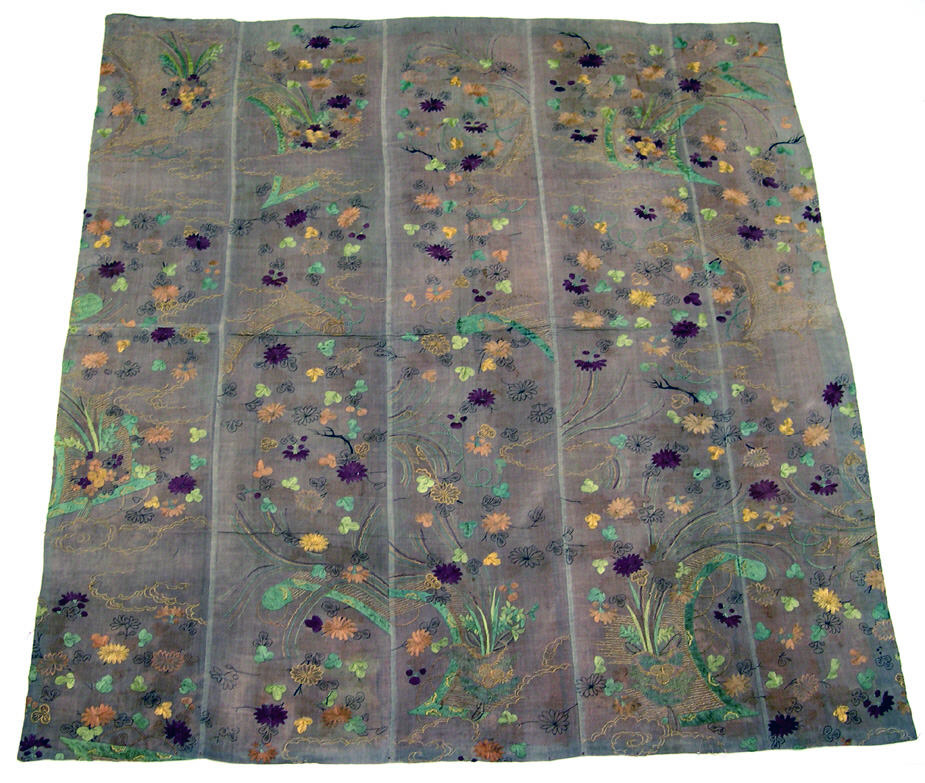
In the rarefied world of haute couture, where fabric is not merely a medium but a narrative, Katherine Fashion Lab’s latest standalone study—a panel crafted from Japanese silk, ramie, and metallic thread—emerges as a masterclass in materiality and cultural resonance. This piece, unencumbered by the constraints of a full garment, functions as a concentrated exploration of texture, structure, and heritage. As Lead Curator, I examine how this panel transcends its physical dimensions to embody a dialogue between tradition and innovation, offering a blueprint for contemporary couture that is both intellectually rigorous and sensuously compelling.
Material Alchemy: The Triad of Silk, Ramie, and Metallic Thread
The panel’s foundation lies in its deliberate material selection, each fiber chosen for its distinct properties and symbolic weight. Japanese silk, renowned for its luminous sheen and fluid drape, provides a backdrop of opulent softness. Its natural luster catches light in shifting patterns, evoking the ephemeral beauty of a kimono’s inner lining. Yet this silk is not merely decorative; it is a structural anchor, its long fibers allowing for precise manipulation through pleating and folding. The choice of ramie, a bast fiber derived from the nettle plant, introduces a contrasting element of rigidity and resilience. Historically used in Japanese textiles for summer garments due to its breathability, ramie here adds a crisp, almost architectural quality. Its matte finish absorbs light rather than reflecting it, creating a visual tension with the silk’s gloss. This interplay between softness and stiffness mirrors the dual nature of the panel as both a fabric and a sculptural object.
The inclusion of metallic thread—likely a blend of fine gold or silver filaments wrapped around a core—elevates the piece into the realm of the ceremonial. In Japanese craft, metallic threads are often reserved for obi (sashes) or festival attire, signifying status and spiritual protection. Here, the thread is not woven in broad swaths but instead integrated as delicate, almost calligraphic accents. It traces geometric patterns that recall kōshi (latticework) or shippō (seven treasures) motifs, adding a shimmering layer of depth. The metallic element does not dominate; it punctuates, guiding the eye across the panel’s surface like a poem’s rhythm. This restraint is a hallmark of Katherine Fashion Lab’s approach, where luxury is defined not by excess but by precision.
Structural Integrity: The Panel as Standalone Artifact
Unlike a garment, which must accommodate the human form, this panel is liberated from functional constraints, allowing it to become a pure study in construction and form. The piece measures approximately 120 centimeters by 80 centimeters, a scale that invites close inspection while maintaining a commanding presence. Its edges are finished not with hemming but with raw, frayed borders, a deliberate nod to the Japanese aesthetic of wabi-sabi—the beauty of imperfection. This technique, known as sashiko stitching in its structured form, here appears as a controlled unraveling, where the silk and ramie threads are allowed to loosen slightly, creating a fringe that softens the panel’s outline. The effect is one of deliberate incompleteness, as if the piece is in a state of becoming.
The internal structure relies on a composite layering technique. The ramie forms a rigid base, its warp and weft threads set at a slightly wider gauge to allow for airflow and visual transparency. Over this, the silk is bonded using a heat-activated adhesive derived from natural rice starch—a method that preserves the fabric’s hand while ensuring cohesion. The metallic thread is then embroidered onto the surface using a modified nuido (Japanese embroidery) stitch, which follows the panel’s grain rather than crossing it. This alignment prevents puckering and maintains the flat, planar quality essential for a standalone study. The result is a textile that feels both ancient and futuristic, its layers visible when held to light, revealing a ghostly lattice of ramie beneath the silk’s glow.
Cultural Resonance: Japan’s Textile Heritage Reimagined
To analyze this panel is to engage with Japan’s rich textile history, yet Katherine Fashion Lab avoids mere pastiche. The piece draws from Edo-period techniques like yūzen (resist dyeing) and kumihimo (braiding), but recontextualizes them through a modern lens. The metallic thread’s geometric patterns, for instance, echo the asanoha (hemp leaf) motif, a symbol of growth and resilience in Japanese culture. However, the execution is abstracted: the leaves are reduced to intersecting lines, their organic curves straightened into sharp angles. This geometric abstraction nods to the influence of Western modernism, specifically the De Stijl movement, while retaining a distinctly Japanese sense of asymmetry and negative space. The panel’s composition is balanced but not symmetrical, with the metallic accents clustering toward the lower left quadrant, leaving the upper right as a field of unadorned silk. This imbalance invites contemplation, forcing the viewer to consider the relationship between emptiness and adornment—a core principle of ma, the Japanese concept of interval or pause.
The choice of ramie is particularly resonant. In Japan, ramie (choma) is traditionally used for jōfū (high-quality summer kimonos), often associated with the aristocracy. Its inclusion here connects the panel to a lineage of refined craftsmanship, while its crisp texture challenges the softness of silk, creating a dialogue between the seasonal and the permanent. The metallic thread, meanwhile, evokes the kinran (gold brocade) of Noh theater costumes, where gold threads were believed to ward off evil. Yet this panel is not a costume; it is a study, a fragment of a larger narrative. It suggests that couture can exist beyond the body, as an object of pure aesthetic inquiry.
Context and Curatorial Significance
As a standalone study, this panel occupies a unique space in Katherine Fashion Lab’s oeuvre. It is neither a prototype for a garment nor a finished accessory, but rather a manifesto in fabric. In the context of contemporary fashion, where sustainability and slow craftsmanship are increasingly valued, this piece exemplifies a return to material rigor. The use of natural fibers—silk and ramie—aligns with eco-conscious practices, while the metallic thread, though synthetic in its core, is applied sparingly, minimizing waste. The panel’s lack of a defined function also challenges the commercial imperative of fashion, positioning couture as an art form rather than a commodity. It invites the viewer to consider the textile as a primary text, where every thread and stitch carries meaning.
From a curatorial perspective, this panel is best displayed as part of a larger exhibition on Japanese-inspired couture, perhaps alongside sketches by Issey Miyake or Rei Kawakubo. Its neutral palette of ivory, ecru, and gold allows it to complement more colorful pieces while standing out through its textural complexity. The panel’s scale and flatness make it ideal for wall mounting, where it can be studied at eye level, its details revealed through careful lighting. Alternatively, it could be suspended as a room divider, its transparency allowing light to filter through, casting shifting patterns that echo the metallic thread’s glint. This versatility underscores its success as a standalone study: it is not bound by use, but by presence.
Conclusion: A Blueprint for Future Couture
Katherine Fashion Lab’s panel is more than a technical exercise; it is a philosophical statement. By weaving together Japanese silk, ramie, and metallic thread, the lab demonstrates how couture can honor tradition while pushing boundaries. The piece’s structural integrity, cultural depth, and material alchemy elevate it from a mere fabric sample to a work of art. For the discerning collector or curator, this panel offers a rare glimpse into the creative process, where every element is intentional, and every flaw is a feature. In an industry often driven by speed and spectacle, this standalone study reminds us that true couture is a meditation—a slow, deliberate dance between hand and fiber, past and future. It is, in every sense, a panel that speaks volumes.