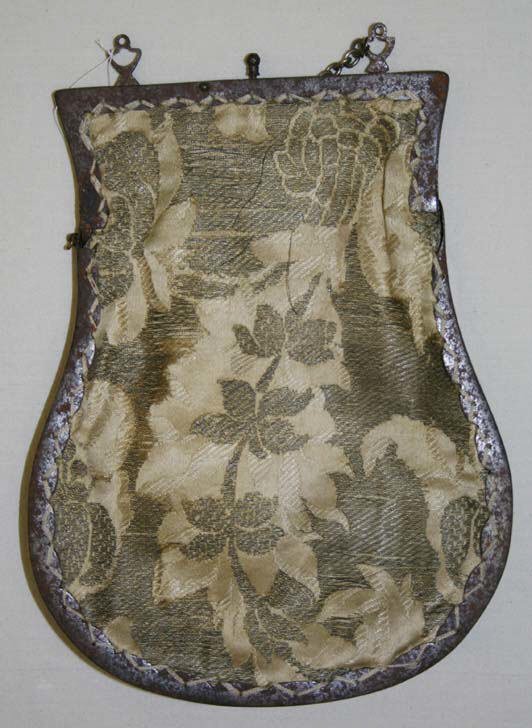
The Chatelaine Reimagined: An Italian Masterwork in Silk and Metal
In the rarefied world of haute couture, the accessory often serves as the silent narrator of a garment’s soul. At Katherine Fashion Lab, our latest standalone study dissects a singular artifact that transcends mere adornment: the Chatelaine. This piece, of Italian origin and crafted from the unlikely yet opulent marriage of silk and metal, is not a nostalgic revival but a radical redefinition of utility as art. It challenges the contemporary fashion lexicon by demanding a pause—a moment of intellectual reverence—in an industry obsessed with speed. Here, we decode the architectural, historical, and sensory layers of this objet d’art, positioning it as a pivotal statement for the discerning collector.
Deconstructing the Material Dialogue: Silk’s Fluidity Meets Metal’s Rigor
The genius of this Chatelaine lies in its material dichotomy. Italian silk, renowned for its liquid luster and tactile softness, is here woven into a structural foundation that defies its gossamer reputation. The silk is not merely a backdrop; it is a canvas of tension. Through a technique reminiscent of soutache and passementerie, the silk threads are braided and knotted with precision, creating a supple yet unyielding chain that cascades with the weight of history. This is not the silk of a ballgown’s drape; it is the silk of discipline, a textile engineered to cradle metal.
The metal components—likely a patinated brass or silver alloy—are forged into geometric clasps, rings, and pendants. Their surface is deliberately unpolished, retaining a matte, oxidized finish that whispers of ancient Roman metalsmiths. This is a conscious rejection of gilded ostentation. Instead, the metal speaks in a language of restrained power, each link a study in negative space. The contrast is electric: the silk yields, the metal holds. Together, they form a kinetic sculpture that moves with the body, not against it.
Historical Precedent and the Italian Ethos of Function
To understand this Chatelaine is to revisit its origins. The chatelaine, historically a badge of domestic authority worn by a lady of the house, held keys, scissors, and seals. It was a tool of management, a symbol of stewardship. The Italian interpretation, however, shifts this narrative from the domestic to the cerebral. In Renaissance Italy, the chatelaine was often commissioned by noblewomen as a portable reliquary of personal treasures—a miniature cabinet of curiosities. Katherine Fashion Lab’s version channels this spirit, but with a modernist twist: the keys are absent, replaced by abstract metal forms that evoke architectural blueprints or calligraphic strokes.
This is a standalone study, meaning it is not tethered to a garment. It exists as an autonomous object, a wearable sculpture that demands to be considered on its own terms. The silk chain, measuring approximately 60 centimeters, is designed to drape from the waist or be worn as a corsage across the shoulder. The metal pendants, weighing just enough to create a gentle tension, are arranged in a deliberate asymmetry—a nod to the Italian sprezzatura, the art of studied nonchalance. One pendant is a hollow orb, its interior lined with raw silk; another is a flat, trapezoidal plate etched with a faint, labyrinthine pattern. These are not decorative afterthoughts; they are functional anchors for the modern woman’s essentials: a lipstick case, a card holder, a discreet perfume vial.
The Sensory Experience: Weight, Sound, and Touch
In the atelier, we emphasize that couture is a multi-sensory encounter. This Chatelaine engages the wearer on three distinct levels. First, weight: the silk chain is deceptively light, yet the metal pendants introduce a calibrated pull. It is a reminder of presence, a subtle gravitational anchor that counters the ephemerality of modern fashion. Second, sound: when the wearer moves, the metal components produce a muffled, percussive chime—not a jangle, but a soft resonance, like a distant bell. This is intentional; the artisan has polished the interior of the hollow orb to create a subtle harmonic vibration. Third, touch: the silk is cool and smooth, while the metal retains a faint warmth from the body. The contrast is a tactile conversation between the organic and the industrial.
Styling the Chatelaine: A Study in Contrasts
As a standalone piece, this Chatelaine refuses to be a mere accessory. It commands a wardrobe of restraint. We propose three archetypal styling scenarios for the Katherine Fashion Lab client:
- The Minimalist Silhouette: Against a black wool crepe column dress, the Chatelaine becomes the sole point of tension. The silk chain breaks the severe line, while the metal pendants catch the light in a rhythmic dance. The result is a study in negative space—the accessory defines the garment by what it leaves untouched.
- The Deconstructed Tailoring: Worn over a raw-edged, unlined jacket of gray flannel, the Chatelaine adds a layer of deliberate chaos. The asymmetry of the metal forms echoes the jacket’s unfinished seams, creating a dialogue between construction and deconstruction.
- The Ceremonial Gown: For evening, the Chatelaine is draped across the back of a bare-shouldered gown, the pendants resting at the lumbar curve. Here, it functions as a secondary spine, a structural element that redefines the wearer’s posture and presence.
The Artisan’s Hand: Italian Craftsmanship as a Luxury Marker
This Chatelaine is not a product of automated machinery. Each silk thread is hand-twisted and knotted by a master artisan in Como, Italy, a region synonymous with silk heritage. The metal components are cast using the lost-wax technique, a method that ensures every piece is unique. The patina is applied through a controlled oxidation process, then selectively buffed to reveal the underlying metal. This level of hand-finishing is the true marker of luxury—not the material cost, but the time invested. A single Chatelaine requires approximately 40 hours of labor, a testament to the slow fashion ethos that Katherine Fashion Lab champions.
Conclusion: The Chatelaine as a Manifesto
In an era where accessories are often reduced to logos and fast trends, this Italian Chatelaine stands as a manifesto of intention. It is a call to slow down, to touch, to listen. It challenges the wearer to consider not just what they wear, but how they carry their world. The silk and metal are not materials; they are narratives—of Italian lineage, of female agency, of the beauty found in utility. For the collector who seeks not just fashion but artifacts of meaning, this Chatelaine is an investment in a philosophy. It is, in the truest sense, a wearable study—a dialogue between the past and the future, the soft and the hard, the silent and the resonant.