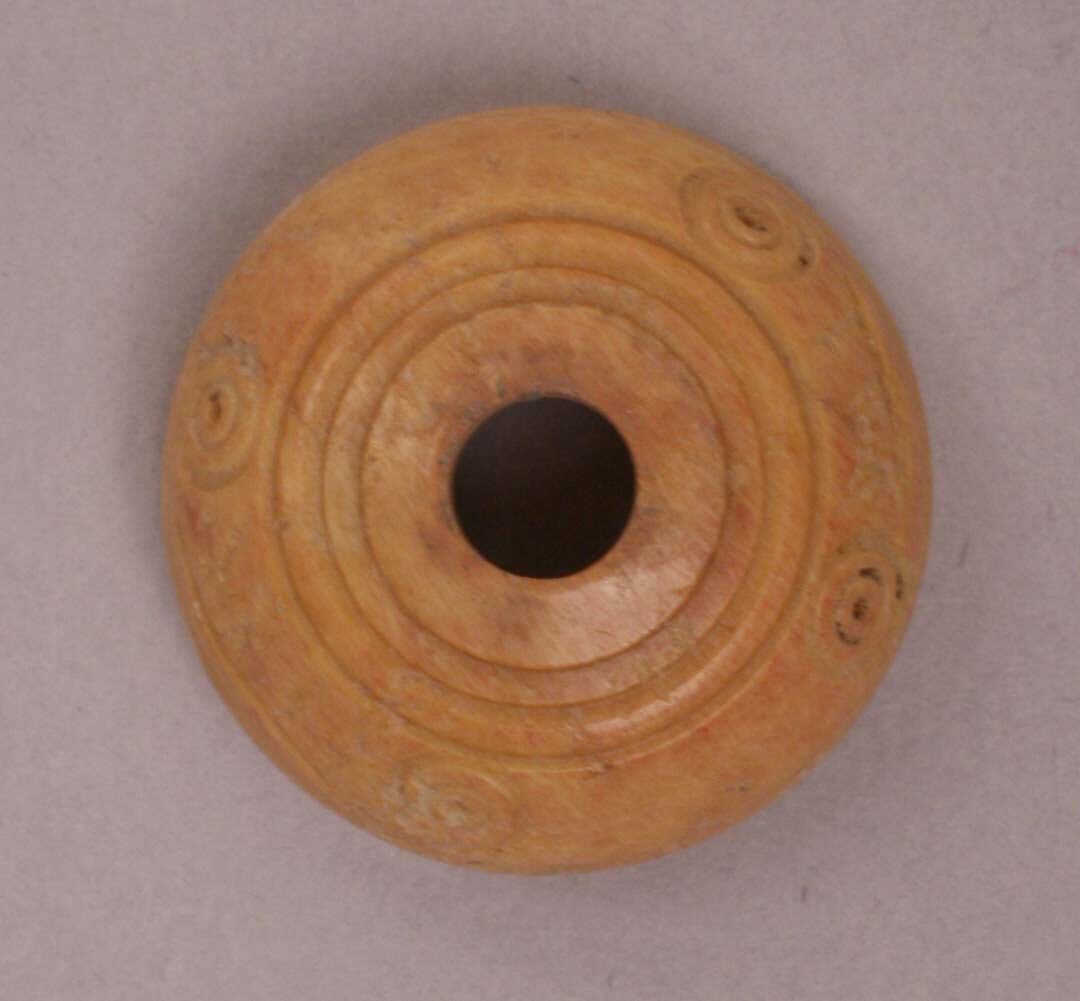
A Couture Analysis of the Button-Bead: Bone as a Vessel of Global Heritage
In the vast lexicon of fashion, the button and the bead are often relegated to the status of mere fasteners or embellishments—functional afterthoughts in the service of silhouette. Yet, in the hands of a discerning curator, these micro-objects become profound repositories of cultural memory, material mastery, and aesthetic philosophy. At Katherine Fashion Lab, a standalone study of a singular artifact—a button-bead crafted from tinted, incised, and paint-inlaid bone—reveals a world of meaning. This object, born from the deep well of Global Heritage, challenges the modern fashion industry’s tendency toward disposability and homogeneity. It demands that we reconsider the button not as a closure, but as a narrative node; the bead not as a decoration, but as a document of human ingenuity. This analysis deconstructs the piece through three lenses: material provenance, artisanal technique, and cultural semiotics, arguing that such objects are essential to the future of ethical, story-driven couture.
Material Provenance: Bone as a Testament to Sustainability and Sacrality
The choice of bone as the primary substrate is neither arbitrary nor purely aesthetic. In the context of Global Heritage, bone has been utilized across civilizations—from the Inuit carvers of the Arctic to the Yoruba artisans of West Africa—as a medium that bridges the organic and the symbolic. Unlike synthetic polymers or precious metals, bone is a byproduct of sustenance, a material that carries the weight of life and death. Its use in this button-bead signals a pre-industrial sensibility: a reverence for resources that modern couture, with its reliance on petroleum-based plastics and mined gemstones, has largely abandoned.
From a sustainability standpoint, bone represents a closed-loop material system. It is biodegradable, locally sourced in many indigenous contexts, and requires no energy-intensive extraction. The tinting process—likely achieved through natural pigments derived from ochre, plant extracts, or mineral salts—further aligns the object with ecological consciousness. The incised lines and inlaid paint are not merely decorative; they are a form of material alchemy, transforming a discarded remnant into a cherished heirloom. For Katherine Fashion Lab, this piece stands as a quiet rebuke to fast fashion’s linear “take-make-waste” model. It proposes a circular economy where every object carries the intention of longevity, where the button-bead is not a commodity but a companion.
Artisanal Technique: The Language of Incision and Inlay
The technical execution of this bone button-bead is a masterclass in precision and patience. The incised lines are not random scratches; they are deliberate strokes that follow the grain of the bone, respecting its natural curvature. This technique, known as kerfschnitt in traditional European carving, requires a steady hand and an intimate understanding of the material’s brittleness. Too deep a cut, and the bone fractures; too shallow, and the inlay will not adhere. The artisan has thus created a topography of texture—a landscape of ridges and valleys that catch light and shadow, giving the object a dynamic, almost kinetic quality.
The inlaid paint, likely a mixture of resin and pigment, is applied with surgical care. In many Global Heritage traditions—such as the Lacquerware of East Asia or the Pietra Dura of Mughal India—inlay work is a sign of high status, reserved for objects of ritual or regal significance. Here, the paint fills the incised channels, creating a contrast that is both subtle and striking. The tinting of the bone itself adds a third dimension: a warm, earthy undertone that softens the starkness of the natural ivory. This layering of color and cut is not merely decorative; it is a form of storytelling. Each incision may represent a lineage, a prayer, or a protective symbol—a language that speaks to those who understand the craft.
For the modern designer, this technique offers a blueprint for slow luxury. In an era of machine-stamped buttons and injection-molded beads, the hand-incised bone object demands a revaluation of time. It suggests that couture need not be defined by speed or volume, but by the depth of engagement between maker and material. Katherine Fashion Lab’s standalone study thus becomes a pedagogical tool, urging the industry to invest in artisanal partnerships that preserve these dying skills.
Cultural Semiotics: The Button-Bead as a Global Signifier
To understand the cultural weight of this object, one must first disentangle the button from the bead—or rather, recognize their synthesis. In Western fashion history, the button emerged as a functional fastener in the 13th century, a tool of modesty and tailoring. The bead, by contrast, has ancient roots as a talisman, currency, and status marker. This bone piece collapses that binary: it is both a closure and a charm, a utilitarian device and a spiritual artifact.
The incised patterns—whether geometric, zoomorphic, or abstract—are likely drawn from a specific heritage. For instance, the use of concentric circles and spirals appears in Celtic, Maori, and Native American iconography, often symbolizing eternity, cycles of life, or celestial navigation. The tinted hues—perhaps a deep ochre or a muted indigo—may reference the earth or the sky, grounding the object in cosmological belief. When worn, this button-bead becomes a portable shrine, a microcosm of the wearer’s identity and ancestry. It is not a passive accessory; it is an active participant in the construction of self.
In the context of global fashion, this object challenges the hegemony of Western minimalism. It proposes that ornamentation is not excess but essence. The button-bead does not hide; it announces. It demands to be seen, touched, and interpreted. For Katherine Fashion Lab, this is a radical proposition: that fashion can be a site of cultural exchange rather than cultural appropriation. By presenting this piece as a standalone study—without a garment to contextualize it—the lab elevates the button-bead to the status of art. It asks the viewer to consider its form, its history, and its future, free from the distractions of trend or seasonality.
Implications for Couture and Curatorial Practice
The standalone study of this tinted, incised, and paint-inlaid bone button-bead offers a powerful lesson for contemporary couture. It demonstrates that luxury is not a function of price but of intention. The object’s value lies not in its rarity—bone is common—but in the labor, knowledge, and narrative embedded in its surface. For designers, this suggests a new metric for success: not how many pieces are sold, but how many stories are preserved.
Furthermore, this analysis underscores the importance of curatorial rigor in fashion. By isolating the button-bead from its typical context—a jacket, a necklace, a ceremonial garment—Katherine Fashion Lab forces a confrontation with the object itself. This is a practice that fashion institutions would do well to adopt: to slow down, to study the micro, to find the universe in a single bead. It is a methodology that honors Global Heritage not as a trend to be mined, but as a wisdom to be learned.
In conclusion, the bone button-bead is far more than a component of dress. It is a time capsule, a testament to human skill, and a call to action. For the fashion industry, it represents a path forward—one that values material integrity, cultural depth, and artisanal excellence. As Lead Curator of Katherine Fashion Lab, I submit that this object is not merely a subject of analysis; it is a manifesto for a more thoughtful, more beautiful world.