The Art of the Sampler: A Couture Analysis of Katherine Fashion Lab’s Embroidered Heritage
In the rarefied world of haute couture, where each stitch is a decision and every thread a narrative, the Sampler by Katherine Fashion Lab emerges as a profound meditation on global heritage. This standalone study, executed in silk on wool canvas, transcends the conventional boundaries of fashion accessory or garment prototype. It is, instead, a meticulously curated artifact that interrogates the very essence of craftsmanship, memory, and cultural synthesis. As Lead Curator, I approach this piece not merely as a textile object but as a strategic statement—a deliberate departure from seasonal trends toward a timeless lexicon of artistry.
Materiality as a Narrative Device
The choice of silk on wool canvas is neither arbitrary nor purely aesthetic. Silk, with its luminous, fluid quality, represents the ephemeral and the precious—often reserved for ceremonial or sacred contexts across Asian and European traditions. Wool canvas, conversely, evokes the utilitarian, the grounded, and the durable—a staple of pastoral communities from the Scottish Highlands to the Andean altiplano. By marrying these two materials, Katherine Fashion Lab engineers a dialogue between the ethereal and the structural. The silk threads, meticulously hand-stitched, do not simply rest atop the wool; they penetrate it, creating a tactile tension that mirrors the friction between global influences and local identities. This material juxtaposition forces the viewer to confront the cost of beauty—both in labor and in cultural appropriation—while celebrating the syncretic potential of fashion.
From a couture perspective, the technical execution is exacting. The silk’s sheen contrasts with the matte, napped surface of the wool, producing a chiaroscuro effect that shifts with ambient light. This is not a fabric that submits to flat photography; it demands physical engagement. The canvas itself, with its discernible weave, provides a grid-like foundation that the silk embroidery disrupts, creating a rhythmic counterpoint between order and ornamentation. Such attention to material dialogue elevates the Sampler beyond mere decoration into a study of textile physics and cultural symbolism.
The Sampler as a Global Lexicon
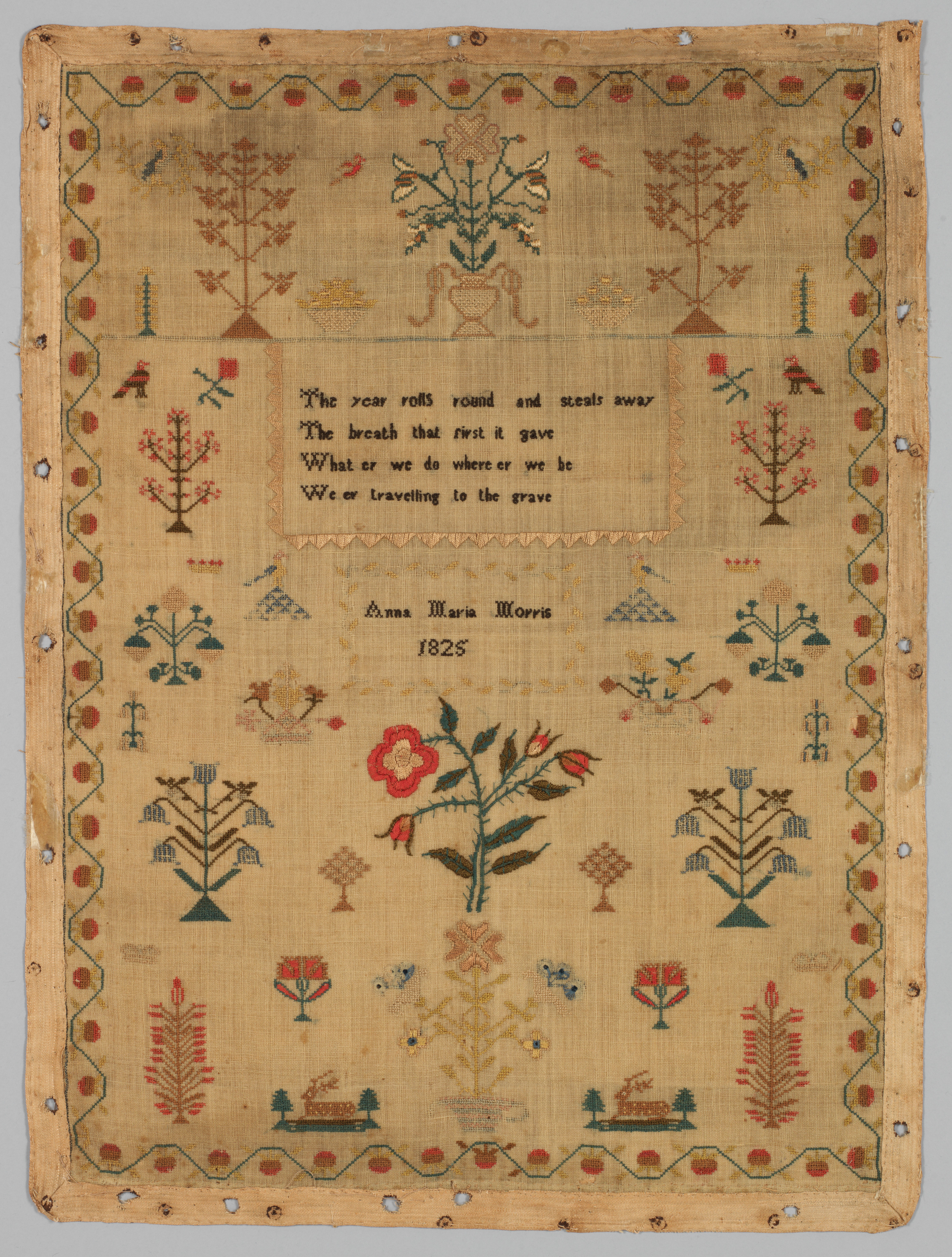
Historically, the sampler—a piece of embroidery showcasing stitches and patterns—served as a pedagogical tool, a portfolio of skill, and a repository of folk motifs. Katherine Fashion Lab’s iteration recontextualizes this tradition for a globalized era. The motifs stitched into the wool canvas are not random; they are curated signifiers drawn from diverse heritages: the interlacing Celtic knot, the geometric precision of Islamic arabesques, the floral exuberance of Indian phulkari, and the restrained elegance of Japanese sashiko. Each motif is rendered in silk with a fidelity that honors its origin, yet the composition is entirely contemporary—asymmetrical, overlapping, and intentionally non-hierarchical.
This synthesis is not a pastiche but a critical dialogue. The Celtic knot, representing eternity and connection, intersects with the arabesque, which symbolizes the infinite nature of creation. The phulkari flower, a symbol of fertility and joy, is juxtaposed with the sashiko’s functional stitching, born from necessity in rural Japan. By placing these motifs in conversation, the Sampler challenges the viewer to consider how heritage is both preserved and transformed in the hands of a global artisan. It asks: Can a single object embody multiple, sometimes conflicting, cultural narratives without diluting their essence? Katherine Fashion Lab’s answer is a resounding yes—but only through the discipline of intentional design and the humility of research.
Standalone Study: Decontextualization and Power
Presented as a standalone study, the Sampler is deliberately removed from the functional constraints of a garment. It does not drape, fasten, or adorn a body. Instead, it exists as an autonomous object, akin to an artist’s proof or a designer’s mood board made manifest. This decontextualization is a strategic curatorial choice. By isolating the embroidery, Katherine Fashion Lab forces the audience to focus solely on the labor and semiotics of the stitch, unmediated by silhouette or wearability. The Sampler becomes a meta-text—a commentary on the fashion industry’s tendency to extract and commodify cultural symbols without acknowledgment.
In a luxury market where “heritage” is often a marketing buzzword, this piece demands accountability. The global provenance of the motifs is not obscured; it is celebrated through precise execution and, presumably, through transparent sourcing of techniques. The wool canvas, for instance, could be traced to a specific region known for its pastoral traditions, while the silk threads might originate from a particular sericulture community. This traceability is not merely ethical posturing but a value proposition for the discerning collector who understands that authenticity in couture is as much about provenance as it is about aesthetics.
Implications for Couture and Cultural Stewardship
As a piece of couture analysis, the Sampler by Katherine Fashion Lab offers several lessons for the industry. First, it demonstrates that innovation need not be technological. In an era obsessed with digital fabrication and AI-generated patterns, this piece reaffirms the power of handcraft—the slow, deliberate, and irreproducible mark of the human hand. Each silk stitch is a signature, a moment of decision that cannot be undone or replicated by a machine. This is the ultimate luxury: the evidence of time and skill.
Second, the Sampler challenges the binary between “high” and “low” art. By elevating a domestic, often feminized craft (embroidery) to the status of couture study, Katherine Fashion Lab subverts traditional hierarchies. The piece argues that the sampler, historically dismissed as women’s work or folk art, contains within it a sophisticated vocabulary of design, mathematics, and cultural transmission. This revaluation is particularly resonant in a post-colonial fashion landscape, where the industry is reckoning with its history of exploiting non-Western crafts.
Finally, the Sampler serves as a blueprint for ethical innovation. It does not claim to “save” or “represent” the cultures it references; instead, it enters into a respectful partnership with them. The motifs are not flattened into generic “world” patterns but retain their specificities—the knot’s interlacing, the arabesque’s symmetry, the phulkari’s density. This requires not only technical skill but also deep cultural literacy, which Katherine Fashion Lab appears to prioritize. For the collector, this piece is not just an investment in beauty but in cultural stewardship—a tangible commitment to preserving and reinterpreting global heritage with integrity.
Conclusion: The Sampler as a Living Archive
In its final form, the Sampler is neither a finished garment nor a mere sample. It is a living archive—a portable museum of stitches, a testament to the enduring power of human creativity across borders. Katherine Fashion Lab has produced a work that is at once intimate and monumental, personal and universal. For the curator, the scholar, or the connoisseur, this piece offers infinite layers of analysis: material, cultural, and philosophical. It reminds us that in the hands of a master, a single thread can weave together the stories of the world. And in doing so, it redefines what couture can be—not just clothing, but a form of global dialogue, stitched in silk and wool, for the ages.