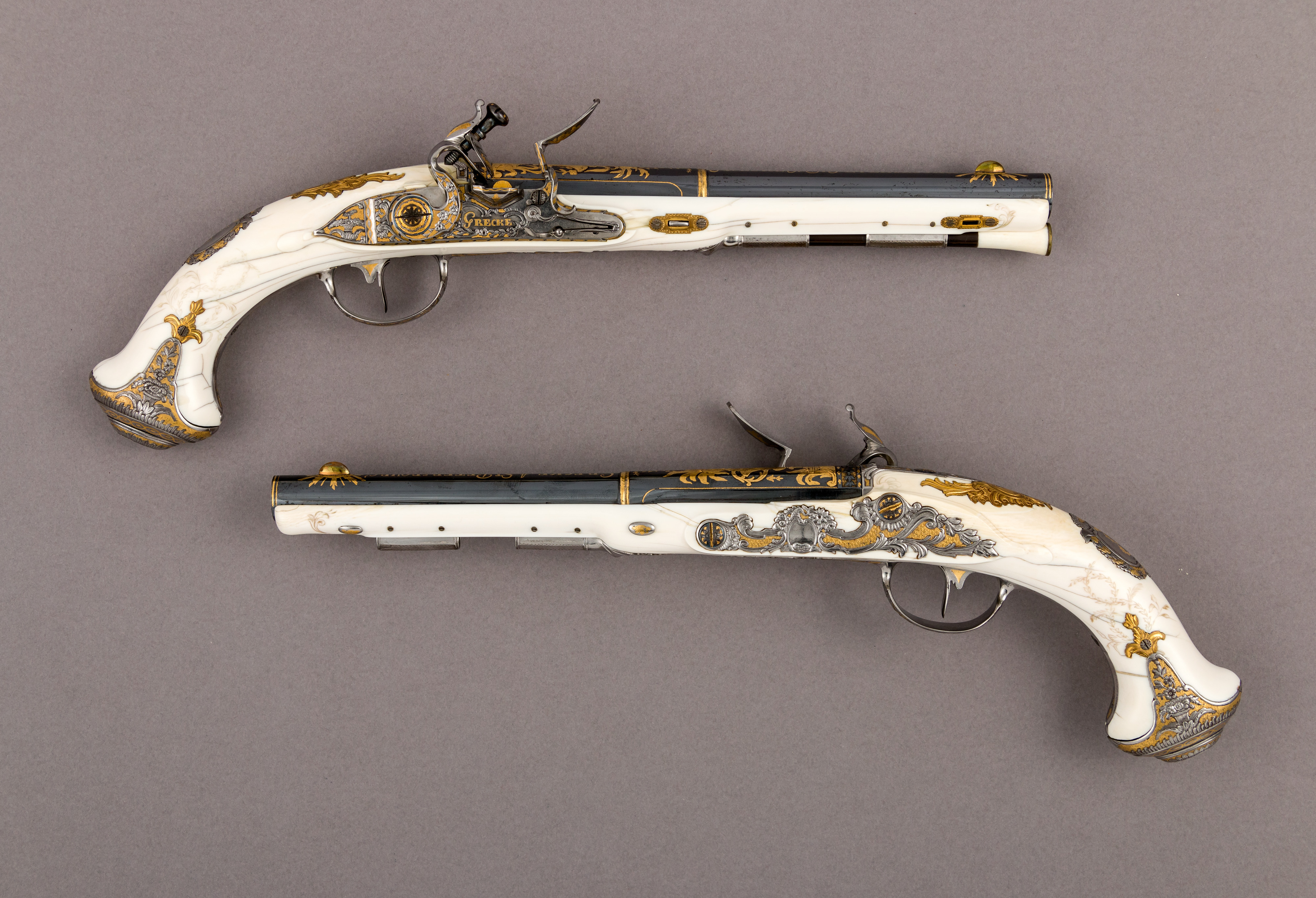
The Imperial Arsenal: Deconstructing the Couture of Catherine the Great’s Flintlock Pistols
In the lexicon of luxury, few artifacts bridge the chasm between martial utility and sovereign artistry as seamlessly as the pair of flintlock pistols crafted for Empress Catherine the Great. Housed within the hallowed vaults of the Hermitage, these weapons are not merely instruments of defense or symbols of imperial might; they are a masterclass in the semiotics of power, rendered through the precise language of materials and form. For the modern couturier at Katherine Fashion Lab, these pistols offer a profound case study in how structure, surface, and narrative converge to create an object of transcendent authority. This analysis deconstructs the pistols not as historical relics, but as a wearable, allegorical lexicon of imperial couture.
Materiality as a Declaration of Sovereignty
The triumvirate of materials—steel, ivory, and gold—is not arbitrary but a deliberate hierarchy of value and meaning. The steel barrels, cold and unforgiving, represent the unyielding sinew of the state. In a couture context, this is the equivalent of a rigid, architectural corset or a sharply tailored shoulder line: the foundational structure that conveys discipline and control. The steel is not polished to a mirror finish; rather, it retains a subtle, matte patina, suggesting a patina of use and history, a fabric that has weathered the elements of governance. This is the antithesis of disposable fast fashion; it is enduring, weighty, and intentional.
Contrast this with the ivory grip, which introduces a tactile, organic warmth. Ivory, sourced from the tusks of the Arctic, is a material of immense rarity and political reach—a testament to Catherine’s dominion over the northern frontiers. In a couture garment, this would translate to a luxuriously draped silk or a hand-embroidered panel of cashmere; it is the surface that invites touch, that softens the severity of the structure. The gold inlays—delicate, filigreed accents along the barrel and lock plate—are the embroidery of empire. They are not structural; they are purely ornamental, yet they dictate the entire visual rhythm. Gold, the metal of the sun and of divine right, elevates the pistol from a tool to a talisman. In a modern collection, this would be the strategic placement of a metallic thread, a crystal, or a gilded button—a whisper of opulence that commands attention without shouting.
Form and Function: The Silhouette of Authority
The silhouette of the flintlock pistol is a study in controlled tension. The long, slender barrel extends forward with a balletic grace, while the squared-off, bulbous handle provides a counterweight. This is the asymmetry of power. In couture, we see this echoed in the exaggerated shoulder of a power suit or the sweeping train of a ball gown: the body is extended, made larger, and given a directional force. The pistol’s profile is not static; it is a line of action, a vector of intent.
The grip, carved from a single piece of ivory, is ergonomically sculpted to fit the hand. But its curvature is also a study in negative space. The space between the trigger guard and the grip is not empty; it is a void that defines the object’s purpose. In fashion, this is the cut of an armhole, the drape of a neckline, or the slit of a skirt—the absence that creates the presence. The pistol’s handle is a lesson in how to frame the human form, to guide the eye and the hand toward a singular point of control. For a designer, this is a reminder that luxury is not merely in the addition of material, but in the mastery of emptiness.
Surface as Narrative: The Gold Inlays and Ivory Carving
The surface decoration of these pistols is where the narrative of Catherine’s reign is inscribed. The gold inlays are not random flourishes; they depict scrolling acanthus leaves, classical motifs, and the imperial double-headed eagle. This is storytelling through surface. In a couture context, this is the equivalent of a hand-painted silk scarf, a beaded evening gown that tells a myth, or a jacquard weave that incorporates a family crest. Every element is deliberate, a coded message of lineage and legitimacy.
The ivory grip is carved with a subtle, low-relief pattern of foliage and geometric bands. This is not a loud proclamation; it is a quiet, tactile secret. The owner’s hand would feel these ridges, these micro-textures, as a constant reminder of the artisan’s labor and the material’s origin. In modern luxury, this translates to the hand-feel of a fabric—the weight of a double-faced cashmere, the irregular slubs of a raw silk, the meticulous stitching of a hand-finished hem. The surface is not just seen; it is experienced.
The Paradox of Utility and Ornament
Perhaps the most compelling aspect of these pistols is their inherent paradox. They are functional weapons, designed to kill, yet they are also objects of supreme aesthetic refinement. This duality is the essence of imperial couture. A gown can be both a statement of power and a cage of restriction; a suit can be both armor and vulnerability. Catherine’s pistols force us to confront the idea that the most potent objects are those that hold contradictory meanings in perfect tension.
In a collection, this would manifest as a garment that appears fragile yet is structurally robust—a dress of sheer organza over a steel-boned corset, or a coat of heavy wool with delicate, hand-cut lace. The pistols teach us that ornament is not a weakness; it is a layer of meaning that does not diminish the object’s primary purpose but elevates it. The gold does not make the pistol less lethal; it makes the act of wielding it a performance of sovereignty.
Lessons for the Modern Atelier
For Katherine Fashion Lab, the flintlock pistols of Catherine the Great are a blueprint for creating objects that are both sculptural and functional. The first lesson is in material hierarchy: choose your primary structure (steel), your softening element (ivory), and your accent of transcendence (gold) with ruthless intention. The second lesson is in silhouette as gesture: every line must suggest motion and purpose, not mere decoration. The third lesson is in tactile storytelling: let the surface invite touch and reveal narrative through texture, not just print or pattern.
Finally, these pistols remind us that true luxury is authoritative, not apologetic. It does not seek to please; it commands attention. It is heavy in the hand, deliberate in its construction, and unapologetically rare. To translate this into a contemporary collection is to imbue each garment with the weight of history, the precision of a gunsmith, and the audacity of an empress who understood that the finest armor is often the one that looks like a jewel. In the hands of a couturier, these pistols are not weapons of war; they are instruments of transformation, turning the wearer into a living monument of imperial grace and unyielding power.