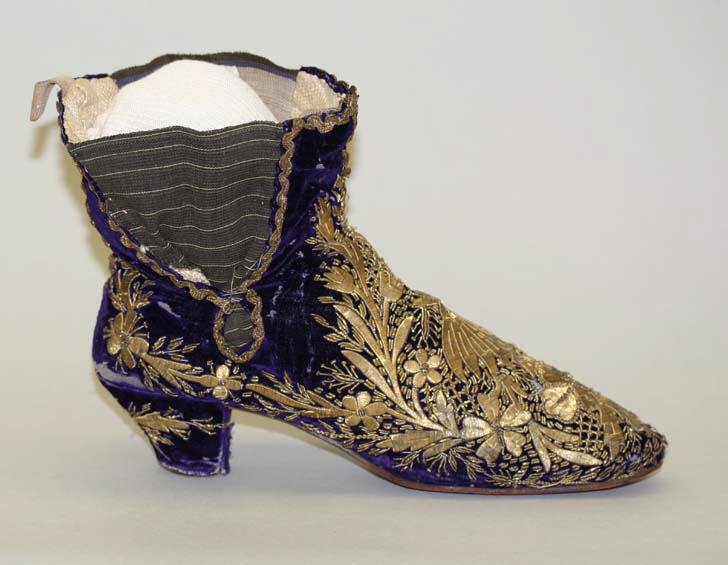
Deconstructing the Artifact: A Standalone Study in Micro-Couture
In the rarefied realm of haute couture, the ankle shoe is often relegated to the status of accessory—a functional afterthought to the grand narrative of the gown. This pair, presented as a standalone study by Katherine Fashion Lab, defiantly refutes that notion. It posits the shoe not as a supplement, but as a self-contained universe of cultural dialogue, technical mastery, and sculptural form. Drawing from a Global Heritage ethos, the artifact synthesizes material intelligence and artisanal legacy into a wearable treatise on the very essence of ornamentation and structure. This analysis dissects its constituent elements, revealing a complex narrative woven into every stitch and sequin.
The Architectural Foundation: A Dialogue of Earth and Craft
The foundation of any shoe is its architecture, and here, the Lab establishes a profound dialogue between elemental materials. The leather sole is not merely a base; it is the fertile ground from which the piece grows. Its supple yet resilient nature speaks to millennia of tanning crafts, a universal human technology found from Europe to Asia to the Americas. It provides the essential interface between body and earth, a testament to functional heritage.
Juxtaposed against this organic pliancy is the wooden heel. Carved and shaped, it introduces geometry and elevation—principles central to both global footwear traditions and architectural marvels. The wood’s grain, a natural fingerprint, contrasts with the refined smoothness of the leather, creating a tactile and visual tension. This combination—organic sole, architectural heel—forms a primary dialectic of the natural and the crafted, a theme that reverberates through the entire piece. The heel’s height and shape suggest influences ranging from the geta of Japan to the chopines of Renaissance Venice, yet it remains abstracted, a nod rather than a replica.
The Surface as Canvas: Embroidery as a Global Lexicon
Upon this architectural foundation rests the true heart of the study: an embroidered upper of silk velvet. Velvet, with its origins in ancient East Asian weaving and later perfected in European courts, is a fabric of inherent luxury and depth. Its pile creates a light-absorbing field, a midnight sky upon which the metallic embroidery can truly scintillate. The choice of silk velvet is strategic; it is a material that has traversed the Silk Road, embodying trade, cultural exchange, and opulent heritage in its very fibers.
The embroidery itself is a masterclass in mixed-media textile art. The use of metal-wrapped thread, twisted wire, and spiral wire moves the technique beyond mere surface decoration into the realm of low-relief sculpture. The metal-wrapped thread recalls the goldwork of Indian zardozi or Chinese imperial robes, where light is captured and linear patterns are drawn with luminous thread. The twisted wire introduces a braided, cord-like dimension, suggesting strength and continuity, while the spiral wire adds a dynamic, three-dimensional spring-like form. This creates a rhythm across the velvet ground—a rhythm punctuated by metallic sequins. Each sequin acts as a pixel of reflected light, a technique seen in the mirror work of Gujarati shisha embroidery and the sequined fantasies of 1920s flapper dresses. Together, these elements form a unified visual language that is geographically non-specific yet historically rich, a true synthesis of global ornamental codes.
The Synthesis of Form and Function: The Elastic Band as Modernist Interjection
Perhaps the most intellectually provocative element is the inclusion of a wool elastic band. In a piece so heavily laden with historical reference and artisanal complexity, the elastic band is a stark, modernist interjection. Wool, a primal, insulating fiber used across nomadic and settled cultures, is here engineered for elasticity—a property emblematic of the 20th century. This component performs a crucial deconstructive function. It bridges the historical dialogue with the reality of the contemporary body in motion. The band provides the necessary tension and release, a functional concession that is itself aesthetic. Its textural contrast—the matte, fibrous wool against the gleaming, smooth metallics—further enriches the material palette. It serves as a reminder that couture, at its best, is not a museum piece but a living interface, and that innovation often lies in the intelligent integration of the humble and the exalted.
Conclusion: The Ankle Shoe as Autonomous Sculpture
This standalone study by Katherine Fashion Lab transcends its category. It is a microcosm of fashion’s deepest currents: the interplay of structure and surface, the global journey of techniques, and the eternal negotiation between tradition and innovation. Each material—from the foundational leather and wood to the opulent silk velvet and metallic threads, down to the pragmatic wool elastic—has been selected not just for its physical property, but for its cultural resonance. The piece does not borrow from a single heritage; it constructs a new, hybrid heritage in miniature.
Ultimately, these ankle shoes are a testament to the concept of micro-couture. They prove that the principles of haute couture—obsessive craftsmanship, narrative depth, and sculptural integrity—can be concentrated into a format as focused as footwear. They invite the viewer to consider the global lineage of every stitch and the intellectual rigor behind every material fusion. In doing so, Katherine Fashion Lab does not simply present a pair of shoes; it presents a philosophy of making, where the ankle becomes a plinth for a wearable, walkable masterpiece of global patrimony.