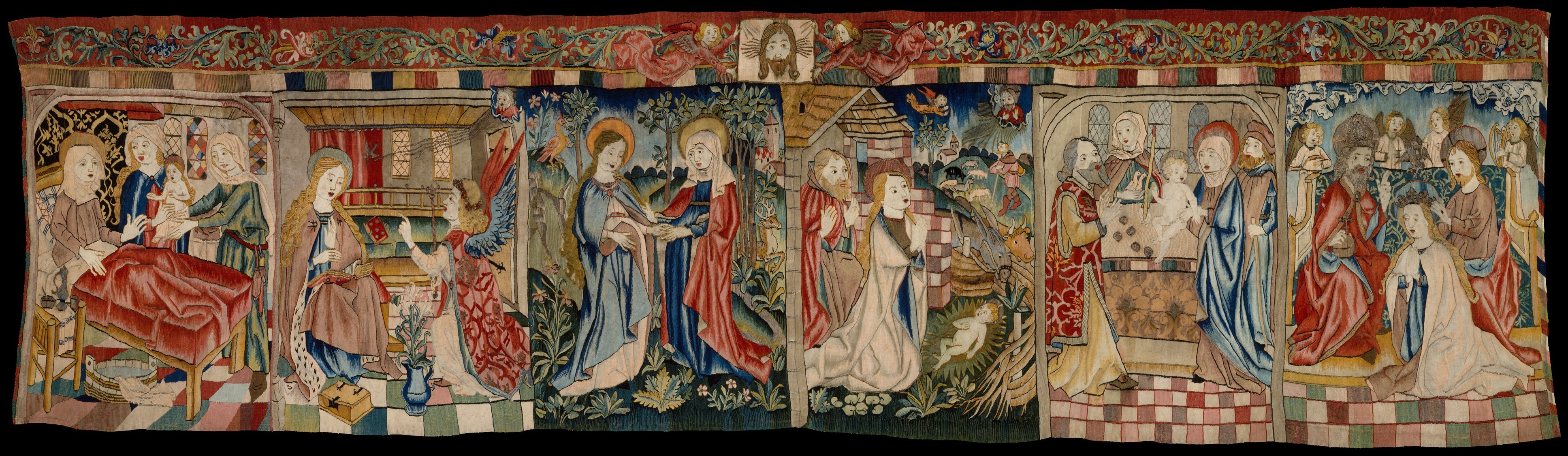
A Tapestry of Devotion: Deconstructing the Upper Rhenish "Scenes from the Life of the Virgin" for Couture Inspiration
Introduction: The Weave of Narrative and Materiality
In the rarefied domain of haute couture, inspiration often transcends the ephemeral dictates of trend cycles, drawing instead from the profound depths of art history. At Katherine Fashion Lab, our analysis of the Upper Rhenish tapestry, "Scenes from the Life of the Virgin," offers a masterclass in translating medieval materiality into a contemporary sartorial lexicon. This standalone study, executed on a linen warp with a complex interplay of wool, linen, silk, silver, and gilt wefts—accentuated by wool pile yarns—is not merely a religious artifact. It is a sophisticated treatise on texture, structure, and narrative layering. For the couturier, this piece presents a paradigm of how disparate elements—humble and opulent—can coalesce into a unified, transcendent whole. The work’s origin in the Upper Rhine, a region historically positioned at the crossroads of Germanic and Burgundian influences, further imbues it with a polyphonic aesthetic that resonates with the globalized yet artisanal ethos of modern luxury fashion.
Material Dialectics: The Couture Vocabulary of Humility and Opulence
The tapestry’s material composition is its most compelling narrative device. The linen warp provides a foundational stability, a quiet, unbleached backbone that echoes the earthiness of peasant life—a subtle nod to the Virgin’s humble origins. This is a strategic counterpoint to the silk and gilt wefts, which introduce a shimmering, celestial quality. In couture terms, this is the equivalent of pairing raw, unpolished linen with liquid gold lamé. The silver wefts, now tarnished to a muted pewter, add a melancholic, aged patina—a visual reminder of temporality and the sacred passage of time. The wool pile yarns, used to create raised, plush textures in halos or architectural details, introduce a third dimension, a tactile topography that invites touch and contemplation. For a Katherine Fashion Lab collection, this dictates a deliberate juxtaposition of textures: a gown might feature a structured, matte linen bodice, a skirt cascading in silk charmeuse with metallic threads, and embroidered appliqués in plush velvet or chenille to replicate the pile effect. The lesson is clear: true luxury is not singular but symphonic, a dialogue between the ascetic and the extravagant.
Compositional Architecture: Framing the Sacred in Garment Silhouettes
The tapestry’s composition—a series of episodic scenes within a unified architectural frame—offers a blueprint for garment construction. The narrative is not linear but spatial, with each episode (the Annunciation, the Nativity, the Adoration) separated by intricate Gothic arches or foliate borders. This compartmentalization can be translated into a modular dress design: a structured, corseted bodice representing the central arch, with panels of embroidered vignettes cascading down the skirt. The wool pile might be used to create a raised, sculptural collar or cuffs, echoing the tapestry’s tactile borders. The use of silver and gilt threads should be strategic, confined to highlights—perhaps the Virgin’s halo or an angel’s wing—rather than overwhelming the entire surface. This restraint is a hallmark of masterful couture, where every embellishment serves a narrative purpose. The overall silhouette should evoke the verticality of a Gothic cathedral, with elongated lines and a sense of aspirational lift, achieved through A-line shapes or high-waisted empire cuts that elongate the torso.
Color Theory: A Palette of Devotion and Decay
The tapestry’s color palette is a study in controlled desaturation. The original dyes—faded by centuries—yield a muted spectrum of indigo blues, verdigris greens, cinnabar reds, and ochre yellows, all softened by the underlying linen’s beige. This is not a vibrant, saturated palette; it is a contemplative one, where color is a whisper rather than a shout. For a couture interpretation, this suggests a move away from synthetic, neon-bright hues toward natural, plant-based dyes. A gown might feature a base of hand-dyed linen in a dusty sage green, with embroidered accents in madder root red and woad blue. The silver threads, now oxidized, introduce a subtle gray-brown tone, which can be echoed in metallic organza or tarnished sequins. The gilt remains a focal point, but it should be used sparingly—perhaps as a single, luminous thread in an intricate brocade or as a gilded leather appliqué. This restrained palette allows the narrative details to command attention, much like the tapestry’s golden halos against its dark, earthy backgrounds.
Narrative Embellishment: Embroidery as Exegesis
The tapestry’s scenes are not merely decorative; they are exegetical, each stitch a theological statement. For couture, this inspires a philosophy of narrative embroidery. Rather than abstract patterns, the embellishment should tell a story. A train might depict the Annunciation, with the angel Gabriel rendered in silk floss and the Virgin’s robes in linen thread. The wool pile yarns could be used to create a raised, three-dimensional landscape—hills, trees, clouds—that the figures inhabit. The silver and gilt wefts should be reserved for divine elements: rays of light, halos, or the star of Bethlehem. This is not fast fashion; it is slow, liturgical craftsmanship. Each garment would require hundreds of hours of hand-embroidery, echoing the tapestry’s own labor-intensive creation. The result is a piece that functions as both clothing and icon, a wearable manuscript that invites the wearer—and the observer—into a state of contemplation.
Structural Integrity: The Architecture of the Garment
Finally, the tapestry’s structural integrity—its ability to hold form across centuries—offers lessons in garment construction. The linen warp provides tensile strength, while the wool and silk wefts add flexibility and drape. A couture gown should mirror this balance: a foundational structure of sturdy, tightly woven linen or cotton, with outer layers of more fluid silk and wool. The wool pile yarns can be used to create structural elements—a raised collar, a sculpted peplum, or architectural sleeves—that mimic the tapestry’s relief. The use of silver and gilt threads should be integrated into the weave itself, perhaps through a jacquard technique, ensuring that the metallic elements are not merely appliquéd but intrinsic to the fabric’s strength. This ensures that the garment, like the tapestry, is not just a surface but a coherent, three-dimensional object that stands the test of time.
Conclusion: The Couture as Reliquary
In the hands of Katherine Fashion Lab, the Upper Rhenish tapestry transcends its original devotional context to become a blueprint for a new kind of couture—one that is reverent of material, narrative, and craft. The interplay of linen, wool, silk, silver, and gilt is not a mere historical curiosity but a living lexicon for contemporary design. This analysis posits that the most profound fashion is not about novelty but about depth—a depth achieved through the deliberate orchestration of humble and precious materials, the architectural framing of narrative, and the slow, meditative labor of the hand. The result is a garment that functions as a reliquary, holding within its folds the sacred stories of our time, woven into the very fabric of being. This is the true lesson of the tapestry: that couture, at its highest, is not just clothing but a form of devotion.