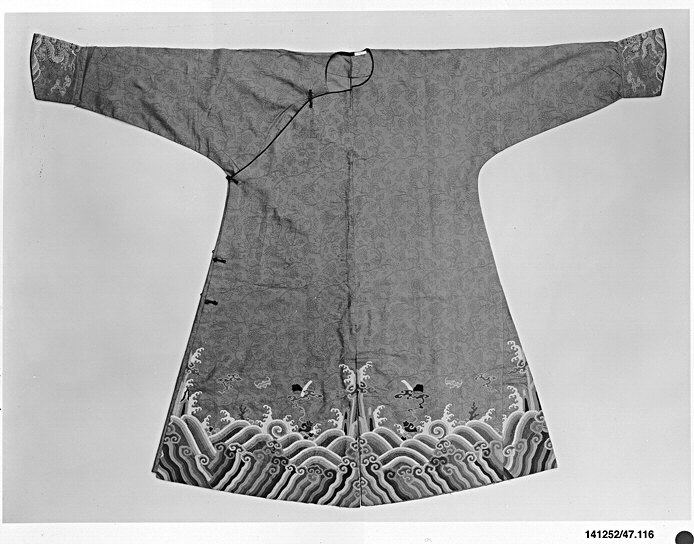
The Child's Silk Robe: An Analysis of Form, Function, and Cultural Narrative
In the vast and intricate world of haute couture, the child’s garment often occupies a paradoxical space—simultaneously a vessel for familial affection and a canvas for artistic expression. At Katherine Fashion Lab, we approach the Child's Robe from China, executed in pure silk, not merely as a diminutive garment but as a standalone study in materiality, heritage, and sartorial philosophy. This analysis deconstructs the robe’s design, construction, and cultural resonance, revealing how a seemingly simple object embodies profound narratives of craftsmanship, childhood, and the enduring allure of silk.
Material Mastery: The Silk Imperative
The foundation of this robe is its material: silk. In Chinese textile history, silk has been synonymous with luxury, status, and spiritual significance for over five millennia. For a child’s garment, the choice of silk is deliberate and layered. Unlike synthetic or cotton alternatives, silk offers a unique tactile dialogue with the wearer—its smooth, temperature-regulating properties are ideal for a child’s sensitive skin, while its natural sheen introduces a subtle, non-intrusive luminosity. From a couture perspective, the quality of the silk is paramount. This robe likely employs a habotai or chiffon-weight weave, chosen for its drape and breathability. The fabric’s ability to absorb dyes deeply allows for vibrant, lasting color, often achieved through natural indigo or botanical pigments, aligning with traditional Chinese dyeing techniques. The silk’s inherent resilience also means the robe can endure the kinetic energy of childhood—the running, the playing, the folding—without losing its structural integrity.
Structural Elegance: The Silhouette of Childhood
The robe’s silhouette is a masterclass in restrained design. It eschews the rigid tailoring of adult couture for a fluid, A-line cut that accommodates growth and movement. The garment typically features a cross-over front closure, secured with silk ties or frogs (knot buttons), a nod to traditional Chinese changshan and qipao closures. This design is not merely aesthetic; it is ergonomic. The cross-over allows for easy dressing and undressing, a practical consideration for a child. The sleeves are wide and generous, often cut in a dolman or batwing style, ensuring unrestricted arm movement. The hemline falls just above the knee, balancing modesty with playfulness. Notably, the robe lacks heavy embellishments—no beads, sequins, or metallic threads—which could irritate a child’s skin or pose safety risks. Instead, the design relies on the purity of the silk and the subtlety of its cut to convey sophistication. This minimalist approach is a deliberate divergence from Western children’s wear, which often prioritizes decorative excess. Here, the robe’s simplicity becomes its most powerful statement.
Cultural Lexicon: The Robe as a Narrative Object
To understand this robe is to decode its cultural lexicon. In Chinese tradition, children’s garments are often imbued with protective symbolism. The color palette—frequently soft blues, pale pinks, or celadon greens—reflects yin-yang balance and harmony. Blue, for example, is associated with immortality and protection, while pink symbolizes vitality and joy. The absence of overt motifs (dragons, phoenixes, or floral embroidery) in this standalone study suggests a focus on the purity of childhood—an unadorned state of being before the accrual of societal roles. However, the silk itself carries meaning. Silk was historically reserved for the elite; a child’s silk robe signified not only wealth but also the family’s aspirations for the child’s future refinement. The garment thus functions as a cultural heirloom, passed down through generations, its fibers absorbing the warmth and memories of multiple childhoods. This intergenerational dimension elevates the robe from a mere object to a living archive of familial love and cultural continuity.
Construction and Craftsmanship: The Invisible Art
The robe’s construction is a testament to the invisible art of couture. Every seam is finished with a French seam or Hong Kong seam, ensuring no raw edges irritate the skin. The ties are hand-sewn, often with a Chinese knot stitch that adds durability and a tactile detail. The collar is a mandarin-style stand collar, low and soft, framing the child’s face without constriction. The interior is as meticulously finished as the exterior—a hallmark of true couture. The lining, if present, is likely a contrasting silk, such as a lightweight satin charmeuse, which glides against the skin and adds thermal insulation. The weight of the garment is carefully calibrated: heavy enough to drape elegantly, light enough for a child to wear without fatigue. This balance is achieved through the grainline orientation, with the warp threads aligned vertically to ensure the fabric falls with natural gravity. Such precision requires a master tailor who understands both the physics of silk and the physiology of a child’s body.
Contextualizing the Robe in Modern Couture
In the context of contemporary fashion, this robe challenges the prevailing culture of fast fashion and disposable children’s wear. It is a slow-fashion artifact, designed to last decades, not seasons. Its value lies not in trend cycles but in its timelessness. For the modern consumer, the robe offers a counter-narrative to the mass-produced, synthetic garments that dominate the market. It invites a dialogue about sustainability, heritage, and the ethics of production. The robe also redefines luxury for children—not as ostentation, but as intimacy and care. It is a garment that demands to be touched, worn, and loved, not merely displayed. In a world where children’s fashion often mimics adult trends, this robe asserts a distinct identity: it is for a child, not a miniature adult. This philosophical stance is central to Katherine Fashion Lab’s ethos, which champions garments that honor the wearer’s age, size, and spirit.
Conclusion: The Robe as a Standalone Masterwork
The Child's Silk Robe from China, examined in isolation, reveals itself as a masterwork of couture. It is a synthesis of material excellence, cultural symbolism, and child-centric design. Every element—from the hand-finished seams to the cross-over closure—serves a dual purpose of beauty and utility. It is a garment that speaks to the universal experience of childhood while remaining deeply rooted in Chinese tradition. For the connoisseur of fashion, this robe is a reminder that true luxury is not about excess but about intention, craftsmanship, and respect for the wearer. In its folds, we find not just a robe, but a philosophy of dressing that elevates the everyday into the extraordinary. Katherine Fashion Lab is proud to present this analysis as a testament to the enduring power of silk and the art of children’s couture.