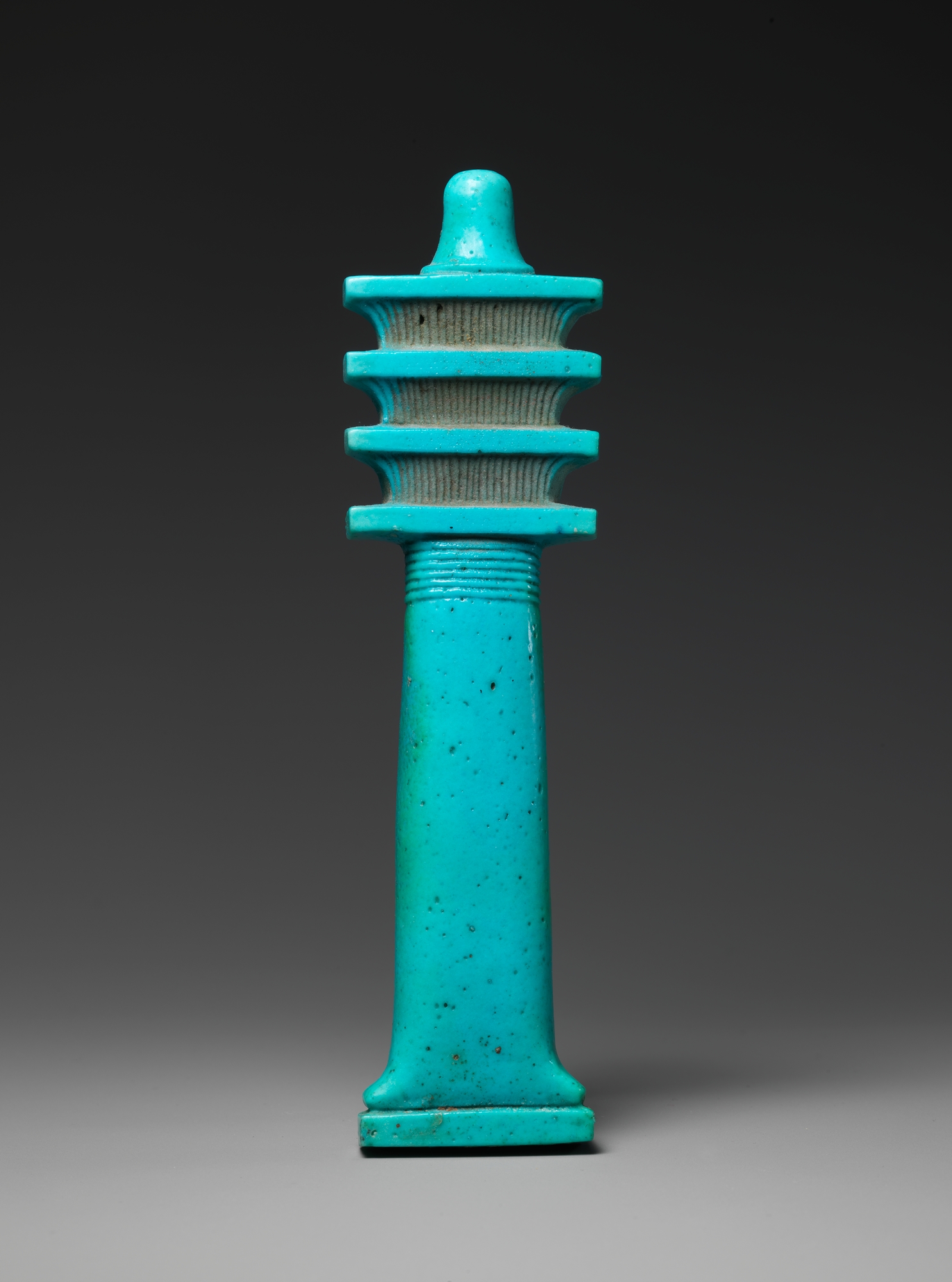
Heritage Analysis: The Djed Pillar Amulet in Faience
In the annals of ancient adornment, few artifacts embody the intersection of spiritual authority and material culture as profoundly as the Djed pillar amulet. Crafted from faience—a vitreous, self-glazing ceramic that shimmered with an otherworldly blue-green hue—this symbol transcended mere ornamentation to become a talisman of cosmic stability and resurrection. For Katherine Fashion Lab, a strategic understanding of the Djed pillar’s symbolic power, its historical role in personal adornment, and its latent spiritual meaning offers a compelling blueprint for positioning luxury collections in 2026. This analysis decodes the Djed pillar’s heritage and translates its core attributes into actionable insights for high-end brand strategy, ensuring that heritage is not merely referenced but recontextualized for contemporary luxury consumers.
Symbolic Power: The Pillar of Osiris and Cosmic Order
The Djed pillar, often interpreted as a stylized tree trunk, a column of grain, or the backbone of the god Osiris, represented stability, endurance, and resurrection. In ancient Egyptian cosmology, the Djed was central to the myth of Osiris, the god of the afterlife, who was murdered and dismembered by his brother Seth, only to be reassembled and resurrected by his wife Isis. The Djed pillar, raised during the Heb Sed festival, symbolized the successful restoration of Osiris and, by extension, the pharaoh’s own renewal of rule and cosmic order (ma'at).
For the wearer of a Djed amulet, this symbolic power was not abstract. It conferred tangible protection against chaos and decay. The amulet was placed on the neck of the deceased, ensuring the backbone remained intact in the afterlife, thereby enabling the soul to stand and walk in the Field of Reeds. This fusion of physical and metaphysical stability—where the object itself becomes a conduit for spiritual resilience—is a potent narrative for luxury brands today. In a 2026 context marked by geopolitical uncertainty and rapid technological disruption, the Djed pillar’s promise of permanence and renewal aligns with consumer desires for grounding, authenticity, and objects that transcend fleeting trends.
Historical Adornment: Faience as a Medium of Prestige and Accessibility
The Djed pillar amulet was predominantly crafted from faience, a material that was both affordable and deeply symbolic. Faience, made from crushed quartz or sand, alkaline salts, and colorants, was fired to produce a lustrous, glass-like surface. Its characteristic turquoise or blue-green color imitated lapis lazuli and turquoise, stones associated with the heavens and rebirth. This deliberate mimicry elevated faience from a humble composite to a democratic luxury—accessible to many while retaining divine connotations.
Historically, Djed amulets were worn by individuals across social strata, from pharaohs to commoners, as part of funerary jewelry or daily talismans. The amulet’s small scale—often less than two inches—required meticulous craftsmanship, with artisans carving the distinct horizontal bars and central column with precision. This blend of mass appeal and artisanal integrity offers a critical lesson for Katherine Fashion Lab: luxury in 2026 must reconcile exclusivity with inclusivity. The Djed pillar’s heritage demonstrates that a symbol’s power is amplified when it is both universally resonant and individually crafted. For high-end strategy, this translates into limited-edition pieces that honor ancient techniques while being reimagined in contemporary materials—perhaps using modern faience analogs or ceramic finishes that evoke the original’s luminosity.
Spiritual Meaning: Resurrection, Protection, and the Eternal Cycle
At its core, the Djed pillar amulet was a spiritual technology—a wearable device designed to manipulate metaphysical forces. Its placement on the mummy’s throat or chest was not arbitrary; it aligned with the body’s energy centers, believed to channel the life force (ka) and ensure the soul’s journey through the Duat (underworld). The amulet’s inscription, often bearing the name of Osiris or the deceased, personalized its protective power, transforming a generic symbol into a bespoke talisman.
This concept of personalized spiritual empowerment is directly translatable to modern luxury. In 2026, consumers increasingly seek objects that serve as anchors for identity and well-being—items that are not merely decorative but functional in a holistic sense. The Djed pillar’s spiritual meaning can be recontextualized as a symbol of inner stability and resilience, appealing to a clientele navigating mental and emotional turbulence. For Katherine Fashion Lab, this suggests a product line that marries ancient symbolism with contemporary wellness narratives: perhaps a pendant that doubles as a meditation aid, or a collection that offers customizable inscriptions, allowing the wearer to imbue the piece with personal affirmations of strength and renewal.
2026 High-End Luxury Strategy: Translating Heritage into Market Relevance
To leverage the Djed pillar’s heritage for a 2026 luxury strategy, Katherine Fashion Lab must move beyond historical reproduction and embrace strategic recontextualization. The following pillars form the foundation of this approach:
1. Symbolic Storytelling as Brand Architecture
The Djed pillar’s narrative of stability through transformation should be woven into the brand’s core messaging. Rather than marketing a “revival” of an ancient motif, position the amulet as a philosophical artifact for the modern age. Campaigns can draw parallels between Osiris’s resurrection and the consumer’s own journey of growth and renewal. This elevates the product from accessory to personal icon, commanding premium pricing justified by narrative depth.
2. Material Innovation and Craftsmanship Authenticity
Faience’s historical status as a “luxury for the many” can inspire a tiered product strategy. At the high end, offer Djed-inspired pieces in precious metals and gemstones, with faience inlays that honor the original medium. At an accessible luxury tier, produce limited runs of ceramic or enamel versions that replicate the ancient glaze, emphasizing artisanal techniques such as hand-carving and kiln-firing. This material storytelling—where the process is as valued as the product—resonates with the 2026 consumer’s demand for transparency and craftsmanship.
3. Ritual and Experience Integration
Leverage the amulet’s spiritual function by creating ritualized purchasing experiences. For example, offer a “Djed Ceremony” where clients select their amulet, have it inscribed with a personal intention, and receive a guided meditation or blessing. This transforms the transaction into a transformative event, aligning with the luxury sector’s shift toward experiential retail. In-store pop-ups could feature Egyptian-inspired sanctuaries, complete with scent, sound, and interactive digital storytelling that immerses the client in the Djed’s mythic universe.
4. Digital and Physical Convergence
In 2026, luxury brands must bridge the physical and digital realms. The Djed pillar’s amulet form, small and portable, lends itself to phygital extensions. For instance, each amulet could contain an NFC chip that unlocks a digital archive—a virtual “Book of the Dead” that tells the owner’s personal story of resilience. Alternatively, launch an AR filter that superimposes the Djed symbol onto the wearer’s image, allowing digital try-ons for social media. This digital talisman extends the amulet’s protective power into the virtual space, appealing to younger, tech-savvy luxury consumers.
Conclusion: The Djed Pillar as a Blueprint for Timeless Luxury
The Djed pillar amulet, in its humble faience form, encapsulates a profound truth about luxury: that the most enduring objects are those that bridge the material and the metaphysical. Its legacy—of stability, resurrection, and personalized protection—offers Katherine Fashion Lab a rich, underexploited heritage asset. By translating the Djed’s symbolic power into narrative-driven, craft-intensive, and experience-oriented offerings, the brand can position itself at the vanguard of 2026’s luxury landscape. The Djed pillar is not merely an artifact; it is a strategic compass, pointing toward a future where heritage is not preserved in amber but reimagined as living, wearable wisdom.