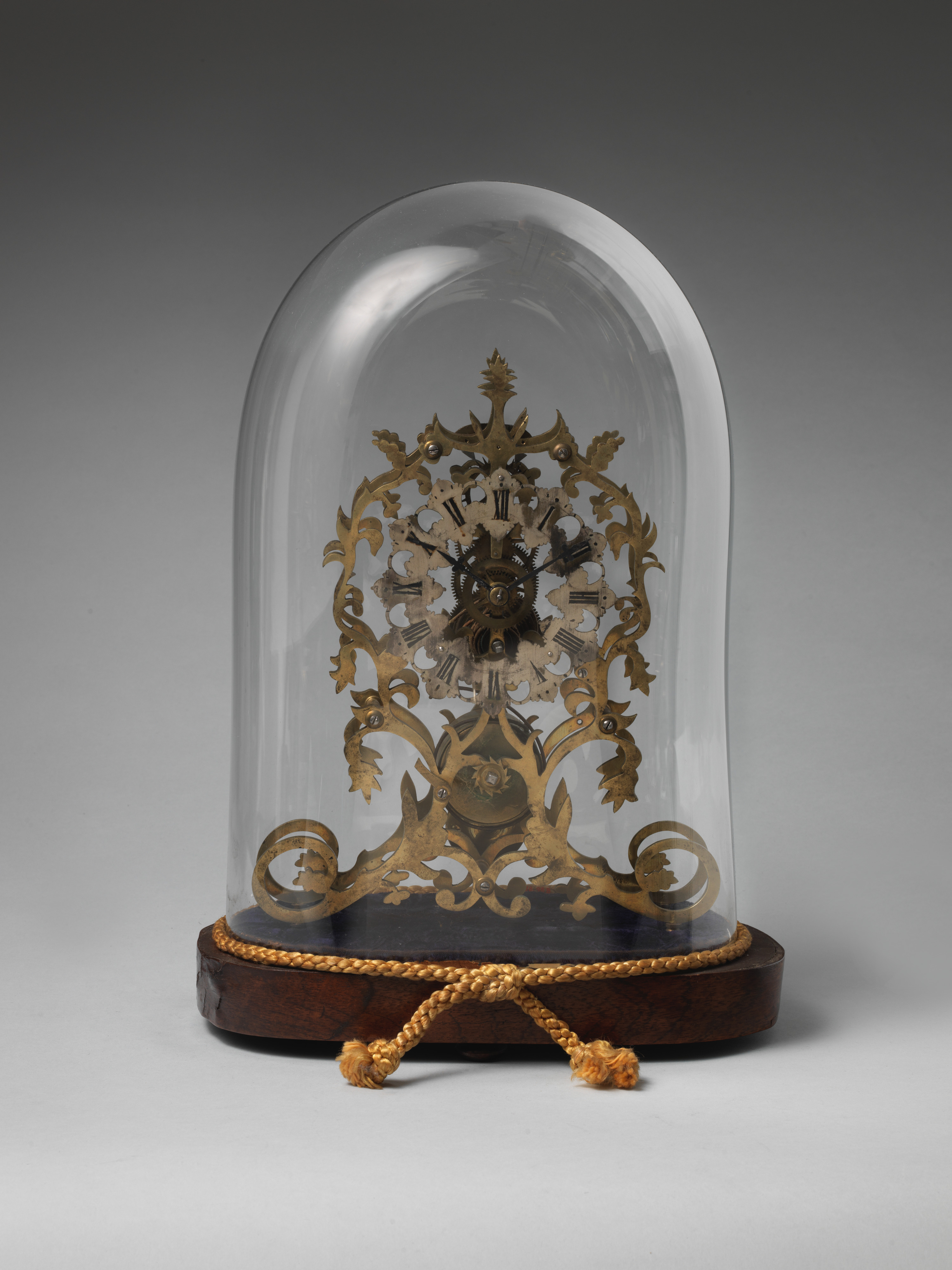
The Temporal Labyrinth: Deconstructing the Skeleton Clock and Key
In the rarefied arena of luxury object analysis, few artifacts command the intellectual and aesthetic gravitas of the skeleton clock and key. This piece, curated by Katherine Fashion Lab, transcends mere horology to become a profound meditation on time, legacy, and the tactile dialogue between heritage and modernity. Crafted from brass, partly silvered and painted, and housed within a delicate ecosystem of velvet, rosewood veneer, and glass, this standalone study object is not merely a timepiece—it is a narrative device. It speaks to the discerning collector who understands that true luxury lies not in ostentation, but in the revelatory exposure of intricate mechanics, the patina of global heritage, and the silent poetry of a key that unlocks more than a winding mechanism.
Material Alchemy: The Dialogue of Brass, Silver, and Paint
The skeleton clock’s defining characteristic is its unapologetic transparency—a literal and metaphorical exposure of its inner workings. The brass foundation, chosen for its durability and warm, golden resonance, is not merely structural; it is the skeleton’s bones. Yet, Katherine Fashion Lab’s curation elevates this base material through a sophisticated interplay of partly silvered and painted surfaces. The silvering process, applied selectively to the gear trains and escapement, creates a stark, luminous contrast against the darker brass. This is not a uniform coating but a deliberate chiaroscuro technique, where light catches the polished silver teeth of the gears, mimicking the fleeting nature of seconds themselves. The painted elements—often floral motifs, arabesques, or delicate numerals on the dial—introduce a human, artistic hand into the mechanical precision. These painted details, rendered in muted, heritage-inspired hues, serve as a counterpoint to the cold metal, reminding the viewer that time, while measurable, is also an emotional and aesthetic experience.
The velvet lining within the display case is a masterstroke of sensory branding. It provides a silent, absorptive backdrop that muffles any metallic echo, transforming the act of viewing into a hushed, almost ritualistic encounter. The rosewood veneer, with its rich, dark grain and subtle reddish undertones, anchors the piece in a tradition of fine cabinetry. Rosewood, often associated with 19th-century European and Asian decorative arts, introduces a global heritage narrative—its presence whispers of colonial trade routes, of exoticism tempered by European craftsmanship. The glass, finally, is not a barrier but a lens. It invites the gaze while protecting the delicate machinery, creating a sense of intimate voyeurism. The viewer is positioned as a privileged observer, peering into the heart of a mechanical universe.
Global Heritage: The Cartography of Craftsmanship
This artifact is not the product of a single culture but a convergence of global influences. The skeleton clock tradition, which flourished in 18th-century France and England, was itself a fusion of scientific inquiry and decorative arts. The exposed gears, reminiscent of early scientific instruments, reflect the Enlightenment’s obsession with demystifying the natural world. However, the painted motifs and the choice of rosewood veneer introduce a distinctly Eastern aesthetic. The delicate floral paintings echo the chinoiserie that swept through European courts, while the rosewood—often sourced from Southeast Asia or Brazil—ties the object to global networks of trade and exploitation. The key, often overlooked in such analyses, is a symbolic linchpin. Its form—ornate, with a hollow shaft and intricate bow—is a miniature sculpture. In many global traditions, the key is a symbol of knowledge, access, and power. To wind this clock is to perform an act of authority over time itself, a ritual that connects the user to centuries of horological mastery from London to Geneva to Beijing.
The Standalone Study: Interiority and the Architecture of Contemplation
Context is critical. This piece is designed for a standalone study, not a bustling living room or a sterile gallery. The study is a space of intellectual retreat, a sanctuary where time is both measured and suspended. Here, the skeleton clock and key function as a contemplative anchor. The exposed gears, with their constant, hypnotic motion, invite the scholar or collector to pause, to observe the passage of seconds as a physical phenomenon. The velvet and rosewood create a micro-environment of warmth and silence, insulating the viewer from external distractions. This is a piece that demands solitude. It refuses to be background noise; instead, it becomes a focal point for meditation on mortality, legacy, and the relentless forward march of time. The key, placed on a dedicated velvet-lined tray or stand, serves as a tangible reminder of the user’s agency—the ability to pause, to wind, to control the mechanism’s energy. In an age of digital omnipresence, this analog, mechanical relationship to time is a radical act of luxury.
Strategic Implications for the Luxury Collector
From a strategic perspective, this artifact occupies a unique position in the market. It is not a decorative accessory but a functional heirloom. Its value lies in its dual nature: it is both a precision instrument and an objet d’art. For the collector, acquiring this piece is an investment in a tangible connection to global heritage, a statement that prioritizes craftsmanship over convenience. Katherine Fashion Lab’s curation underscores a key market insight: the modern luxury consumer craves authenticity, story, and materiality. They seek objects that resist obsolescence, that require care and attention. The skeleton clock and key, with its exposed mechanics and delicate materials, demands maintenance—a relationship, not a transaction. This aligns with the broader trend toward “slow luxury,” where the object’s value is enhanced by the time and expertise required to preserve it.
Furthermore, the piece’s standalone nature makes it a powerful tool for personal branding. In a study, it becomes a silent communicator of the owner’s intellectual curiosity, appreciation for history, and rejection of mass-produced mediocrity. It is a conversation starter, not because it is loud, but because it is deep. The key, in particular, can be interpreted as a metaphor for unlocking hidden knowledge—a subtle but potent signal in professional and social circles.
Conclusion: The Unwinding of Meaning
The skeleton clock and key, as curated by Katherine Fashion Lab, is far more than a sum of its materials. It is a temporal labyrinth, inviting the viewer to get lost in its gears, its history, and its silent, rhythmic heartbeat. The brass and silver speak of precision; the velvet and rosewood speak of luxury; the glass speaks of revelation. But the true genius of this piece lies in its ability to make time tangible—to transform an abstract concept into a physical, beautiful, and deeply personal experience. In a world racing toward the next digital instant, this artifact dares to ask: What does it mean to truly see time? The answer, etched in brass and painted in heritage hues, is a masterpiece of quiet, enduring power.