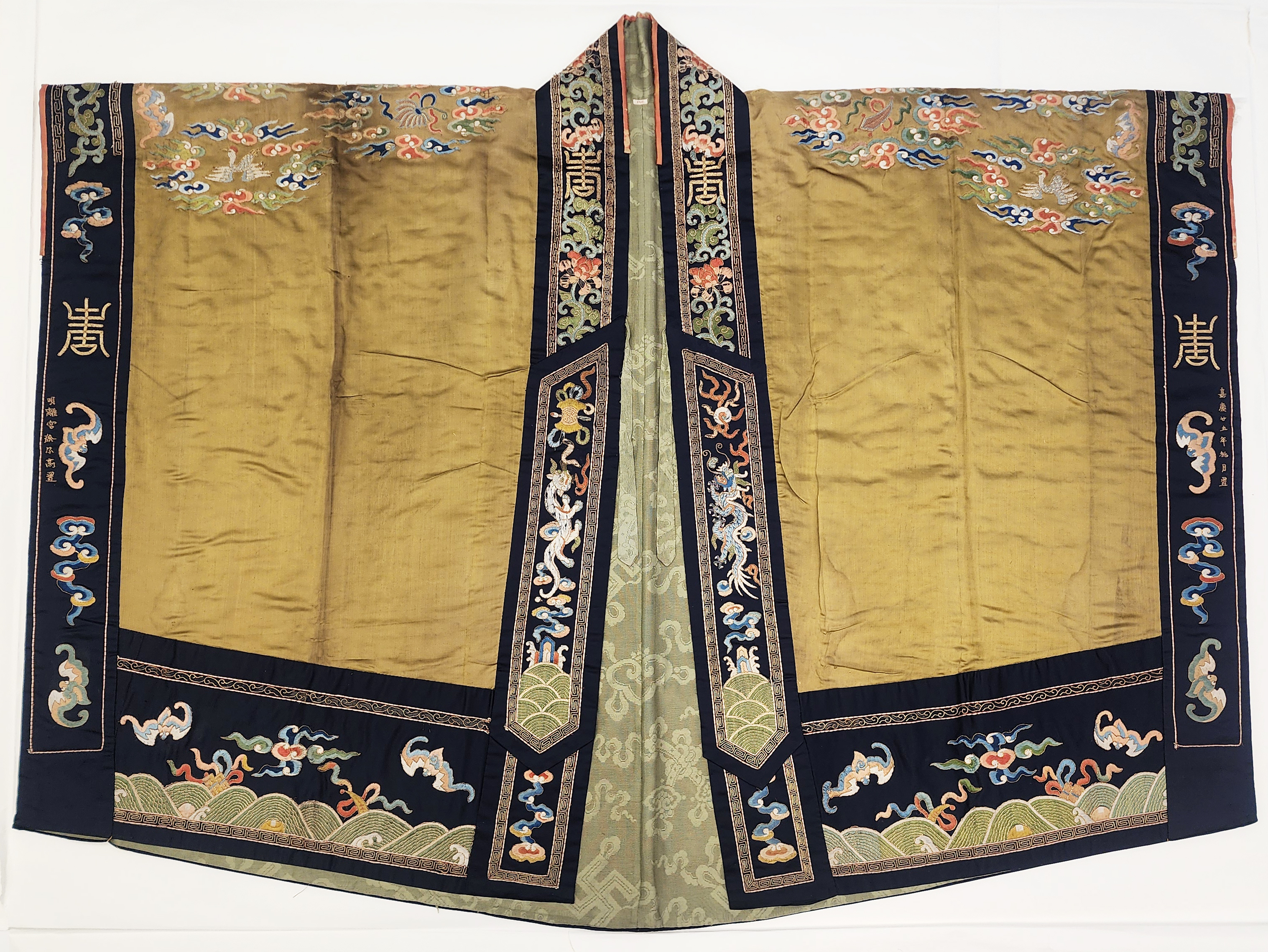
The Celestial Embodied: A Couture Analysis of the Daoist Ritual Robe
In the rarefied world of haute couture, where fabric meets philosophy, few artifacts command the reverence of a Daoist priest’s ritual robe. At Katherine Fashion Lab, we approach this garment not merely as a historical relic but as a masterclass in symbolic engineering and textile artistry. This particular robe, originating from China and crafted from silk satin with intricate metal thread embroidery featuring a celestial palace, stands as a standalone study in the convergence of spiritual cosmology and material luxury. To deconstruct its couture value is to decode a language of power, transcendence, and meticulous craft that rivals the most exclusive ateliers of Paris or Milan.
Materiality as Sacred Foundation
The choice of silk satin as the base fabric is no accident. In both Daoist ritual and high fashion, silk represents the pinnacle of natural luxury—its lustrous surface reflects light with a fluidity that suggests the ethereal. For the robe, this satin serves as a canvas for the divine, its smoothness allowing the embroidery to float rather than sit heavily. The material’s weight and drape are critical: it must fall with a gravity that commands respect, yet remain breathable for the priest’s meditative movements. In couture terms, this is akin to selecting a silk charmeuse for an evening gown—except here, the “runway” is a sacred altar, and the “model” is a conduit between heaven and earth.
The metal thread embroidery—often gold or silver-wrapped silk—introduces a tactile and visual opulence that transcends decoration. These threads are not mere embellishments; they are conduits of qi, or spiritual energy. In Daoist philosophy, metal is associated with the element of air and the direction of the west, symbolizing clarity and refinement. The embroidery technique, likely using couching or split stitches, requires thousands of hours of labor, mirroring the patience of a master tailor in a couture house. The result is a surface that shimmers with a controlled brilliance—never gaudy, always intentional. This is not ornament for ornament’s sake; it is a strategic use of luminosity to guide the eye and the spirit toward the celestial palace depicted at the robe’s center.
The Celestial Palace: Architecture of the Divine
The celestial palace embroidered on the robe is the focal point of its narrative. Unlike the fleeting trends of Western fashion, this motif is a fixed constellation of meaning. The palace—often depicted with multi-tiered roofs, flying eaves, and intricate gates—represents the Daoist heaven, a realm of immortality and harmony. In couture analysis, we view this as a structural motif that organizes the garment’s visual hierarchy. The palace is typically positioned on the back or chest, aligning with the priest’s spine or heart, transforming the wearer into a living temple. The embroidery’s density here is maximal: layers of metal thread create a raised, almost three-dimensional effect, as if the palace is emerging from the fabric. This technique—similar to broderie de Lunéville in haute couture—adds depth and texture, inviting touch while commanding distance.
The architectural details are not random. The number of roof tiers, the presence of cloud motifs, and the inclusion of cranes or auspicious animals all follow strict Daoist iconography. For instance, a five-tiered roof might symbolize the Five Elements, while cranes signify longevity. In couture, such precision is akin to a designer’s signature silhouette—every element must align with the brand’s ethos. Here, the ethos is cosmic order. The robe becomes a wearable mandala, a map of the universe that the priest navigates during rituals. The palace’s central placement ensures that it remains the visual anchor, even as the robe’s sleeves and hem ripple with secondary motifs like clouds or dragons, which serve as transitional elements—much like a couture gown’s train or shoulder details.
Symbolic Language and Ritual Function
To understand this robe’s couture value, one must grasp its functional symbolism. In Daoist practice, the robe is not a passive garment but an active tool. The celestial palace embroidery empowers the priest to embody the heavens, while the metal threads are believed to ward off malevolent spirits. This dual role—aesthetic and spiritual—parallels the haute couture ideal of form meeting function. Consider a Chanel tweed suit: its structure allows movement while its weave signifies status. Similarly, this robe’s embroidery must withstand the physical demands of ritual—bowing, chanting, and gesturing—without fraying. The metal threads are reinforced with silk backing, a technique that ensures durability without sacrificing flexibility. This is engineering disguised as art, a hallmark of exceptional craftsmanship.
The color palette further reinforces the garment’s hierarchy. While many Daoist robes feature deep blues, blacks, or reds, this example likely uses a satin base of imperial yellow or rich azure, colors reserved for high-ranking priests. Yellow symbolizes the earth’s center, while azure represents the sky—both grounding the celestial palace in a tangible spectrum. The metal thread’s gold or silver tones contrast sharply against these backgrounds, creating a chiaroscuro effect that draws the eye upward, toward the palace’s pinnacle. In couture, this is a masterful use of color blocking and contrast, reminiscent of a Yves Saint Laurent Mondrian dress, where geometry becomes poetry.
Comparative Couture: East Meets West
Placed in a contemporary couture context, this robe challenges Western notions of luxury. Where a Dior gown might use hand-painted silk or Swarovski crystals for opulence, this garment achieves grandeur through symbolic density. Every stitch is a prayer; every motif is a mantra. The robe’s construction—often using a cross-shaped pattern with wide sleeves and a closed front—allows for ease of movement while maintaining a majestic silhouette. This is not unlike a Balenciaga cocoon coat, which prioritizes volume and flow over fitted structure. Yet the Daoist robe’s volume is not for drama alone; it creates a sacred space around the priest, a physical barrier between the mundane and the divine.
The metal thread embroidery also invites comparison with Indian zardozi or Japanese karaori, yet it is distinct in its restraint. The celestial palace is not overcrowded; negative space is respected, allowing the satin to breathe. This principle of ma—the Japanese concept of interval—is echoed here, where emptiness is as important as fullness. In high fashion, this is the difference between a heavily embellished Versace gown and a minimalist Jil Sander piece. The robe chooses the former but with a Daoist sensibility: every element must serve the cosmic narrative.
Conclusion: The Timeless Art of Spiritual Couture
As a standalone study, this Daoist ritual robe transcends its original context to offer lessons in luxury, symbolism, and craftsmanship that are profoundly relevant to modern couture. It reminds us that the most powerful garments are those that carry meaning beyond the visual—that transform the wearer into a vessel for something greater. At Katherine Fashion Lab, we celebrate this robe as a testament to the enduring dialogue between fabric and faith, between the earthly and the celestial. It is not merely a garment; it is a woven universe, and its couture value lies in its ability to clothe not just the body, but the soul.