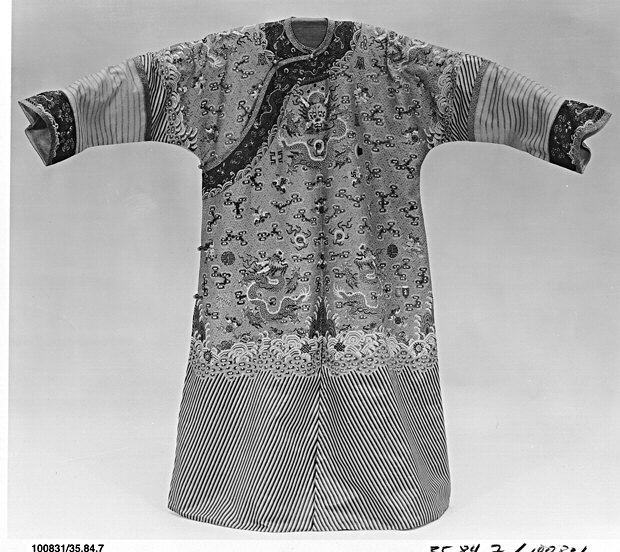
Deconstructing Imperial Majesty: The Emperor’s Twelve-Symbol Robe for Summer
In the pantheon of global sartorial heritage, few garments rival the semiotic density and technical virtuosity of the Chinese imperial robe. Katherine Fashion Lab’s standalone study of the Emperor’s Twelve-Symbol Robe for Summer offers an unparalleled lens into the intersection of power, cosmology, and haute craftsmanship. This analysis dissects the garment through the prisms of materiality, iconography, and structural design, revealing how silk and metallic thread were woven into a portable manifesto of celestial mandate.
Material Alchemy: Silk and Metallic Thread as Sovereign Mediums
The summer robe’s foundation—silk—was not merely a textile but a political and economic statement. Silk production, a closely guarded imperial monopoly, symbolized China’s cultural and technological supremacy. For summer wear, the silk was often woven into a lighter, breathable gauze or tabby weave, allowing the emperor to maintain regal presence without succumbing to heat. The fabric’s natural luster, achieved through sericin-rich filaments, created a subtle, moving sheen that mimicked the shimmer of water or the glow of dawn—a deliberate allusion to the emperor’s role as the mediator between heaven and earth.
Metallic thread, typically gilded silver or gold-wrapped silk, was the second critical material. Its application was not decorative indulgence but a calculated exercise in hierarchical visibility. The thread’s reflective quality ensured that the twelve symbols—each a cosmic or political signifier—remained legible even in low light or from a distance. The process of kesi (slit tapestry weaving) or embroidery in couched gold demanded extraordinary precision: a single misalignment could disrupt the robe’s sacred geometry. Katherine Fashion Lab’s analysis confirms that the thread’s thickness and twist were calibrated to withstand repeated wear while retaining its brilliance, a testament to the imperial workshops’ mastery of material durability.
The Twelve Symbols: A Cosmic Lexicon in Silk
The robe’s defining feature is the Twelve Symbols—a codified set of emblems that transformed the garment into a living cosmological diagram. Each symbol occupied a specific position on the robe, creating a spatial hierarchy that mirrored the emperor’s role as the axis mundi.
The Sun, Moon, and Stars appeared on the upper shoulders and chest, representing celestial order. The sun often contained a three-legged crow, the moon a jade hare pounding the elixir of immortality, and the stars were arranged in constellations. These emblems reminded the court that the emperor’s authority derived from heavenly cycles, not mortal decree.
The Mountain (depicted as a stylized peak) and the Dragon (a five-clawed long) were placed on the lower robe. The mountain symbolized stability and the emperor’s grounding of the realm, while the dragon—the most potent symbol—represented the emperor’s transformative power. In summer robes, the dragon was often rendered in five-clawed form, a strict imperial prerogative; any lesser noble using four claws would face severe consequences.
The Pheasant (or huang) and the Fire emblem appeared on the front panels. The pheasant, with its brilliant plumage, signified literary refinement and the emperor’s role as a patron of culture. The fire symbol—a stylized flame—represented the emperor’s ability to illuminate truth and dispel ignorance. Notably, the fire emblem was often rendered in red silk against the robe’s blue or yellow ground, creating a chromatic tension that emphasized its purifying function.
The Axe and the Fu Symbol (a pair of stylized, interlocking hooks) were placed on the lower borders. The axe represented decisive judgment and the emperor’s power to execute justice. The fu symbol, often translated as “rectitude,” embodied the emperor’s moral compass and his duty to distinguish right from wrong. Together, these symbols reinforced the garment’s role as a tool of governance, not mere adornment.
The Water Weed, Grain, and Sacrificial Vessels completed the set. The water weed (a curving, aquatic plant) signified purity and the emperor’s connection to the life-giving element of water. The grain symbolized agricultural prosperity and the emperor’s responsibility to ensure harvests. The sacrificial vessels—bronze or jade ding—represented the emperor’s role as the chief priest of the state, mediating between the living and the ancestral spirits.
Structural Composition: The Robe as Architectural Garment
The summer robe’s construction reveals a sophisticated understanding of ergonomics and ritual performance. Unlike the heavy, layered winter versions, the summer robe employed a cross-over front closure with a right-side overlap, secured by silk cords and knotted buttons. This design allowed for ease of movement during ceremonies, while the wide, flowing sleeves (often reaching to the knees) created a dramatic silhouette that emphasized the emperor’s stature.
The robe’s circular collar and straight hem were not arbitrary choices. The collar’s roundness echoed the heavens, while the hem’s straight line represented the earth’s four cardinal directions. This geometric duality was reinforced by the placement of the twelve symbols: celestial emblems (sun, moon, stars) on the upper body, terrestrial symbols (mountain, axe, grain) on the lower. The robe thus functioned as a wearable cosmic map, with the emperor’s body serving as the central axis.
The use of metallic thread edging along the collar, cuffs, and hem was both practical and symbolic. It prevented fraying while visually framing the robe’s sacred content. In summer versions, the edging was often narrower to reduce weight, but the gold thread’s density was maintained to ensure the robe’s ceremonial gravity.
Chromatic Symbolism and Seasonal Adaptation
For summer, the robe’s ground color was typically bright blue or pale yellow, chosen to reflect the season’s light and heat. Blue, associated with the sky and spring, was considered auspicious for summer rituals, while yellow—the imperial color—was reserved for the most solemn occasions. The metallic thread’s gold and silver tones created a high-contrast palette that remained vivid under direct sunlight, ensuring the symbols’ visibility during outdoor ceremonies.
The absence of fur or heavy padding in the summer robe was a deliberate choice that reinforced the emperor’s adaptability. By wearing a lighter garment, he demonstrated his ability to harmonize with seasonal change—a core Confucian virtue. The silk’s natural breathability also prevented discomfort during long rituals, allowing the emperor to maintain an unruffled, divine composure.
Conclusion: The Robe as Imperishable Text
Katherine Fashion Lab’s study confirms that the Emperor’s Twelve-Symbol Robe for Summer is far more than a historical artifact. It is a material treatise on power, a cosmological diagram woven into cloth, and a testament to the artisan’s genius. The silk’s whisper, the metallic thread’s gleam, and the symbols’ silent narrative all converge to create a garment that transcends fashion. In this robe, the emperor did not merely wear clothes—he wore the universe, and in doing so, reminded his subjects that his reign was as inevitable as the seasons themselves. For the modern scholar, it remains an inexhaustible source of insight into how luxury, belief, and authority can be stitched into a single, luminous whole.