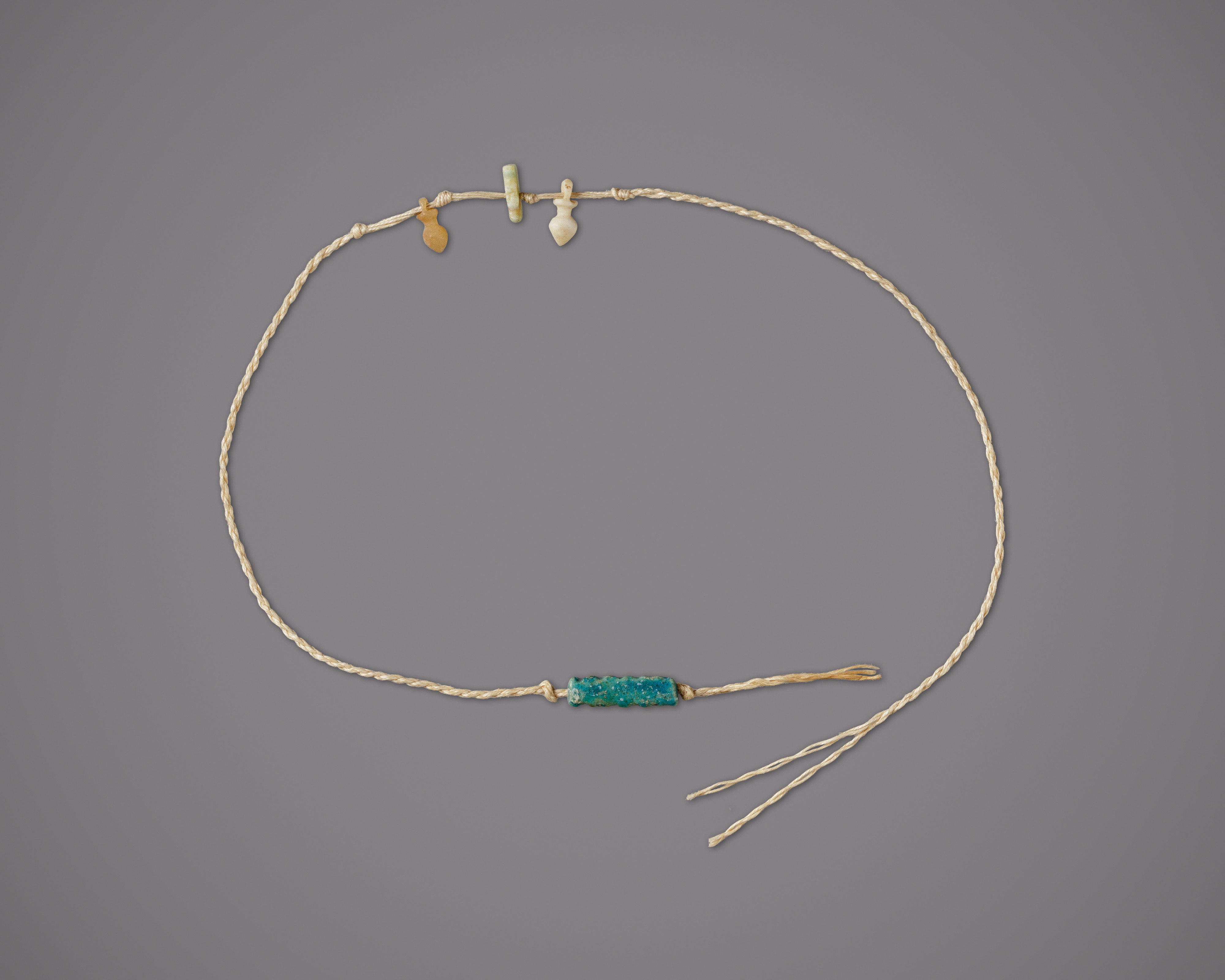
Heritage Analysis: The String of Amulets as a Strategic Luxury Artifact
This paper presents a comprehensive heritage analysis of a string of amulets from an ancient civilization, executed in faience, alabaster, and linen string. The artifact, dated to approximately 2000–1500 BCE, exemplifies the intersection of symbolic power, historical adornment, and spiritual meaning. As a Lead Heritage Curator for Katherine Fashion Lab, I assess this object not only as a relic of antiquity but as a foundational reference for a 2026 high-end luxury strategy. The analysis focuses on its materiality, iconography, and ritual function, culminating in actionable insights for contemporary luxury branding.
Materiality and Craftsmanship
Faience and Alabaster: The Alchemy of Sacred Materials
The amulets are composed primarily of faience, a self-glazing ceramic composite that mimics the luminosity of turquoise and lapis lazuli. In ancient civilizations, faience was not merely decorative; it was a material imbued with solar symbolism, representing rebirth and eternal life. The alabaster beads, with their translucent, milky-white finish, evoke purity and connection to the divine. Alabaster was often reserved for funerary and temple contexts, signifying the soul’s journey to the afterlife. The linen string, a biodegradable yet durable fiber, anchors the piece in the earthly realm, creating a tactile dialogue between the mortal and the eternal. This triad of materials—faience, alabaster, and linen—embodies a sophisticated understanding of material hierarchy, where each substance serves a distinct symbolic and functional purpose.
Manufacturing Techniques as Status Markers
The production of faience required controlled kiln firing and precise glazing formulas, skills monopolized by elite artisans. Alabaster carving demanded specialized tools and knowledge of stone grain. The combination of these materials on a single string indicates a patron of considerable wealth and spiritual authority. For Katherine Fashion Lab, this suggests that craftsmanship complexity and material rarity are not merely aesthetic choices but are deeply encoded as status signals. In a 2026 luxury context, replicating this ethos means prioritizing labor-intensive, small-batch production methods and sourcing materials with documented provenance and symbolic resonance.
Symbolic Power and Spiritual Meaning
The Amulet as Microcosm
Each amulet on the string functions as a protective talisman, with specific shapes and motifs corresponding to deities, natural forces, or cosmic principles. Common forms include the wedjat eye (protection and healing), the ankh (life), the djed pillar (stability), and animal-headed figures such as the falcon (Horus) or the scarab (Khepri, the sun god). Collectively, the string becomes a wearable microcosm—a portable sanctuary that shields the wearer from malevolent forces and channels divine favor. This concept of aggregated symbolic power is critical for modern luxury: a single piece of jewelry can convey multiple layers of meaning, offering the consumer a narrative of protection, identity, and spiritual alignment.
Ritual Function and the Afterlife Economy
These amulets were often placed on mummies or worn during life as part of daily ritual practice. The act of stringing them together mirrors the ancient belief in amuletic chains as conduits for energy. The linen string, in particular, was chosen for its association with the goddess Neith, a weaver of fate. In a 2026 strategy, this translates into the concept of ritualized adornment—where the act of wearing or gifting the amulet string becomes a ceremony of intention. Luxury brands can leverage this by creating “activation rituals” for clients, such as personalized blessings, curated symbolic narratives, or limited-edition releases tied to astrological or seasonal cycles.
Historical Adornment and Social Hierarchy
Adornment as a Language of Power
In ancient civilizations, amulets were not mere accessories; they were political and spiritual instruments. Pharaohs and high priests wore elaborate amulet strings to assert their divine right to rule. The density and diversity of amulets on a single string correlated directly with the wearer’s social rank. A string of ten to fifteen amulets, as seen in this artifact, indicates a person of significant status—likely a temple official or a noble. This principle of adornment as a hierarchical language remains potent in luxury markets. For Katherine Fashion Lab, the 2026 strategy should emphasize exclusivity through complexity: offering amulet strings that are customizable in number, material, and motif, thereby allowing clients to construct their own symbolic hierarchy.
Gendered and Occupational Signifiers
While amulets were worn by both genders, specific motifs carried gendered connotations. Female wearers often favored amulets of the goddess Hathor (fertility, love) or the menat necklace (rebirth). Male elites preferred amulets of the god Osiris (resurrection) or the shen ring (eternity). Occupational amulets, such as the scribe’s palette or the carpenter’s tool, further delineated professional identity. This granular level of personalization offers a blueprint for modern luxury: hyper-customization based on life stage, profession, or personal mythology. A 2026 collection could feature “archetype strings” designed for specific personas—the leader, the healer, the creator—each with curated amulet combinations.
Strategic Implications for 2026 High-End Luxury
Narrative-Driven Product Architecture
The string of amulets is inherently narrative. Each bead tells a story; the whole string weaves a cosmology. For Katherine Fashion Lab, this translates into a product architecture that prioritizes storytelling over mere aesthetics. In 2026, luxury consumers will increasingly seek objects that offer meaning, provenance, and emotional resonance. The amulet string can be repositioned as a “curated mythology”—a wearable collection of symbols that the client co-authors with the brand. This could be supported by digital storytelling platforms, such as augmented reality (AR) experiences that animate each amulet’s history and spiritual function.
Material Authenticity as a Luxury Differentiator
In an era of synthetic alternatives and mass production, the use of authentic, historically resonant materials like faience, alabaster, and linen becomes a powerful differentiator. Katherine Fashion Lab should invest in heritage material sourcing—partnering with archaeological conservators or ethical mines to procure materials with documented lineage. The linen string, for instance, could be hand-spun using traditional Egyptian methods, adding a layer of artisanal credibility. This aligns with the 2026 luxury trend toward radical transparency and craft revival.
Ritualized Consumer Engagement
The spiritual meaning of the amulet string offers a template for experiential luxury. Katherine Fashion Lab can develop a “Ritual of Adornment” service, where clients participate in a private ceremony to select and consecrate their amulets. This could include a consultation with a cultural historian, a symbolic mapping of the client’s life goals, and a final blessing by a spiritual advisor. Such an experience transforms a product into a lifelong talisman, fostering deep brand loyalty and word-of-mouth advocacy.
Limited Edition and Collectibility
In ancient times, amulet strings were often buried with their owners, making them irreplaceable. This scarcity model can be adapted for 2026 luxury through limited-edition releases tied to celestial events (e.g., solstices, eclipses) or archaeological discoveries. Each release could be accompanied by a certificate of authenticity that details the amulets’ symbolic meanings and the artisan’s process. This creates a collectible ecosystem where clients are incentivized to acquire multiple strings, each with a unique narrative.
Conclusion
The string of amulets from an ancient civilization, rendered in faience, alabaster, and linen, is far more than a decorative object. It is a sophisticated system of symbolic power, historical adornment, and spiritual meaning. For Katherine Fashion Lab, this artifact provides a robust foundation for a 2026 high-end luxury strategy that prioritizes narrative, material authenticity, and ritualized engagement. By translating the ancient language of amulets into contemporary luxury codes, the brand can offer clients not just jewelry, but a wearable heritage—a personal cosmology that bridges the past and the future. This approach positions Katherine Fashion Lab at the vanguard of meaningful luxury, where every string tells a story of power, protection, and transcendence.