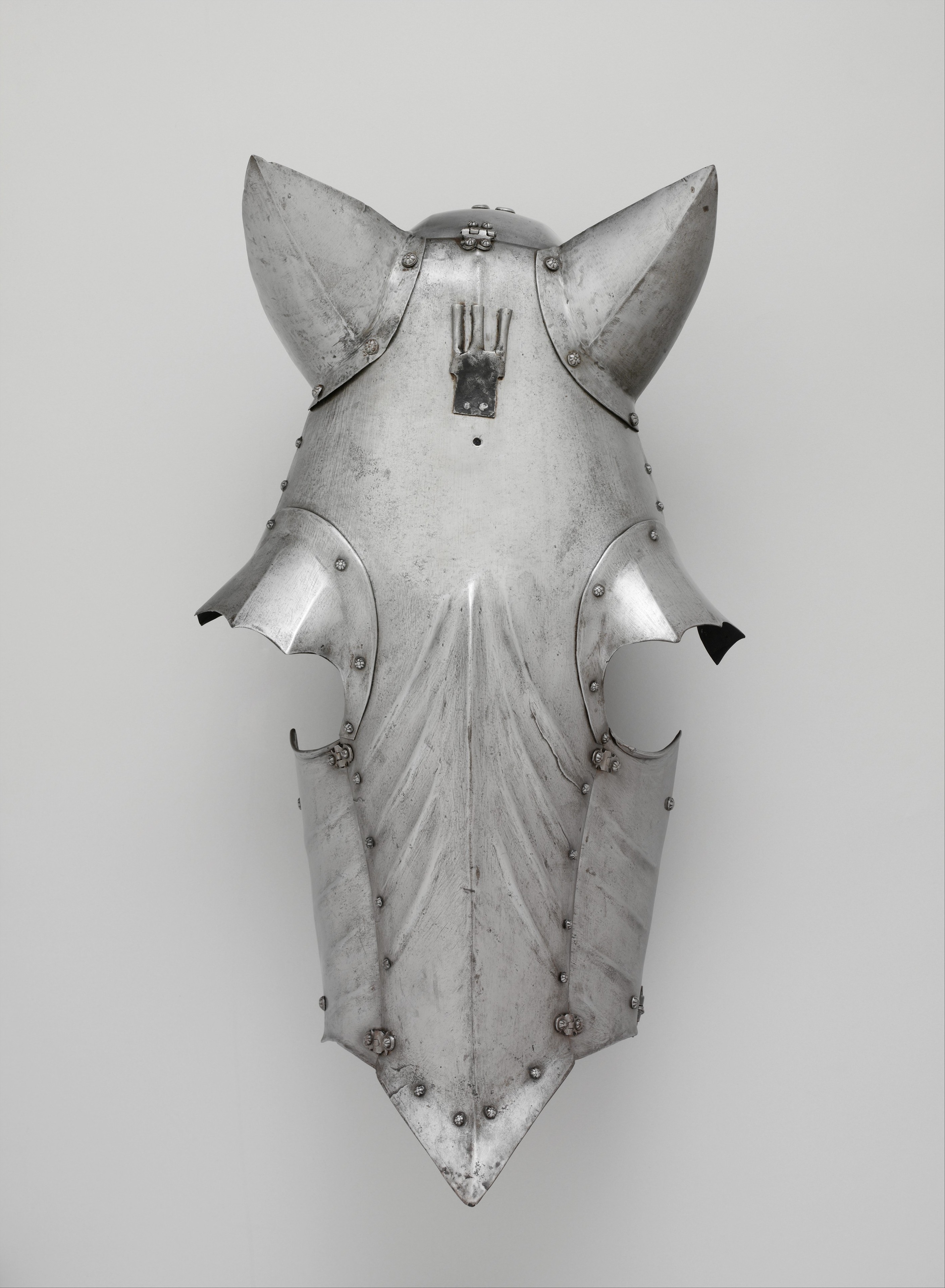
The Shaffron as Couture: An Analysis of a Franco-Italian Masterwork
In the annals of equestrian armor, the shaffron—the articulated plate defense for a horse’s head—stands as a singular testament to the convergence of martial necessity and aristocratic artistry. At Katherine Fashion Lab, we approach this artifact not merely as a relic of medieval warfare, but as a profound expression of couture: a bespoke, material narrative of power, identity, and craftsmanship. This analysis examines a Franco-Italian shaffron from the late 15th century, forged from steel and layered with textile remnants, to decode its significance as a standalone object of luxury and strategic design.
Material Alchemy: Steel as Structural Elegance
The shaffron’s primary material—steel—was not chosen solely for its defensive properties. In the context of Franco-Italian armorers, steel represented a medium of precision and status. The piece under study exhibits a masterful balance of weight and articulation, with plates that seamlessly contour to the equine skull. The steel is not monolithic; it is worked into overlapping laminae, allowing for movement while maintaining an unyielding barrier. This is engineering as couture: each curve and rivet is calibrated for both protection and aesthetic fluidity. The surface, though now patinated, would have originally been polished to a mirror-like sheen, catching torchlight in processions and battle alike. The armorer’s skill lies in rendering the rigid supple—a paradox that defines high-end armor design. The steel’s subtle hammer marks, visible under magnification, reveal a hand-forged uniqueness, akin to the imperfections prized in bespoke tailoring.
Textile Integration: The Soft Power of Fabric
What elevates this shaffron beyond pure militaria is the incorporation of textile elements—fragments of silk and velvet, now faded, that once lined the interior and adorned the edges. In Franco-Italian workshops, textiles were not mere padding; they were signifiers of wealth and diplomatic exchange. The remnants of crimson velvet, likely dyed with kermes or cochineal, speak to a chromatic strategy: red symbolized both martial blood and noble lineage. The textile’s weave—a diamond twill—mirrors the geometric patterns etched into the steel, creating a visual dialogue between hard and soft materials. This integration is a precursor to modern couture’s use of contrasting textures—think of a Chanel jacket’s bouclé paired with leather trim. The shaffron’s textile lining also served a functional couture purpose: it absorbed sweat, reduced friction, and protected the horse’s coat, ensuring the animal’s comfort during prolonged display or combat. This attention to the wearer’s experience—even a non-human one—is the hallmark of luxury design.
Regional Synthesis: Franco-Italian Aesthetic Fusion
The shaffron’s origin in the Franco-Italian borderlands, particularly the Milanese and Burgundian spheres, is critical to its design vocabulary. Italian armorers, renowned for their articulated plate construction, introduced a fluidity that allowed the shaffron to move with the horse’s head without compromising coverage. French influence, by contrast, emphasized ornamental excess: the shaffron’s brow plate is etched with a frieze of acanthus leaves and a central medallion—possibly a heraldic device now worn away. This fusion creates a hybrid aesthetic: the Italian commitment to ergonomic logic meets the French penchant for narrative decoration. The result is a piece that is simultaneously functional and theatrical, a three-dimensional canvas for identity. The shaffron’s silhouette—a gentle taper from poll to muzzle—echoes the contemporary Italian fashion for elongated, streamlined forms in human armor, while the etched motifs borrow from French manuscript illuminations. This cross-pollination anticipates the globalized design exchanges of today’s fashion houses.
Standalone Significance: Beyond the Battlefield
To treat this shaffron as a standalone study is to recognize its role as an autonomous object of desire, detached from the full barding set. In the late medieval period, such pieces were often commissioned as gifts, diplomatic tokens, or commemorative items—worn in tournaments, parades, and portraits rather than on the battlefield. The shaffron’s condition, with minimal combat damage and preserved textile, suggests it was a ceremonial object. This shifts its analysis from utility to symbolism. The horse, as the knight’s partner, was a mobile throne, and the shaffron was its crown. The piece’s standalone value lies in its ability to condense power into a single, portable artifact. It is couture in the sense that it is a total statement: every detail—from the rivet pattern to the edge finish—communicates the owner’s rank, wealth, and aesthetic sensibility. In this, it prefigures the modern luxury handbag or watch: an object that speaks without words.
Design Principles for Contemporary Couture
From this Franco-Italian shaffron, Katherine Fashion Lab extracts three enduring principles. First, material honesty: steel is not disguised but celebrated, its weight and texture becoming part of the design narrative. Second, articulated flexibility: true luxury accommodates movement, whether in a horse’s gallop or a human’s stride. Third, contextual ornament: decoration is not superfluous but serves as a code for identity—heraldic, regional, or personal. These principles challenge modern designers to consider how objects can be both protective and expressive, functional and symbolic. The shaffron’s legacy lives in the armored silhouettes of contemporary fashion—from structured shoulders to metallic finishes—but its essence remains in the marriage of craft and meaning.
Conclusion: The Shaffron as Eternal Couture
This Franco-Italian shaffron, now a silent object in a collection, once thundered through courts and fields. Its steel and textile are not materials of war alone but of aspiration and artistry. As a standalone study, it reveals that couture is not bound by human form or era; it is a method of making that elevates the necessary into the magnificent. At Katherine Fashion Lab, we see in this shaffron a blueprint for how design can negotiate between protection and expression, between the horse’s power and the rider’s prestige. It is a lesson in material storytelling that remains as relevant today as in the 15th century—a testament to the enduring dialogue between the maker, the wearer, and the world they inhabit.