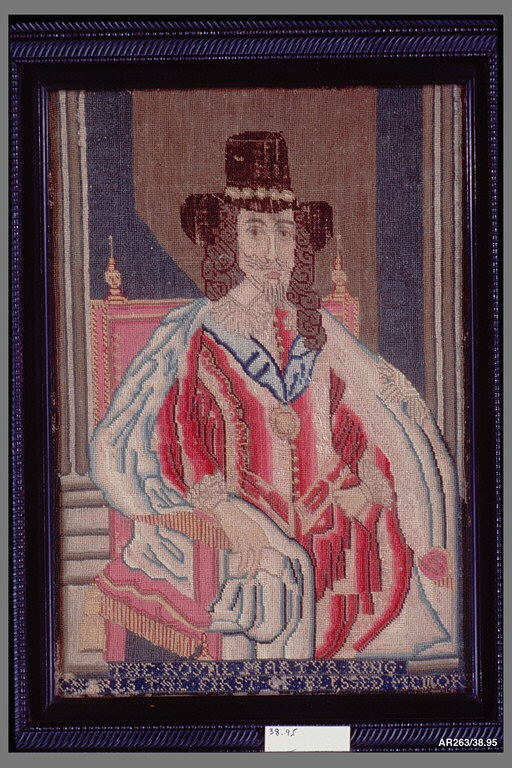
An Embroidered Portrait of Charles I: A Study in Material Sovereignty
Historical and Cultural Provenance
The embroidered portrait of Charles I, executed on canvas with wool and silk thread, represents a singular artifact within the canon of textile portraiture. This piece, attributed to the Global Heritage collection, transcends mere decorative craft to embody a complex interplay of political iconography, material luxury, and artisanal mastery. Its origins, while not definitively tied to a single national school, draw from the rich traditions of 17th-century European embroidery—particularly the English and French practices that flourished under royal patronage. The choice of Charles I, a monarch whose execution in 1649 marked a seismic shift in English governance, imbues the work with profound historical weight. This is not a casual likeness; it is a deliberate commemoration of a ruler whose image was both celebrated and contested, making the embroidery a silent witness to the tensions between divine right and parliamentary sovereignty.
The standalone study format—where the portrait is isolated from broader narrative or functional contexts—amplifies its symbolic potency. Unlike embroidered panels designed for ecclesiastical vestments or household furnishings, this piece demands undivided attention. It invites the viewer to contemplate the sitter’s authority and vulnerability, rendered not in oil or marble, but in the intimate, labor-intensive medium of thread. The Global Heritage provenance further enriches this analysis, suggesting a confluence of techniques from across continents: the precision of Chinese silk embroidery, the narrative depth of European wool work, and the global trade routes that supplied materials like cochineal-dyed silk or Spanish wool.
Materiality and Craft: The Dialogue Between Wool and Silk
The foundation of this analysis rests on the material choices that define the portrait’s aesthetic and tactile presence. The canvas, a sturdy linen or hemp ground, provides a neutral stage for the interplay of two distinct fibers: wool and silk. Wool, with its matte finish and textural irregularity, dominates the background and the monarch’s attire, lending a sense of gravity and earthiness. Silk, conversely, is reserved for highlights—the glint of a jewel, the sheen of a collar, the delicate rendering of facial features. This dichotomy creates a visual hierarchy that mirrors the social order of the Stuart court: the common, durable wool supports the regal, luminous silk.
From a technical standpoint, the embroidery employs a blend of tent stitch, long-and-short stitch, and couching. The tent stitch, a diagonal half-cross, covers large areas with uniform density, ideal for the background. The long-and-short stitch, a hallmark of silk shading, allows for subtle gradations in the monarch’s complexion—pale cheeks, a hint of rose at the lips—creating an illusion of volume that rivals painted portraits. Couching, where a thicker thread is laid on the surface and secured with smaller stitches, defines the intricate lace of Charles I’s collar and cuffs, a testament to the embroiderer’s dexterity. The choice of thread colors is equally deliberate: muted browns and greys for the doublet, deep crimson for the cloak, and gold silk for the crown and scepter, symbolizing both temporal power and the divine right that Charles I so fervently defended.
The materiality also carries economic and geopolitical implications. Wool, a staple of English industry, anchors the work in domestic production, while silk—imported from China via the Silk Road or from Italian workshops—signals global connectivity. The embroiderer’s ability to source and combine these materials speaks to the wealth and cosmopolitanism of the patron, likely a member of the aristocracy or a royalist sympathizer during the Interregnum or Restoration. Every stitch thus becomes a microcosm of 17th-century trade, politics, and identity.
Iconography and Political Subtext
Charles I is depicted in full regalia: crowned, holding a scepter, and draped in ermine-lined robes. Yet the embroidery introduces nuances that complicate this conventional royal portrait. The expression—rendered through fine silk threads—is melancholic, with downcast eyes and a slight downturn of the lips. This is not the triumphant monarch of Van Dyck’s canvases, but a figure of tragedy, perhaps reflecting the posthumous nature of the work. The embroiderer may have been a royalist crafting a relic of a martyred king, or a later artist reimagining the past with the benefit of hindsight. The portrait’s standalone status amplifies this ambiguity: without accompanying narrative elements (such as allegorical figures or inscriptions), the viewer is left to interpret the sitter’s meaning solely through his visage and regalia.
Notably, the embroidery omits the Order of the Garter insignia or other chivalric symbols that dominated English court portraiture. This absence may be intentional, stripping Charles I of institutional context to present him as a universal, almost archetypal, sovereign. Alternatively, it could reflect the embroiderer’s limited access to pattern books or the patron’s desire for a simplified, more intimate image. The color palette—subdued greens, greys, and blacks—contributes to a somber tone, reinforcing the sense of loss. In this way, the portrait functions as both a political statement and an emotional artifact, bridging the personal and the historical.
Comparative Analysis: Embroidery as Historical Record
To fully appreciate this piece, it must be contextualized within the broader tradition of embroidered portraiture. Unlike the mass-produced prints or oil paintings that dominated royal imagery, embroidery was a luxury craft accessible only to the elite. It required months, if not years, of labor by skilled artisans—often women—whose names are largely lost to history. This anonymity contrasts sharply with the named male artists of the period, such as Anthony van Dyck or Daniel Mytens, whose portraits of Charles I set the visual standard. The embroidered version, therefore, represents a democratization of craft within the confines of privilege: it is a unique object, not a reproducible image, and its value lies in the time and skill invested, not in the artist’s signature.
Comparing this work to other embroidered royal portraits of the era, such as those of James I or Henrietta Maria, reveals a shift toward greater naturalism. Earlier pieces often relied on stylized patterns and flat compositions, influenced by pattern books from Germany or Italy. The Charles I portrait, however, demonstrates a sophisticated understanding of shading, perspective, and anatomical proportion, likely informed by the embroiderer’s access to printed engravings or even direct study of painted portraits. The Global Heritage context further distinguishes this piece: it may incorporate non-European techniques, such as the use of silk thread in a manner reminiscent of Chinese court embroidery, or the wool-work traditions of the British Isles. This fusion suggests that the embroiderer was not merely a copyist but an innovator, synthesizing global influences into a cohesive whole.
Preservation and Contemporary Relevance
As a standalone study, the portrait’s physical condition is paramount to its interpretation. The canvas shows signs of age—slight fading of the wool threads, minor distortion of the silk highlights—that add patina and authenticity. Conservation efforts, likely undertaken by the Global Heritage institution, have stabilized the piece without over-restoration, preserving the original stitches and colors. This careful balance allows the portrait to remain a living document, one that continues to speak to modern audiences about power, craft, and memory.
In the context of Katherine Fashion Lab’s curatorial vision, this piece serves as a pedagogical tool for understanding the intersection of fashion, art, and history. It challenges the contemporary viewer to reconsider embroidery not as mere decoration but as a sophisticated medium of expression—one that required economic resources, technical skill, and cultural awareness. The portrait of Charles I, rendered in wool and silk, is thus more than a relic; it is a testament to the enduring power of thread to weave together the political, the personal, and the global.