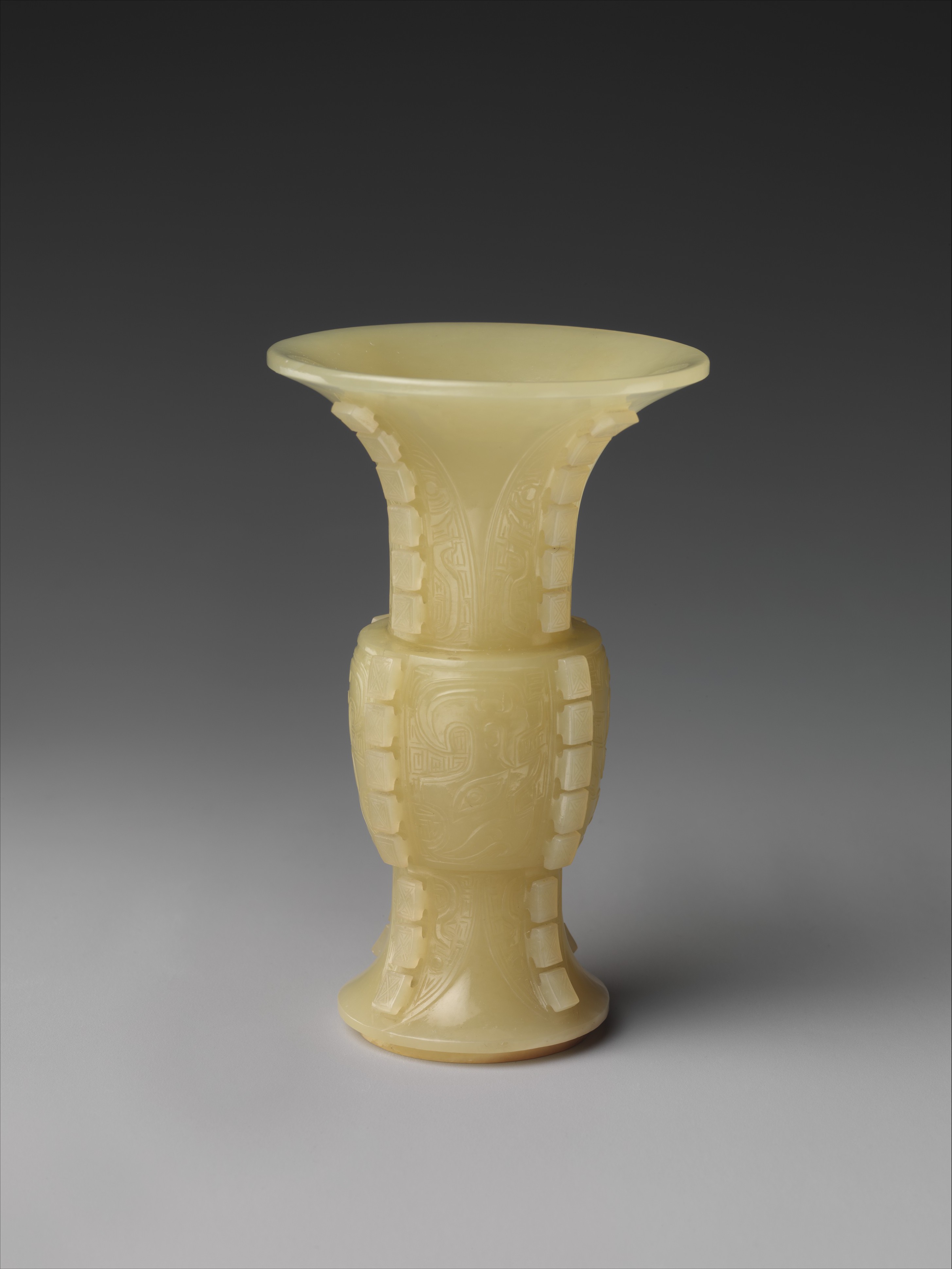
Heritage Analysis: The Miniature Jade Gu Vessel
This report presents a comprehensive heritage analysis of a miniature jade (nephrite) vase shaped as an ancient Chinese ritual vessel, known as a gu. Commissioned as a Strategic Standalone Research brief for Katherine Fashion Lab, this analysis examines the object through four critical lenses: symbolic power, historical adornment, spiritual meaning, and strategic application for 2026 high-end luxury positioning. The gu vessel, while diminutive in scale, embodies a profound legacy of imperial authority, cosmological harmony, and material transcendence—attributes that resonate powerfully with contemporary luxury consumers seeking authenticity, rarity, and cultural depth.
Symbolic Power of the Gu Vessel
The gu (觚) is one of the most archetypal ritual vessels of ancient China, originating in the Shang (c. 1600–1046 BCE) and Zhou (1046–256 BCE) dynasties. Its form—a slender, trumpet-shaped body with a flared mouth, a narrow waist, and a flared foot—was not merely aesthetic but deeply symbolic. In the context of ancestral worship and state ceremonies, the gu was used to hold wine offerings, serving as a conduit between the earthly realm and the celestial spirits. The vessel’s elongated silhouette evoked a sense of upward aspiration, symbolizing the connection between the living and the divine.
The choice of nephrite jade amplifies this symbolic power. Jade, or yu (玉), has been revered in Chinese civilization for over 5,000 years as the "essence of heaven and earth." It embodies five cardinal virtues: benevolence, righteousness, wisdom, courage, and purity. A miniature jade gu, therefore, condenses multiple layers of authority—political, spiritual, and moral—into a single, portable object. For the aristocratic elite, owning such a piece signified not only wealth but also cultural legitimacy and cosmic alignment. The miniature scale does not diminish its power; rather, it transforms the vessel into an intimate talisman, a personal artifact of immense symbolic weight.
Historical Adornment and Material Prestige
Historically, jade objects of this nature were not merely functional but were central to the practice of adornment—both of the body and of ritual spaces. During the Shang and Zhou periods, jade gu vessels were often placed in elite tombs as part of burial ensembles, intended to accompany the deceased into the afterlife. Their presence ensured continued access to ritual offerings and spiritual protection. The nephrite material, sourced primarily from the Kunlun Mountains in Xinjiang, was considered more precious than gold or silver due to its rarity, its tactile warmth, and its perceived metaphysical properties.
In later dynasties, particularly the Song (960–1279) and Ming (1368–1644), jade vessels became prized collectibles among scholars and connoisseurs. The miniature gu was often displayed on scholar’s desks as a symbol of refined taste and historical erudition. This tradition of intellectual adornment—where objects are not worn but curated—parallels the modern luxury concept of personalized heritage. The jade gu becomes a statement piece, not through ostentation, but through its embedded narrative of craftsmanship, material provenance, and cultural lineage.
Spiritual Meaning and Transcendence
Beyond its political and aesthetic dimensions, the jade gu holds profound spiritual meaning. In Daoist and Confucian thought, jade is believed to possess qi (life energy) that can harmonize the wearer or owner’s own energy. The gu form, with its flared mouth and foot, is often interpreted as a representation of the axis mundi—the cosmic pillar connecting heaven, earth, and the underworld. When miniaturized, this spiritual geometry becomes a personal meditation tool, a focal point for contemplation and inner balance.
Furthermore, the act of carving nephrite, one of the hardest known minerals, was itself a spiritual discipline. Master carvers spent months or even years on a single piece, using abrasive sands and bamboo drills. The resulting object is not just a product but a repository of human intention and patience. For the contemporary wearer, a miniature jade gu serves as a tangible reminder of impermanence and permanence—the fleeting nature of human life contrasted with the enduring beauty of stone. This duality aligns with the growing luxury consumer desire for objects that offer meaning beyond materiality.
2026 High-End Luxury Strategy for Katherine Fashion Lab
To leverage the heritage of the miniature jade gu in a 2026 high-end luxury strategy, Katherine Fashion Lab must position this object not as a simple accessory but as a curatorial artifact within a broader narrative of cultural stewardship. The following strategic pillars are recommended:
1. Artifact-as-Statement: Limited Edition "Spiritual Heirloom" Series
Launch a tightly controlled series of miniature jade gu vessels, each authenticated with a provenance dossier that traces its symbolic lineage from Shang ritual to contemporary luxury. Emphasize the nephrite’s geological rarity and the master carver’s lineage. Pricing should reflect the object’s status as an heirloom, not a commodity. The narrative should frame the vessel as a "portable temple," a personal object of spiritual and aesthetic power.
2. Material Alchemy: Jade as the New "Black Diamond"
In the 2026 luxury market, material scarcity and ethical sourcing are paramount. Position nephrite jade as the ultimate "quiet luxury" material—subtle, luminous, and deeply resonant. Contrast it with the flashiness of diamonds or colored gems. The miniature gu can be integrated into modular jewelry systems (e.g., pendants, brooches, or cufflinks) that allow the wearer to transform the vessel from a desk object to a wearable talisman. This flexibility caters to the high-net-worth individual’s desire for versatility and personalization.
3. Experiential Heritage: The "Gu Ritual" Private Salon
Develop an exclusive, invite-only salon experience where clients can engage with the jade gu through a curated ritual: a guided meditation on its form, a discussion of its historical context, and a personal commissioning process. This transforms the purchase into a transformative experience, reinforcing brand loyalty and word-of-mouth among elite circles. The salon should be held in heritage-rich locations—such as a restored Ming-dynasty courtyard or a private museum—to underscore the object’s authenticity.
4. Digital Provenance: Blockchain and Cultural Authentication
To address concerns about authenticity and cultural appropriation, implement a blockchain-based digital certificate that verifies the jade’s origin, the carver’s credentials, and the vessel’s historical references. This transparency builds trust and positions Katherine Fashion Lab as a responsible custodian of cultural heritage. Additionally, collaborate with museum curators and sinologists to produce a limited-edition monograph that contextualizes the gu within the broader narrative of Chinese ritual art.
5. Cross-Cultural Resonance: The "East Meets West" Collection
For the 2026 global market, the miniature jade gu can be reimagined in a capsule collection that blends Eastern symbolism with Western tailoring. For instance, a jade gu pendant set in a platinum cage, or a brooch that echoes the vessel’s silhouette in a minimalist Art Deco style. This hybrid approach avoids cultural tokenism while appealing to cosmopolitan collectors who value cross-cultural dialogue. The narrative should emphasize universal themes—spirituality, craftsmanship, and timelessness—rather than exoticizing the object.
Conclusion
The miniature jade gu vessel is far more than a historical artifact; it is a potent symbol of authority, a vessel of spiritual energy, and a testament to human artistry. For Katherine Fashion Lab, this object offers a unique opportunity to bridge ancient heritage with modern luxury, creating a product that is both intellectually rigorous and emotionally resonant. By adopting a strategy rooted in cultural authenticity, material prestige, and experiential depth, the brand can secure a distinctive position in the 2026 high-end market, appealing to discerning clients who seek not just objects of beauty, but objects of meaning. The jade gu is not merely a vase; it is a dialogue with eternity.