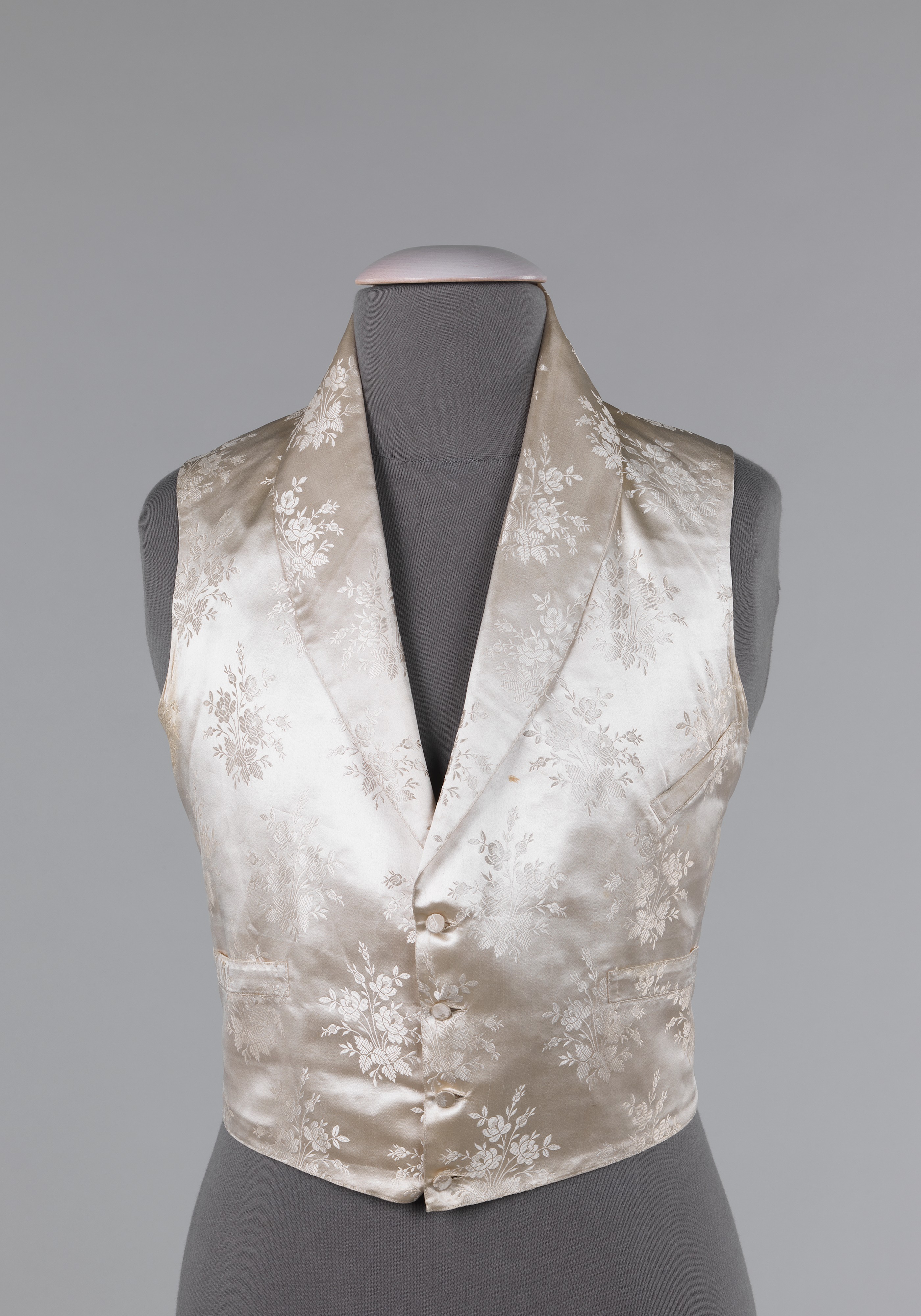
The Evening Vest: A Study in Structural Elegance
Within the rarefied atmosphere of haute couture, the evening vest occupies a paradoxical space: it is at once a relic of formal menswear and a canvas for the most audacious expressions of feminine silhouette. At Katherine Fashion Lab, our curatorial lens focuses on a singular artifact—a vest of probable French origin, executed in silk and cotton. This is not a garment intended to be hidden beneath a dinner jacket; it is a standalone study, a declaration of intent. To analyze it is to dissect the interplay of structure, material, and cultural narrative that defines true couture.
Material Dialectics: Silk and Cotton in Opposition
The choice of materials in this vest is far from arbitrary. Silk, with its luminous, almost liquid surface, speaks to the evening’s demand for opulence. It catches light with the subtlety of a whispered secret, suggesting wealth without vulgarity. Yet, the presence of cotton introduces a grounding tension. Cotton—often relegated to the utilitarian sphere of daywear—here serves as a structural counterpoint. It provides the vest with a crispness that silk alone cannot achieve, a rigidity that allows the garment to hold its shape against the body without constriction.
This is a masterclass in material dialectics. The silk offers sensuality; the cotton offers integrity. Together, they create a fabric that is neither purely decorative nor purely functional. It is a textile that breathes, that moves with the wearer while retaining a sculptural presence. In the hands of a French couturier—likely trained in the traditions of Lyon or Paris—this blend becomes a statement: luxury need not sacrifice structure, and structure need not sacrifice grace.
Silhouette and the Art of the Standalone Vest
To wear an evening vest as a standalone piece is to embrace a form of architectural dressing. The garment does not rely on a jacket to complete its narrative. Instead, it defines the torso with precision, often featuring a deep V-neckline that elongates the neck and draws the eye downward. The waist is cinched, not through aggressive boning, but through careful tailoring—darts and seams that follow the body’s natural curves.
The probable French origin of this vest suggests an adherence to the maison’s tradition of “tailleur”—the art of cutting cloth to fit the human form with mathematical exactitude. Yet, the evening vest also borrows from the “flou” technique, where fabric is draped and softened. The result is a silhouette that is both sharp and yielding. The shoulders may be slightly extended, offering a subtle nod to the masculine tuxedo vest, but the waist is unmistakably feminine, creating an hourglass that is less about corsetry and more about the illusion of perfect proportion.
Cultural Context: The French Art of the Ambiguous Garment
Why does this vest matter? Because it embodies a distinctly French approach to fashion: the elevation of the ambiguous. In French couture, a garment need not declare its gender or its occasion immediately. The evening vest, worn alone, blurs the line between day and night, between masculine and feminine, between undergarment and outerwear. It is a “pièce d’exception”—a piece that demands the wearer to complete its story.
Historically, the vest (or “gilet”) emerged in the 17th century as a male garment, later adopted by women in the 19th century as a symbol of rebellion and sophistication. This particular vest, with its silk-cotton composition, likely dates from the late 20th or early 21st century, a period when French ateliers began to deconstruct formalwear. It is a product of what we might call “post-tuxedo modernism”—a movement that treats the vest not as an accessory but as a primary garment, capable of commanding a room on its own.
Construction Details: The Invisible Architecture
To appreciate the vest’s craftsmanship, one must look beyond its surface. The interior reveals a faille silk lining—a fabric with a subtle ribbed texture that reduces friction against the wearer’s clothing or skin. The seams are finished with a French seam technique, where raw edges are encased, ensuring durability and a clean aesthetic. The buttonholes, likely hand-stitched with silk thread, are reinforced with a tiny bar tack at each end—a detail that speaks to the garment’s intended longevity.
The vest fastens with a series of mother-of-pearl buttons, each one individually sewn with a shank to allow for easy movement. The button placement is deliberate: the top button sits just below the collarbone, the bottom at the natural waist. This spacing creates a visual rhythm that guides the eye, while also allowing the vest to open slightly at the hips, offering a glimpse of the wearer’s choice of trousers or skirt.
Styling the Standalone Vest: A Curatorial Perspective
At Katherine Fashion Lab, we advocate for the vest as a singular statement. It is best paired with high-waisted, wide-leg trousers in a matte fabric—perhaps a wool crepe or a heavy satin—to contrast with the vest’s sheen. Avoid jewelry at the neckline; the vest’s V-shape is its own ornament. Instead, consider a single cuff bracelet or a pair of sculptural earrings that echo the vest’s angular lines.
For evening events, the vest can be worn with a floor-length skirt in a matching or complementary hue. However, the true power of this garment lies in its versatility within limitation. It is not a piece for layering; it is a piece for exposure. The wearer must be comfortable with the vulnerability of a bare back or décolletage, yet confident in the armor of impeccable tailoring.
Conclusion: The Vest as a Modern Heirloom
This evening vest is more than a garment; it is a curatorial artifact that challenges our assumptions about formalwear. Its French origins remind us that couture is not merely about decoration but about the intellectual rigor of construction. The silk and cotton are not just fibers; they are arguments for balance. And the standalone presentation is not a lack of context but a deliberate choice—a refusal to be reduced to an accessory.
In the hands of a skilled wearer, this vest becomes a second skin, a declaration of personal style that is both timeless and utterly modern. At Katherine Fashion Lab, we celebrate such pieces as the epitome of what fashion can achieve when it respects tradition while daring to stand alone.