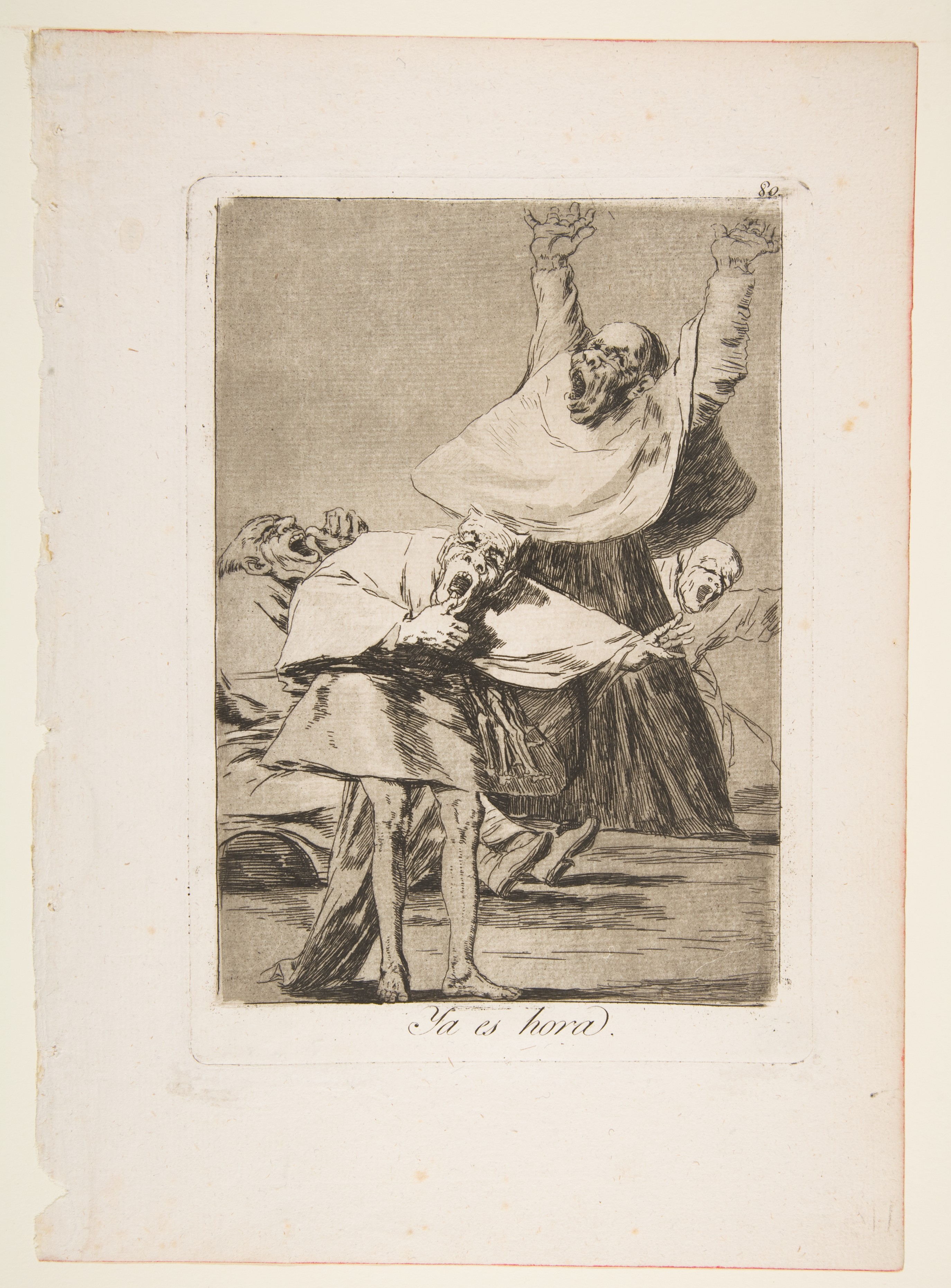
Deconstructing Time: A Couture Analysis of Plate 80 from Goya’s “Los Caprichos”
Introduction: The Eternal Present in Fashion’s Narrative
In the rarefied world of haute couture, where fabric meets philosophy and silhouette becomes statement, the analysis of a single artistic plate can unlock profound insights into the temporal nature of fashion. Plate 80 from Francisco Goya’s seminal series Los Caprichos, titled “Ya es hora” (It is time), offers a startlingly modern meditation on urgency, decay, and the relentless march of time—themes that resonate with uncanny precision in the context of Katherine Fashion Lab’s mission to bridge global heritage with avant-garde design. Executed in etching, burnished aquatint, drypoint, and burin, this standalone study transcends its 18th-century origins to become a masterclass in the tension between the ephemeral and the eternal. For the couturier, this plate is not merely an artifact; it is a pattern of existential reckoning, a blueprint for deconstructing the very fabric of temporality.
Materiality and Medium: The Couture of Printmaking
The technical virtuosity of Goya’s chosen materials mirrors the meticulous craftsmanship of haute couture. The etching provides the foundational line—the equivalent of a garment’s structural seams—while the burnished aquatint introduces tonal gradations that evoke the nuanced draping of silk or the shadow play of organza. The drypoint technique, with its characteristic burr, creates a tactile, almost velvet-like texture in the darkest areas, reminiscent of the plushness of velvet or the depth of a hand-embroidered beadwork. The burin, used for incising precise, sharp lines, suggests the clean cut of a couture scissor or the decisive stroke of a tailor’s chalk.
In Katherine Fashion Lab’s analysis, these techniques are not historical relics but active design vocabularies. The burnished aquatint, for instance, can be translated into a gradated jacquard weave that shifts from opaque to translucent, mirroring the plate’s atmospheric depth. The drypoint’s burr becomes a textural motif in a hand-felted wool or a distressed leather, where the surface is deliberately roughened to capture light unevenly. The burin’s precision informs the architectural cut of a tailored jacket, where every seam must be exact to preserve the integrity of the form. This material dialogue between print and textile underscores the global heritage of craftsmanship—a lineage that connects Goya’s Madrid workshop to the ateliers of Paris, Milan, and beyond.
Visual Analysis: The Figure of Urgency
The composition of “Ya es hora” is deceptively simple yet laden with symbolic weight. A central figure, often interpreted as an old woman or a grotesque allegory of time, gestures with a sense of frantic immediacy. The expressive distortion of the figure’s anatomy—elongated limbs, exaggerated facial features—echoes the deconstructionist principles that define contemporary couture. The garment she wears is not a static costume but a narrative of decay: tattered edges, uneven hemlines, and a silhouette that seems to dissolve into the background. This is not fashion as adornment; it is fashion as entropy.
For the couture house, this plate challenges the conventional obsession with perfection. The unfinished hem becomes a deliberate design choice, a raw edge that speaks to the transient nature of beauty. The figure’s gestural urgency can be translated into a collection that prioritizes dynamic movement over static form—garments that shift, twist, and reveal their construction as the wearer moves. The burnished aquatint backgrounds, with their smoky, indistinct forms, suggest layered organza or chiffon that obscures and reveals in equal measure, creating a sense of temporal depth.
Contextual Resonance: Global Heritage and Temporal Anxieties
Standing as a standalone study, Plate 80 emerges from a series that critiqued the social and political follies of Goya’s Spain. Yet its message is universal: time is running out. In the context of global heritage, this urgency takes on new dimensions. The fashion industry, with its relentless cycles of production and consumption, is itself a monument to temporality. Katherine Fashion Lab’s analysis positions this plate as a call to slow down, to honor the artisanal processes that defy the speed of fast fashion. The burnished aquatint, which requires patience and layering, becomes a metaphor for sustainable couture—a practice that values time as a precious resource.
The global heritage aspect is further enriched by the plate’s cross-cultural relevance. The figure’s gesture of warning can be found in the memento mori traditions of European art, the transience symbols of Japanese wabi-sabi, and the cyclic time concepts of Indigenous cultures. For a collection, this translates into hybrid silhouettes that blend Western tailoring with Eastern draping, or textile treatments that mimic the patina of age—intentional distressing, natural dye fading, and hand-mended repairs. Each garment becomes a palimpsest, a record of its own making and unmaking.
Couture Implications: Designing for the Inevitable
The most radical interpretation of “Ya es hora” is its embrace of the inevitable. In couture, where garments are often preserved as museum pieces, Goya’s plate suggests a different path: design for decay. This is not nihilistic but liberating. Materials can be chosen for their biodegradability, their ability to return to the earth. Construction can be deconstructable, allowing for the garment to be disassembled and reborn. The drypoint burr, with its fleeting texture, inspires temporary embellishments—flowers that wilt, sequins that fall away, threads that unravel. The collection becomes a performance of time, a living document of change.
In practical terms, Katherine Fashion Lab could envision a line where each piece is accompanied by a “time map”—a guide to how the garment will evolve over months or years. A coat might begin with a crisp, sharp silhouette, but over time, the burnished aquatint-inspired gradient dye will fade, the drypoint-like textural patches will soften, and the burin-cut seams will become more pronounced. The wearer is not a passive consumer but an active collaborator in the garment’s lifecycle.
Conclusion: The Couture of Now
Plate 80 from Los Caprichos is more than a historical curiosity; it is a manifesto for the present. Goya’s urgent cry—“It is time”—resonates across centuries, demanding that the fashion world confront its own relationship with temporality. For Katherine Fashion Lab, this analysis yields a collection that is intellectually rigorous, emotionally resonant, and materially innovative. The etching, aquatint, drypoint, and burin are not merely techniques; they are design philosophies that infuse every stitch, drape, and cut with meaning. In the end, the greatest luxury is not permanence but presence—the courage to create garments that acknowledge their own fleeting beauty. It is time, indeed.